
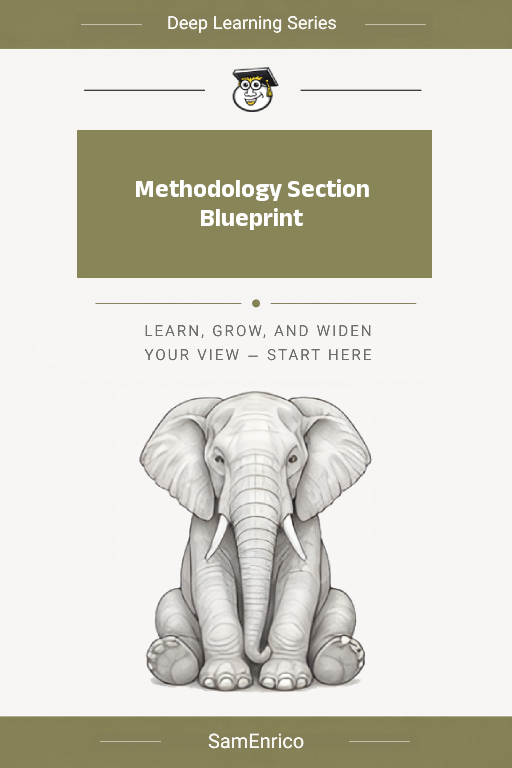
Non-FictionStudent's ShortcutMethodology
Methodology Section Blueprint eBook
Write detailed methodology chapters that convince
by Timm Magaret
Write detailed methodology chapters that convince committees your design is rigorous. Cover sampling, instruments, procedures, and data analysis plans.
Formats
Free sample
Chapter 1: The Persuasion Shift...--Most methodology chapters are dead on arrival. Not because the research is flawed. Not because the student is lazy. But because the chapter reads like a grocery list rather than a winning argument. Committees open the methodology section, skim for three things—alignment, justification, and self-awareness—and if those signals are missing, they stop reading.
The student spends six months collecting data, only to be told: "This is descriptive, not persuasive." And no one ever explained what that actually means.This chapter fixes that problem at its root. It reframes the methodology chapter from a procedural manual into a strategic argument. You will learn why "just describing what you did" is the fastest path to committee rejection, how to shift from passive reporting to active justification, and the single most important organizing principle—the Alignment Triangle—that governs every credible methodology chapter. By the end of this chapter, you will be able to write a one-paragraph "roadmap" that convinces your committee to trust you before you've presented a single piece of data.Why Methodology Chapters Fail (And It's Not What You Think)Let us start with a hard truth. The typical methodology chapter fails not because the student made a technical error.
It fails because the student committed the sin of description without justification. Consider these two passages from real dissertation proposals. The first is weak. The second is strong. Study the difference.Weak Version: "This study will use a survey.
The survey will be administered online via Qualtrics. Participants will be recruited through email. The survey contains 25 questions using a 5-point Likert scale. Data will be analyzed using SPSS. Descriptive statistics and t-tests will be conducted."Strong Version: "Because this study asks a relational research question—specifically, whether years of experience are associated with burnout scores—a cross-sectional survey design is appropriate.
The survey instrument was chosen because it has demonstrated reliability (Cronbach's α = 0.87) with populations similar to the target sample. Email recruitment was selected over social media recruitment to ensure that all participants had an organizational affiliation, which is necessary for the secondary analysis of unit-level effects. T-tests will compare high- and low-tenure groups, as this test is designed for two-group mean comparisons and directly answers the relational question."Do you see the difference? The weak version tells you what happened. The strong version tells you why each choice was made and how each choice serves the research question.
The weak version is a recipe. The strong version is an argument.Committees are not looking for a lab report. They are looking for a persuasive brief that demonstrates you understand the logic linking your question to your methods. Every sentence in your methodology chapter should answer a hidden question that the committee is silently asking: "Why should I trust this choice over the alternatives?" If your chapter does not answer that question, it is not a methodology chapter. It is a to-do list.The Core Problem: Recipe Writing Why do students default to recipe writing?
Three reasons. First, methodology is often taught as a set of procedures to be followed rather than a set of choices to be justified. Second, students are terrified of being wrong, so they stick to describing what they did rather than defending why it is right. Third, and most importantly, students have never been shown what a persuasive methodology chapter actually looks like.Recipe writing follows a predictable pattern. It begins with "The study will use..." It proceeds through a chronological list of actions.
It ends with "...and then data will be analyzed." There is no "because." There is no "rather than." There is no acknowledgment that other designs, instruments, or samples were possible and were rejected for defensible reasons.Committees reject recipe chapters not because they are incorrect but because they are insufficient. A correct methodology chapter that fails to justify its choices is a failed chapter. You can have perfect sampling, validated instruments, and appropriate statistics, and still receive a "revise and resubmit" because you never told the committee why those choices were the best possible answers to your specific research question.The Shift: From Description to Argument The transformation required is not cosmetic. It is structural. You must move from a chronological frame ("First I did X, then I did Y") to a justificatory frame ("X was chosen because...
Y was chosen because..."). This shift affects every sentence of your chapter.Here is a practical rule: If you cannot insert the word "because" after a methodological claim, that claim does not belong in your chapter. Test this rule on the weak example above. "The survey will be administered online via Qualtrics because..." The weak version has no because. The strong version has because after every claim.This shift also changes your relationship to your committee.
You are no longer a student reporting on what you plan to do. You are a designer defending your design choices to a panel of experts. That is a different posture. It requires confidence, yes. But more importantly, it requires preparation.
You must know why you chose your design over the alternatives. You must know the weaknesses of your design and have mitigation strategies ready. You must anticipate what a skeptic would say and answer that skeptic before the skeptic speaks.The Alignment Triangle: Your Central Organizing Principle Every credible methodology chapter is organized around a single idea: alignment. Alignment means that every methodological choice—sampling, instruments, procedures, analysis—serves the research question. If a choice does not serve the question, it is irrelevant.
If a choice contradicts the question, it is fatal.The Alignment Triangle is a visual and conceptual tool for ensuring alignment. It has three corners:Corner 1: Research Question. This is the driver of everything. Your question type determines every subsequent choice. There are four primary question types: descriptive ("How many?" or "What is the frequency of X?"), relational ("Are X and Y associated?"), causal ("Does X cause Y?"), and interpretive ("What is the lived experience of X?").
Each type demands different methods.Corner 2: Data Type. The kind of data you collect must match your question type. Descriptive questions can be answered with quantitative surveys or qualitative counts. Relational questions require quantitative data that can be correlated. Causal questions require data with temporal order (the cause must come before the effect) and control for confounders.
Interpretive questions require rich qualitative data that captures meaning and context.Corner 3: Analysis Technique. The way you analyze your data must match both your question type and your data type. You cannot use means and standard deviations to answer an interpretive question. You cannot use thematic coding to test a causal hypothesis. The analysis technique is the final expression of your design logic.The Alignment Triangle works as a diagnostic tool.
Draw the triangle. Write your research question at the top. At the bottom left, write your planned data type. At the bottom right, write your planned analysis technique. Now ask: Does the data type serve the question?
Does the analysis technique serve both the question and the data? If the answer to either question is no, your design is misaligned. And as you will learn in this chapter, misalignment is the single most…
This is the end of the free sample. Get the eBook to keep going. Buy now
About this book
Details
- Author
- Timm Magaret
- Publisher
- SamEnrico
- Language
- English
- Genre
- Non-Fiction, Student's Shortcut, Methodology
- Released
- 2026-06-01
- Pages (approx.)
- 153
- Available as
- eBook, Audiobook

Read better in the ZLOADR app
Your eBooks on your phone or tablet. Sign in with your SamEnrico account and start reading.
More by Timm Magaret
 Dahlia Cold Case GeneticsTimm Magaret$11.99
 Burnout and Mindfulness GuideTimm Magaret$11.99
 The VOC Prevention GuideTimm Magaret$11.99
 Middle Eastern Nonverbal GuideTimm Magaret$11.99
 The Dotcom Bubble Burst: When Billions Vanished in 60 SecondsTimm Magaret$11.99
 How to Produce Bicycle Brake LeversTimm Magaret$11.99
 Poetry ReadingTimm Magaret$11.99
 How to Start a Discharge Lamp (electronic) and other Flashlight Apparatus Business (Beginners Guide)Timm Magaret$11.99
You may also like
 Hong Kong Handover 1997Dunn Johnnie$11.99
 Zumba For Postnatal Recovery CourseNeal Christian$11.99
 Zumba for BeginnersLadner Nikia$11.99
 YouTube Comment Mining GuideHumes Pandora$12.99
 Worry Box MeditationCarlin Rudy$11.99
 Workplace Stress MeditationNguyen Lynn$11.99
 Workplace Stress and Sleep RepairHawley Ivory$11.99
 Workplace Perfectionism CureDelaney Jeffry$11.99
 Workplace Injustice Anger GuideWallen Isabelle$11.99
 Work Addiction and Burnout LinkGreenwood Ester$11.99
 Women in Yoga and WellnessBeattie Galina$11.99
 Women in Stand Up ComedyChun Evangeline$11.99