
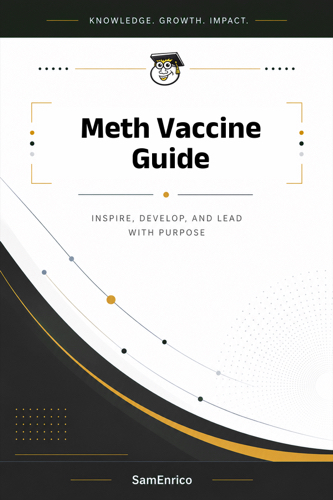
Non-FictionSelf-HelpImmunotherapy
Meth Vaccine Guide eBook
Developments in anti-methamphetamine immunotherapy
by Solomon Sung
Developments in anti-methamphetamine immunotherapy.
Formats
Free sample
Chapter 1: The Corpse with No Antidote...--The paramedics found her in a gas station bathroom just off Interstate 5, needles still in the crook of her arm, the word “Tweak” tattooed across her knuckles in fading blue ink. She was twenty-three years old, weighed ninety-four pounds, and had been dead for approximately forty-five minutes by the time the EMTs pried open the locked door. They did not bother with Narcan. Not because they were cruel, but because Narcan does nothing for methamphetamine. Nothing at all.
The opioid reversal drug that has saved hundreds of thousands of lives from heroin and fentanyl might as well have been saline solution in this woman’s veins. The paramedics pronounced her at 3:17 AM and called the coroner. Another one. Another meth death in a county that had already recorded more stimulant fatalities in 2025 than the previous five years combined.This is not an isolated story. It is not an aberration or a statistical outlier.
It is the face of the deadliest drug crisis most Americans have never heard of—because meth does not kill in the gentle, sleepy way of opioids. Meth kills through seizures that shatter spines, through heart attacks that drop healthy twenty-year-olds mid-sentence, through hyperthermia that cooks the brain from the inside, through strokes that leave survivors paralyzed and mute in long-term care facilities. And unlike the opioid epidemic, which finally received a coordinated public health response after decades of neglect, the methamphetamine crisis continues to accelerate without a single FDA-approved medication to stop it. Not one pill. Not one injection.
Not one vaccine. Zero.The woman in the gas station bathroom had been through rehab six times. She had completed two intensive outpatient programs, attended over three hundred twelve-step meetings, and worn a GPS ankle monitor for eight months as part of a drug court diversion program. She had a sponsor who loved her, a mother who had mortgaged her house to pay for treatment, and a three-year-old daughter who would grow up without memories of her voice. None of it mattered.
Not because she lacked willpower—by any measure, she had fought harder than most cancer patients fight their tumors—but because she was fighting a biological enemy that no amount of talk therapy or good intentions could disarm. She was fighting a molecule that had rewired her brain’s reward circuitry so thoroughly that the prospect of a single hit outweighed every consequence: jail, homelessness, psychosis, death. And every time she walked out of a treatment center, clean and motivated, the methamphetamine molecule was waiting for her, unchanged, undiminished, and completely untouchable by the tools modern medicine had given her.This book is about a different kind of weapon. Not a pill that replaces meth with a weaker substitute—the way methadone replaces heroin—because no such pill exists for stimulants. Not a therapy that teaches coping skills, because coping skills fail when the craving rises like a tidal wave at 2 AM.
This book is about immunotherapy: vaccines and antibodies designed to intercept methamphetamine in the bloodstream, bind it so tightly that it cannot reach the brain, and render the drug as useless as tap water. It is about a radical reconceptualization of addiction as an immunological problem rather than purely a behavioral one. And it is about the race—underfunded, underappreciated, and urgent—to bring this technology from the laboratory bench to the people dying in gas station bathrooms.But before we can understand the solution, we must understand the full scope of the problem. Because the methamphetamine crisis is not what you think it is. It is not a rural problem, though it ravaged the Rust Belt and the South first.
It is not a poor problem, though poverty accelerates its destruction. It is not a moral failing, though stigma continues to kill as surely as the drug itself. It is, above all else, a biological problem—and biology does not respond to shame.The Hidden Epidemic: Meth by the Numbers Let us begin with a number that should shock you: between 2015 and 2025, methamphetamine-related deaths in the United States increased by more than 500 percent. That is not a typo. Five hundred percent.
In 2015, the Centers for Disease Control and Prevention recorded approximately 5,000 deaths involving psychostimulants (the category that includes meth). By 2025, that number had surpassed 30,000 annually. To put that in perspective, meth now kills more people each year than gun homicides. It kills more people than drunk driving. It kills nearly as many as opioids, a crisis that has received ten times the research funding and a hundred times the media attention.But unlike opioids, where the mortality curve has begun to plateau thanks to aggressive distribution of naloxone, expansion of medication-assisted treatment, and public awareness campaigns, the meth curve is still climbing exponentially.
The National Survey on Drug Use and Health estimates that 2.6 million people used methamphetamine in the past year—a number that has held steady while deaths have skyrocketed. This suggests not that more people are using, but that the meth supply has become more potent, more toxic, and more lethal. Seized samples analyzed by the Drug Enforcement Administration show average purity rising from 45 percent in 2010 to over 95 percent in 2025, while the price per gram has dropped by 70 percent. The result is a drug that is cheaper, stronger, and deadlier than at any point in American history.Geographically, meth has shed its old stereotypes. It is no longer the province of biker gangs cooking in rural trailers.
Mexican transnational criminal organizations now control over 90 percent of the US meth market, producing the drug in superlabs capable of churning out hundreds of kilograms per day. This industrial-scale production has pushed meth into every corner of the country—urban, suburban, and rural alike. In 2025, the DEA reported meth seizure increases in all fifty states, with the largest percentage increases occurring in traditionally low-meth regions like New England and the Pacific Northwest. There is no safe zip code.Demographically, meth use has also shifted. The stereotypical user—a white male in his thirties or forties, employed blue-collar, living in a small town—still exists.
But the fastest-growing group of new meth users is young adults aged eighteen to twenty-five, with no significant differences across race or class lines. More alarming, meth use among pregnant women has tripled since 2020, leading to a surge in neonatal abstinence syndrome specific to stimulants—a condition for which there is no established treatment protocol. Babies born dependent on meth face weeks of withdrawal symptoms: tremors, high-pitched crying, feeding difficulties, and seizures. Their long-term neurodevelopmental outcomes remain largely unknown because the research has simply not been done.The Biological Wall: Why Meth Defies Conventional Treatment To understand why the methamphetamine crisis has proven so intractable, we must understand the molecule itself. Methamphetamine (chemical formula C10H15N) is a synthetic stimulant that belongs to the phenethylamine class.
Its molecular weight is 149.23 Daltons, which makes it tiny by pharmaceutical standards—small enough to slip through the blood-brain barrier with embarrassing ease. Compare this to a typical antibody, which weighs 150,000 Daltons and is physically incapable of crossing that barrier. This size disparity is the entire foundation of anti-meth immunotherapy, but we will return to…
This is the end of the free sample. Get the eBook to keep going. Buy now
About this book
Details
- Author
- Solomon Sung
- Publisher
- SamEnrico
- Language
- English
- Genre
- Non-Fiction, Self-Help, Immunotherapy
- Released
- 2026-06-07
- Pages (approx.)
- 148
- Available as
- eBook, Audiobook

Read better in the ZLOADR app
Your eBooks on your phone or tablet. Sign in with your SamEnrico account and start reading.
More by Solomon Sung
 HGH in Long Lived SpeciesSolomon Sung$11.99
 Procrastination For Graduate StudentsSolomon Sung$11.99
 Learning Goal RoadmapSolomon Sung$11.99
 Distraction Proof Evening RoutineSolomon Sung$11.99
 The Second Career Nonprofit GuideSolomon Sung$11.99
 Parent Illness Death GriefSolomon Sung$11.99
 Apache Struts Vulnerability Zero DaySolomon Sung$11.99
 The Silent Revolution: Descartes and the Birth of Modern ThoughtSolomon Sung$11.99
 The Battle of Nihriya: The Hittites Strike Back (1450 BC)Solomon Sung$11.99
 How to Produce Medical SuppliesSolomon Sung$11.99
 Growing AgrostisSolomon Sung$11.99
 Remote Employee Legal TrapSolomon Sung$12.99
You may also like
 Hong Kong Handover 1997Dunn Johnnie$11.99
 Zumba For Postnatal Recovery CourseNeal Christian$11.99
 Zumba for BeginnersLadner Nikia$11.99
 YouTube Comment Mining GuideHumes Pandora$12.99
 Worry Box MeditationCarlin Rudy$11.99
 Workplace Stress MeditationNguyen Lynn$11.99
 Workplace Stress and Sleep RepairHawley Ivory$11.99
 Workplace Perfectionism CureDelaney Jeffry$11.99
 Workplace Injustice Anger GuideWallen Isabelle$11.99
 Work Addiction and Burnout LinkGreenwood Ester$11.99
 Women in Yoga and WellnessBeattie Galina$11.99
 Women in Stand Up ComedyChun Evangeline$11.99