
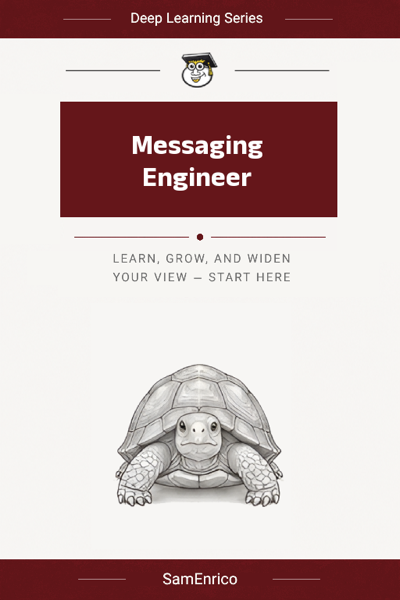
Messaging Engineer eBook
A Coursebook on Messaging Engineer
A Coursebook on Messaging Engineer
Formats
Free sample
Chapter 1: The Invisible Plumbing--– In the summer of 2016, a ride-sharing company lost $5 million in forty-five minutes. Not because of a security breach, not because of a competitor’s pricing war, but because a single line of configuration in their message broker—a setting called max.poll.records—was set too high. When one slow consumer caused a rebalance, every consumer in the group paused, the backlog grew to three hours, and drivers stopped receiving ride requests. The company’s on-call engineer, a brilliant backend developer who had built the payment system from scratch, spent four hours debugging because he had never studied how consumer groups actually work. He knew database indexes, API idempotency, and load balancers.
He did not know messaging. That night, the company learned what a messaging engineer is—by discovering they did not have one.This is the story of the invisible plumbing. Every modern application—from your banking app to your grocery delivery tracker to the navigation system in your car—relies on asynchronous message passing. Yet the engineers who build and maintain this plumbing rarely have formal training in it. They learn on call, during outages, by reading forum posts at 3 AM.
This chapter ends that cycle. It defines the messaging engineer, explains why the role exists separately from backend or Dev Ops, and sets the foundation for everything you will build in the rest of this book.The Great Misunderstanding: APIs Are Not Enough Ask five engineers what a messaging engineer does, and you will get five answers. "Someone who manages Kafka." "A Dev Ops person who also writes consumers." "A backend role for event-driven systems." None of these are wrong, but they miss the essential truth: messaging engineering is a distinct discipline with its own failure modes, metrics, and design patterns. It overlaps with backend and Dev Ops but cannot be reduced to either.Consider a standard e-commerce checkout flow. A customer clicks "Place Order." Synchronously, an API endpoint validates the cart, creates an order record, and returns a 200 OK.
Asynchronously, dozens of messages fan out: charge the payment method, reserve inventory, update real-time analytics, send a confirmation email, notify the warehouse picker, update the customer's order history index. A backend engineer designs the synchronous API. A Dev Ops engineer provisions the servers and the Kafka cluster. But who decides how many partitions the order events topic should have? Who sets the retention period for failed payment messages?
Who designs the dead-letter queue strategy so a malformed JSON payload from the mobile app doesn't block all order processing? Who tunes the consumer prefetch settings to balance latency and throughput for the real-time analytics pipeline?That person is the messaging engineer. They own the asynchronous path from producer to consumer through broker to dead-letter queue and back again. They do not just run the brokers; they design the message flows, establish delivery contracts, monitor the health of each consumer group, and plan for failure at every step.A Tale of Two Engineers To make the distinction concrete, compare two hypothetical engineers at a streaming video company.Alice is a backend engineer. Her job is to build the "Watch History" service.
She designs a REST API that accepts a user ID and a video ID, writes to a Postgre SQL database, and returns a 201. She writes unit tests, sets up connection pooling, and deploys with a blue-green strategy. When the service is slow, she adds indexes. When traffic grows, she adds read replicas. She is excellent at her job.Bob is a messaging engineer.
He owns the event pipeline that feeds data into the Watch History service. He chooses the topic naming convention, partitions by user ID to preserve per-user ordering, sets the retention to 30 days, configures replication factor of three across availability zones, establishes a dead-letter topic for malformed events, writes the consumer that reads from the topic and calls Alice's API, tunes the prefetch count so consumers are not overwhelmed during peak hours, sets up alerts for consumer lag and dead-letter queue size, and writes a runbook for rebalancing the cluster when a broker fails. When a new version of the mobile app emits an event with an extra field that breaks the consumer's JSON parser, Bob's dead-letter queue catches the poison messages, alerts the team, and replays them after the fix is deployed. Alice's API never even sees the malformed events.Alice and Bob are equally valuable. But their skills are not interchangeable.
Alice can build a beautiful API that fails under backpressure from Bob's consumers if Bob misconfigures his prefetch. Bob can architect a perfect Kafka cluster that starves because Alice's API cannot handle the write throughput. The backend engineer and the messaging engineer must collaborate, but they bring different toolkits to the table.The Historical Shift: Why Messaging Ate the World In the 1990s and early 2000s, most distributed systems were built on synchronous communication. A client called a server, the server called a database, the database returned results, the server returned a response. This model was straightforward and debuggable, but it had a fatal flaw: it did not scale beyond a certain point.
The more services you added, the more synchronous calls you made, the longer the request chains became, and the more vulnerable the system was to cascading failures.The shift began in earnest at Amazon around 2001. Jeff Bezos famously mandated that all teams expose their data and functionality through service interfaces and that no direct database access was allowed between services. The lesser-known part of the mandate was that communication should be asynchronous wherever possible. Services should emit events, not just wait for responses. This was radical at the time.
Most engineers thought in terms of request-response. Events were for mainframes and message-oriented middleware (MOM) from vendors like IBM and TIBCO—expensive, proprietary, and uncool.But Amazon persisted. They built a massive infrastructure of queues, topics, and consumers. By the mid-2000s, thousands of services communicated asynchronously. The benefits were undeniable: loose coupling, fault tolerance, scalability, and the ability to replay events for debugging or rebuilding state.
Other companies noticed. Linked In open-sourced Kafka in 2011, based on their internal event bus. Rabbit MQ, originally developed for financial services, gained mainstream adoption. AWS launched Simple Queue Service (SQS) in 2006, and it remains one of their most popular services.Today, asynchronous messaging is not a niche pattern; it is the default for any system of nontrivial scale. The question is no longer "Should we use messaging?" but "Who on our team understands messaging?" Too often, the answer is "no one" until the first catastrophic outage.The Five Pillars of Messaging Engineering Every messaging system—whether Kafka, Rabbit MQ, Pulsar, SQS, or NATS—must address five fundamental concerns.
A messaging engineer is defined by their ability to navigate these pillars and make informed trade-offs.Pillar One: Reliability Reliability means that messages are not lost once they have been acknowledged. If a producer sends a message and the broker returns a successful acknowledgment, that message must survive broker crashes, disk failures, and network partitions (within the system's fault tolerance design). If a consumer acknowledges a message, the broker must not redeliver it unless the consumer crashes before the acknowledgment is stored.Reliability is…
This is the end of the free sample. Get the eBook to keep going. Buy now
About this book
Details
- Author
- Watters German
- Publisher
- SamEnrico
- Language
- English
- Genre
- Non-Fiction, Informative, Educational
- Released
- 2026-05-06
- Pages (approx.)
- 154
- Available as
- eBook, Audiobook

Read better in the ZLOADR app
Your eBooks on your phone or tablet. Sign in with your SamEnrico account and start reading.
More by Watters German
 Facebook Addiction Recovery WorkbookWatters German$11.99
 Stress Induced Gut Problems ExplainedWatters German$11.99
 French Resistance Torture SurvivorsWatters German$11.99
 Breath Awareness For Divorce GriefWatters German$11.99
 Earthworm Phobia Garden Glove PlanWatters German$11.99
 The Velvet Coup: How a Secret PR Firm Shaped Global PoliticsWatters German$11.99
 How to Become a Land SurveyorWatters German$11.99
 Strategy Meeting Mastery GuideWatters German$12.99
 Understanding Marcus Gunn PhenomenonWatters German$17.99