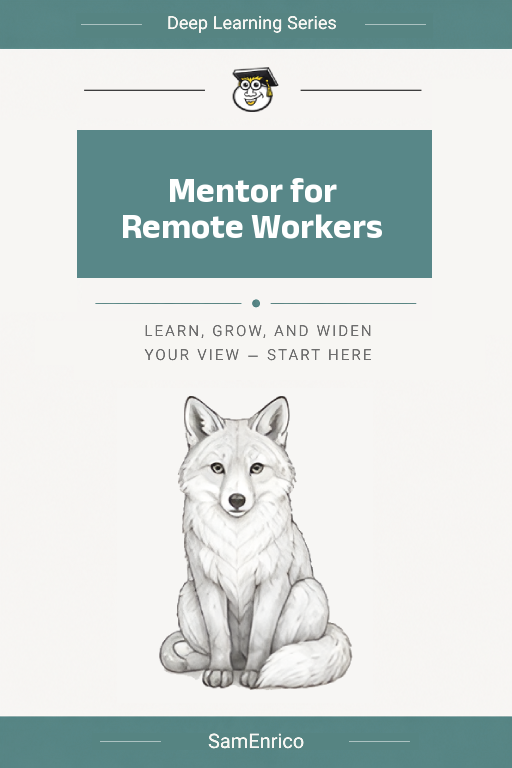
Mentor for Remote Workers eBook
Find experienced remote professionals for advice o
Find experienced remote professionals for advice on productivity, work-life balance, and visibility.
Formats
Free sample
Chapter 1: The Hallway You Lost--–- On a Tuesday morning in March, Sarah did something she had done thousands of times before. She opened her laptop, joined a Zoom call, and waited to be seen. Her camera was on. Her background was neutral. Her speaking points were prepared.
She answered three questions, volunteered for a follow-up task, and stayed five minutes after the meeting ended to chat with colleagues who lingered. By every objective measure, she had performed well.Two weeks later, she learned that a leadership retreat had been planned—a two-day offsite where strategy would be set, relationships would be deepened, and informal decisions about promotions would be made over dinner and drinks. She had not been invited. Her boss, seated in Chicago, had assumed she was too far away in Ohio. Her peers in Austin and New York had assumed she already knew.
No one had excluded her maliciously. No one had thought about her at all.That is the single most dangerous sentence in remote work: No one thought about me at all.This book exists because that sentence is being whispered by millions of remote workers right now, in every time zone, in every industry, at every level. And the whisper is about to become a roar.The Invisibility That Precedes Extinction Let us name the problem precisely, because vague problems yield vague solutions. Remote workers are not failing at their jobs. The data is clear: productivity has remained stable or increased across virtually every sector that shifted to distributed work.
Deadlines are met. Code is shipped. Customers are served. The work is getting done.The problem is that being good at your job and being seen as good at your job have decoupled. In an office, they were the same thing.
Your presence was your proof. When you sat at your desk, you were working. When you spoke in a meeting, you contributed. When you stayed late, you cared. The physical signals of effort were so deeply embedded in workplace culture that no one even recognized them as signals.
They just felt like reality.Remote work stripped those signals away overnight. And in their place, nothing automatically arrived.You are now judged almost entirely on outputs you document, decisions you influence through writing, and relationships you maintain across digital space. If you are doing excellent work but failing to document it, you are invisible. If you are solving critical problems but no one sees the solve, you are invisible. If you are mentoring junior colleagues through Slack DMs but your manager never knows, you are invisible.Invisibility is not a personality flaw.
It is a structural feature of remote work that you must actively defeat.The Hidden Curriculum of the Office To understand what you lost, you must first see it clearly. Let us walk through a single ordinary day in the pre-remote office—not an exceptional day, not a promotion day, not a big presentation day. Just a Tuesday.You arrive at 9:15 AM. Your manager walks past your desk on the way to coffee and says, "How's that report coming?" You say, "Almost done, just waiting on the data from finance." That exchange took eleven seconds. But in those eleven seconds, your manager learned: you are working on the report, you are aware of dependencies, you are on schedule, and you are at your desk.
Eleven seconds of incidental visibility.At 11 AM, you attend a team meeting. After the meeting ends, three people linger by the whiteboard to clarify next steps. You are one of them. In those seven minutes, you hear your colleague mention a problem in production, you offer a suggestion, and the group agrees on a path forward. No formal decision was recorded.
No email was sent. But four people now know you are helpful under pressure.At 1 PM, you eat lunch at your desk while scanning emails. Your manager walks by again, notices you working through lunch, and thinks, "Dedicated." You are not trying to impress anyone. You are just eating a sandwich and clearing your inbox. But the impression forms anyway.At 3 PM, you walk to the printer.
On the way, you pass the VP's office. She is on a call, but she sees you, nods, and remembers your face. Six months later, when someone mentions your name in a promotion meeting, she thinks, "Oh yes, I've seen her around. Seems solid." That flicker of recognition is worth months of performance reviews.At 5:30 PM, you pack up to leave. Your manager is also leaving.
You walk to the elevator together, and in ninety seconds of small talk, you mention that your child has a school play tomorrow. Your manager now knows you are a parent with competing priorities—and when you need to leave early next week, they will grant it without hesitation because they understand your context.This is the hidden curriculum of office work. It is not written in any handbook. It is not taught in any training. It is simply the ambient background radiation of physical proximity—millions of tiny, unearned visibility events that accumulate into career capital.Now let us walk through that same Tuesday in a remote environment.You open your laptop at 9:15 AM.
Your manager has no idea when you started. You send a Slack message: "Report is progressing, waiting on finance data." That is intentional communication, not incidental. It requires effort. It feels like self-promotion. Many remote workers hesitate to send such messages because they worry about seeming needy or high-maintenance.
So they don't send them. And their manager assumes nothing.The 11 AM meeting ends. Everyone drops off the call within thirty seconds. There is no whiteboard lingering. No seven-minute clarification.
No incidental problem-solving. If you have a suggestion about the production issue, you must either interrupt the meeting to make it (risking seeming off-topic) or send a follow-up message later (which feels like extra work). Most people do neither. The suggestion never happens.At 1 PM, you step away from your computer to eat lunch. Your manager notices nothing.
You could be eating lunch. You could be napping. You could be interviewing for another job. There is no signal either way. Your manager does not think "dedicated." Your manager does not think anything, because your manager has not seen you.At 3 PM, you print a document to a home printer.
No one sees you. The VP has no idea you exist. Six months later, when your name comes up in a promotion meeting, the VP says, "I don't think I've ever met her." That is not a judgment of your work. It is a statement of fact. But it lands like a judgment.At 5:30 PM, you close your laptop.
You do not walk to an elevator with your manager. You do not mention your child's school play. Six months later, when you need to leave early for a school event, your manager asks, "Is everything okay?" not because they are suspicious, but because they lack the context that would have been built in ninety seconds of elevator small talk.This is not a worse way of working. It is simply a different way of working—one that requires intentionality where the office required…
This is the end of the free sample. Get the eBook to keep going. Buy now
About this book
Details
- Author
- Stover Tenisha
- Publisher
- SamEnrico
- Language
- English
- Genre
- Non-Fiction, First 30 Days, Remote
- Released
- 2026-06-01
- Pages (approx.)
- 143
- Available as
- eBook, Audiobook

Read better in the ZLOADR app
Your eBooks on your phone or tablet. Sign in with your SamEnrico account and start reading.
More by Stover Tenisha
 Water Rights MarketsStover Tenisha$11.99
 Mindfulness Meditation Breath Awareness PrimerStover Tenisha$11.99
 Parent Caregiver DepressionStover Tenisha$11.99
 Meditation for Rejection SensitivityStover Tenisha$11.99
 Student Mental Health ResourcesStover Tenisha$11.99
 Young Talent MigrationStover Tenisha$11.99
 Loci Palace Construction HandbookStover Tenisha$11.99
 Loving Kindness For BurnoutStover Tenisha$11.99
 Katmai Bear CountryStover Tenisha$11.99
 The Iron Forges of Meroë: The Queens Who Built an EmpireStover Tenisha$11.99
 Hakeem Olajuwon: From Lagos to Houston – The Untold Journey of a Basketball PioneerStover Tenisha$11.99
 How to Start a ASD Teaching Business (Beginners Guide)Stover Tenisha$11.99