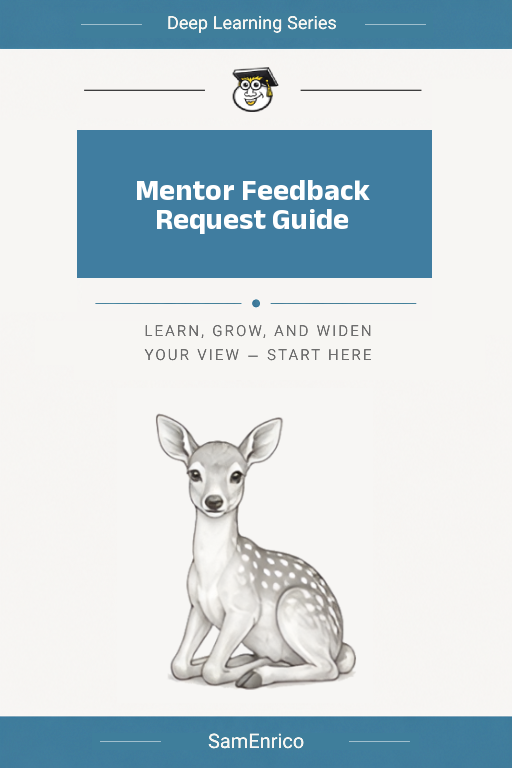
Mentor Feedback Request Guide eBook
Ask for specific, actionable feedback on your work
Ask for specific, actionable feedback on your work, presentation, or career decisions.
Formats
Free sample
Chapter 1: The Silence Tax--–- On a Tuesday morning in March, a senior product manager named Sarah walked into her quarterly review with a folder full of positive customer metrics, three successful product launches, and a quiet, gnawing feeling that she was about to be passed over for promotion. Her manager, a well-intentioned executive named David, smiled warmly and said, "Great work this quarter, Sarah. Keep doing what you're doing." Sarah thanked him, walked back to her desk, and spent the next six months doing exactly what she had always done. Eight months later, a less-tenured colleague was promoted to the role Sarah had wanted. When she finally gathered the courage to ask David why, he looked genuinely confused.
"I thought you were happy where you were," he said. "You never asked for feedback on how to get to the next level."Sarah's story is not an exception. It is the rule.After fifteen years of studying workplace communication, analyzing thousands of feedback conversations, and coaching executives at companies ranging from startups to Fortune 500 firms, I have discovered a painful pattern: Most professionals fail not because they lack talent, effort, or ambition. They fail because they never learned how to extract the criticisms that could save them. They wait for feedback that will never come, operate under assumptions that no one corrects, and drift into mediocrity while their more strategic colleagues accelerate past them.This chapter introduces a concept I call the Silence Tax—the invisible career cost of not asking for specific, actionable feedback.
The Silence Tax compounds daily, grows exponentially over years, and by mid-career can amount to hundreds of thousands of dollars in lost promotions, missed opportunities, and wasted effort. The good news? The tax is entirely optional. You can stop paying it today. But first, you need to understand why you're paying it—and why almost everyone around you is paying it too.The Feedback Fallacy: Why Waiting Is a Losing Strategy Let me start by destroying a myth.
Most people believe that if they do good work, someone will notice and tell them. This is the Feedback Fallacy—the assumption that honest, useful feedback flows naturally from managers, mentors, and peers to those who deserve it. According to a landmark study published in the Harvard Business Review, this assumption is not merely optimistic. It is dangerously wrong.The research reveals a uncomfortable truth: People systematically avoid giving honest feedback, even when they know it would help the recipient. In controlled studies, participants were asked to evaluate another person's work.
When given the option to deliver critical feedback that would help the recipient improve, the majority chose to deliver vague praise instead. They knew they were being unhelpful. They did it anyway. Why?The answer lies in three psychological forces that operate beneath conscious awareness.First, the Empathy Gap. Humans are wired to avoid causing immediate emotional pain, even at the cost of long-term benefit.
When a manager looks at you and contemplates saying, "Your presentation lacked structure," their brain simulates your potential reaction—the flinch, the defensiveness, the damaged relationship. That simulation feels bad. So they say, "Good job," and move on. They have chosen your short-term comfort over your long-term growth.Second, the Laziness Heuristic. Giving specific, actionable feedback requires cognitive effort.
The mentor must recall specific examples, articulate a clear critique, and offer a path forward. Vague praise requires none of that. "Looks great" is the path of least resistance. In a world of overflowing inboxes and back-to-back meetings, the easy answer wins.Third, the Fear of Consequences. What if you react poorly?
What if you go to HR? What if you cry, argue, or quit? The potential downside of honest feedback feels catastrophic to most managers. The potential upside—your improvement—accrues to you, not to them. So they stay silent.This is the Feedback Fallacy in action: the belief that good work generates its own feedback.
It does not. Feedback is not a natural byproduct of performance. It is a social transaction that most people are terrified to initiate.The Ask Paradox: The Fear That Keeps You Silent If the Feedback Fallacy explains why mentors don't give feedback freely, the Ask Paradox explains why you don't ask for it. Here is the paradox: You fear looking incompetent by asking for negative feedback, but staying silent guarantees stagnation. Let me repeat that because it is the central insight of this book.You fear looking incompetent by asking for negative feedback, but staying silent guarantees stagnation.The fear is not irrational.
Asking "What am I doing wrong?" or "How could this be better?" requires vulnerability. It signals that you do not already know the answer. In workplace cultures that reward confidence and punish uncertainty, this feels dangerous. I have watched brilliant professionals spend months—sometimes years—avoiding a single question that would have saved them. They knew they needed feedback.
They knew they were stuck. But the fear of hearing something painful paralyzed them.Consider the research on self-handicapping, a psychological phenomenon where people avoid asking for feedback precisely because they fear the answer will confirm their worst fears about themselves. If you never ask, you can maintain the comfortable illusion that you are doing everything right. The moment you ask, you risk discovering that you are not. Many people prefer the comfort of uncertainty to the pain of clarity.The Ask Paradox has a cruel second layer: When you finally do ask for feedback, your fear often becomes a self-fulfilling prophecy.
Because you are nervous, you ask vaguely—"Do you have any feedback for me?"—which triggers the mentor's own avoidance mechanisms. They hear your hesitation and respond with generic reassurance. You interpret this as confirmation that you were right to be afraid. The cycle continues.The Knowing-Doing Gap: Why Information Isn't Enough At this point, you might be thinking: "I already know I should ask for feedback. I already understand the psychology.
Why haven't I changed?"Welcome to the Knowing-Doing Gap—the chasm between understanding a principle and acting on it. This gap is the graveyard of good intentions. Every smoker knows cigarettes are harmful. Every dieter knows that exercise works. Every professional knows that feedback is valuable.
Knowing is not the problem. Doing is.The Knowing-Doing Gap persists for three reasons.First, the Cost of Action. Asking for specific, actionable feedback requires time, emotional energy, and social risk. Even when you know the potential benefit, the immediate cost often feels higher. Your brain, optimized for short-term survival, prioritizes avoiding embarrassment today over accelerating your career next year.Second, the Absence of Feedback Loops.
When you ask for feedback, the benefit is delayed and uncertain. You might get useful information. You might not. The mentor might be helpful. They might not.
Your brain craves immediate, predictable rewards. Asking for feedback offers neither.Third, Skill Deficiency. Most people do not actually know how to ask for feedback effectively. They have never been taught the specific phrases, timing strategies, and framing techniques that trigger helpful responses. They try once, get a useless answer, and conclude that feedback requests don't work.
They don't realize that the problem was not the act of asking but the way they asked.This book exists to…
This is the end of the free sample. Get the eBook to keep going. Buy now
About this book
Details
- Author
- Carlos Starla
- Publisher
- SamEnrico
- Language
- English
- Genre
- Non-Fiction, First 30 Days, Feedback
- Released
- 2026-05-30
- Pages (approx.)
- 144
- Available as
- eBook, Audiobook

Read better in the ZLOADR app
Your eBooks on your phone or tablet. Sign in with your SamEnrico account and start reading.
More by Carlos Starla
 Natural Disaster Dream ProcessingCarlos Starla$11.99
 Mindfulness Meditation for Dads HandbookCarlos Starla$11.99
 Alphabet Loci MethodCarlos Starla$11.99
 Anger Management EQ WorkbookCarlos Starla$11.99
 Loving Kindness For JealousyCarlos Starla$11.99
 Family Guide to AddictionCarlos Starla$11.99
 The Law Student PressureCarlos Starla$11.99
 Memory Palace SuccessCarlos Starla$11.99
 Yosemite Half Dome FallsCarlos Starla$11.99
 The Golden Voices of the African Diaspora: Opera’s Forgotten TitansCarlos Starla$11.99
 The Shadow King: How a Teenager Ruled EthiopiaCarlos Starla$11.99
 The Symphony of the Sun: Chevalier de Saint-Georges, the Black Mozart of VersaillesCarlos Starla$11.99