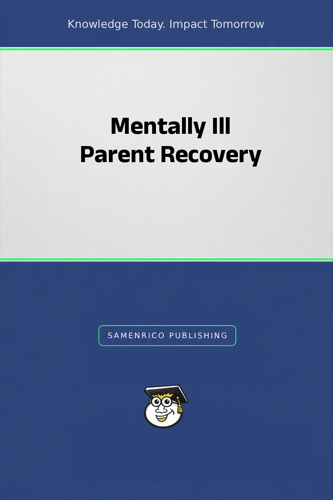
Mentally Ill Parent Recovery eBook
Heals self worth after unpredictable childhood.
Heals self worth after unpredictable childhood.
Formats
Free sample
Chapter 1: The Invisible Wound--–- It begins, for most of us, with a strange kind of silence. Not the silence of a quiet house or the peace of a sleeping child. It is the silence of having no language for what you lived through. You know something was wrong. You can feel it in your body, in the way you startle at sudden noises, in the way you apologize for existing, in the way you cannot trust a calm day because calm days always meant the storm was coming.
But when you try to explain it to someone—a partner, a friend, a therapist—the words feel too small. You weren't beaten. You weren't locked in a closet. Your parent wasn't a monster. They were sick.
They loved you. And yet, here you are, an adult who feels broken in ways you cannot name.This chapter is called The Invisible Wound because that is precisely what you are carrying. It is a wound that does not bleed. It does not show up on an X-ray. It does not have a scar you can point to and say, "See?
This is where they hurt me." Instead, it lives in your nervous system, in your habitual thoughts, in the way you shrink when someone raises their voice, in the way you work too hard to be perfect, in the way you cannot say no without a flood of guilt so powerful it feels like drowning. The wound is invisible to the outside world, but to you, it is everywhere.If you are reading this book, you likely grew up with a parent whose mental illness made their behavior unpredictable. Perhaps your parent had bipolar disorder, swinging between manic euphoria and crushing depression with no warning. Perhaps they had borderline personality disorder, loving you intensely one moment and raging at you the next. Perhaps they had schizophrenia, and you never knew whether the person speaking to you was your parent or the voices in their head.
Or perhaps they were never formally diagnosed at all—you just knew that your house operated by rules that kept changing, that your parent's mood was the weather you had to dress for every single day, that your job as a child was to read the room and adapt before the explosion came.You are not alone. The National Alliance on Mental Illness reports that one in five adults in the United States experiences mental illness each year. That means millions of children are growing up—or have grown up—in homes where a parent's psychiatric condition creates an environment of chronic unpredictability. And yet, the adult children of mentally ill parents remain one of the most under-recognized populations in the mental health field. We have language for the children of alcoholics.
We have language for survivors of physical abuse. But the child who was never hit, never molested, never starved, yet never felt safe? That child grows into an adult who struggles to validate their own pain.The Grey Area of Suffering Let me name something that might make you uncomfortable: many of you reading this have spent your entire life waiting for permission to feel hurt. You tell yourself that other people had it worse. You tell yourself that your parent couldn't help it because they were sick.
You tell yourself that you should be grateful you weren't physically abused. And all of that is true. And none of it makes your pain any less real.This is what I call the grey area of suffering. It is the space between "obvious trauma" and "normal childhood struggle." In this grey area, you learn to minimize your own experience. You become an expert at saying "it wasn't that bad" while simultaneously being unable to function in relationships, hold down a job without burning out, or go a single day without some form of anxiety or shame.
The grey area is where invisible wounds fester, because without external validation, you never learn to give yourself permission to heal.Consider two children. Child A is beaten regularly by a parent who is drunk and cruel. Child B lives with a parent who has paranoid schizophrenia; the parent is loving during lucid moments but sometimes believes the child is a spy sent to harm them, screaming accusations for hours before collapsing into tears and apologies. Which child suffers more? The answer is that you cannot compare trauma.
Both children's nervous systems will be profoundly altered. Both will carry scars. But Child A will likely receive intervention, sympathy, and a clear narrative: "My parent abused me." Child B will grow up confused, wondering whether the screaming was "really" the parent or the illness, wondering whether they have a right to be angry at someone who didn't choose to be sick, wondering whether the love was real and whether the terror invalidates it.This book is written for Child B. And for Child A, too, because many of you experienced both. But primarily, this book exists because the grey area has been ignored for too long.The Good Will Hunting Moment There is a scene in the film Good Will Hunting that has become iconic in therapy circles.
The protagonist, Will, a young man with a genius-level intellect and a history of abuse, sits across from his therapist, Sean. Will has been deflecting, joking, avoiding. And then Sean says, over and over, with growing intensity: "It's not your fault. It's not your fault. It's not your fault."Will finally breaks down.
He sobs in Sean's arms. The dam breaks because someone finally said the words he needed to hear but could not say to himself: what happened to you was not your fault.When I work with adult children of mentally ill parents, I have learned that they need their own version of this moment. But the words are slightly different. Not just "it's not your fault"—because many of you have already intellectualized that. You know, cognitively, that you did not cause your parent's illness.
The deeper wound is different. The deeper wound is the belief that your needs, your emotions, your very existence, were the trigger. You may not believe you caused the illness. But you do believe, somewhere in your bones, that if you had been better—quieter, smarter, happier, smaller, more successful, less needy—the episodes would not have happened. Or at least, they would have been less frequent.
Less severe.This is magical thinking. It is also utterly normal for children who grow up with unpredictable parents. The child's brain is designed to make sense of the world. When a parent's behavior is erratic, the child cannot understand that the parent has an illness that operates independently of the child's actions. Instead, the child concludes: I must be doing something wrong.
If I can figure out what it is and fix it, I can make them better. When they don't get better, the child concludes: I am not good enough. I am defective. I am the problem.This is the invisible wound. It is not the memory of the screaming or the silence or the hospitalizations or the suicide attempts.
It is the meaning you made of those events. And the meaning you made was: I am not safe because…
This is the end of the free sample. Get the eBook to keep going. Buy now
About this book
Details
- Author
- Marshall Wilbur
- Publisher
- SamEnrico
- Language
- English
- Genre
- Non-Fiction, Self-Help, Mental Illness
- Released
- 2026-06-05
- Pages (approx.)
- 131
- Available as
- eBook, Audiobook

Read better in the ZLOADR app
Your eBooks on your phone or tablet. Sign in with your SamEnrico account and start reading.
More by Marshall Wilbur
 Sitting Posture for MeditationMarshall Wilbur$11.99
 ABC Prioritization for Military PersonnelMarshall Wilbur$11.99
 The Priority and Hofstadter LawMarshall Wilbur$11.99
 Alcohol Recovery Phone Apps GuideMarshall Wilbur$11.99Alcohol Recovery Phone Apps GuideMarshall Wilbur$11.99
 LinkedIn Success ComparisonMarshall Wilbur$11.99
 James Van Praagh GuideMarshall Wilbur$11.99
 Pomodoro For Anxiety ManagementMarshall Wilbur$11.99
 Yuki-Onna's Lament: The Snow Woman's Unspoken LoveMarshall Wilbur$11.99
 Loke's Lament: The Hidden Ballads of the Norse TricksterMarshall Wilbur$11.99
 Mastering The Art of Longquan (龙拳) Dragon FistMarshall Wilbur$11.99
 How to Produce Handbag and Wallet AccessoriesMarshall Wilbur$11.99