
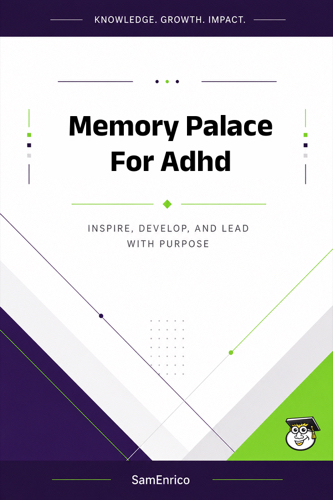
Memory Palace For Adhd eBook
Adapt loci techniques for attention-differing brai
Adapt loci techniques for attention-differing brains with practical hacks.
Formats
Free sample
Chapter 1: The RAM Lie--–- You do not have a bad memory. Let me repeat that, because your brain has already started arguing with it. You do not have a bad memory. What you have is a working memory that functions like a sieve in a hurricane, and a lifetime of being told that sieve is your fault.If you have ADHD, you have probably stood in a room—any room—and completely forgotten why you walked into it. You have lost your keys while holding them.
You have introduced yourself to someone twice in the same conversation. You have studied for an exam, felt prepared, and then watched the information evaporate the moment the timer started. And after each of these moments, a small voice whispered the same sentence: What is wrong with you?The answer, which will take this entire book to unpack, is simpler than you think. Nothing is wrong with you. You have been using the wrong user manual for your brain.Let me tell you about a study that changed how I think about ADHD and memory.
In 2022, researchers at Uppsala University in Sweden did something unusual. Instead of assuming that people with ADHD would fail at memory techniques, they asked a different question: What if we designed the technique differently? They took a group of adults with ADHD and taught them the Method of Loci—the ancient memory palace technique used by world champions. But they stripped away the assumptions. No long periods of sitting still.
No requirement to visualize perfectly. No shame if the images got weird.The results were striking. The participants not only learned the technique, they found it "easy and fun." Their memory performance improved significantly. And most importantly, they kept using it after the study ended. Not because they had developed superhuman discipline, but because the adapted method worked with their brains rather than against them.This book is the extension of that study.
It takes the ancient art of the memory palace and rebuilds it from the ground up for the ADHD brain. We will not ask you to sit still. We will not demand that you clear your mind. We will not pretend that silence is golden when your brain treats silence like a vacuum that must be filled with every random thought, earworm, and sudden urge to reorganize your sock drawer.Instead, we will turn your wandering mind into the engine of your memory.The Working Memory Traffic Jam Before we build anything, we need to understand why traditional memory advice fails for you. And to do that, we have to talk about working memory.Working memory is not a storage unit.
It is a processing table. It is the small, cluttered desk where your brain puts information while it decides what to do with it. For most people, that desk can hold about four to seven items at once. For people with ADHD, that desk is smaller, and the items keep sliding off.Think of it this way. Your long-term memory is a massive hard drive.
It holds everything—the smell of your grandmother's kitchen, the lyrics to every song from high school, the exact route to a friend's house you haven't visited in a decade. That part of your brain works perfectly. The problem is not storage. The problem is getting information from the world into that hard drive before it disappears.Working memory is the doorway between the world and your long-term memory. And for the ADHD brain, that doorway is not broken—it is crowded.
Imagine trying to move furniture through a doorway while eighty-seven other people are trying to walk through it at the same time. That is your working memory during a typical day. You are trying to remember what your boss just said, what you need to buy at the grocery store, whether you took your medication, what time your appointment is, and also somehow process the conversation happening in front of you while noticing that interesting bird outside the window.Nothing gets through. And then you feel stupid.Here is what no one told you. The problem is not that your working memory is too small.
The problem is that your brain is trying to process too many streams of information at once, and the doorway was never designed for that volume. The solution is not to try harder. The solution is to build a different doorway.Why the Memory Palace Works for ADHD Brains The Method of Loci—the memory palace technique—is over two thousand years old. Legend says the Greek poet Simonides of Ceos invented it after a building collapsed and he identified the bodies by remembering where each person had been sitting. That story may be apocryphal, but the technique is real.
It is used by every competitive memory champion in the world. And it works for a simple reason: the human brain is exceptionally good at remembering spaces, images, and stories.We are not naturally good at remembering abstract lists. Milk, eggs, butter, call the dentist, return that email, pick up dry cleaning—that string of words has no hooks. Your brain slides right over it. But you can remember the layout of your childhood home.
You can remember the smell of your elementary school cafeteria. You can remember the exact spot in your living room where you stood when you got a piece of surprising news.The memory palace hijacks that natural ability. You take a place you know well—your apartment, your commute, your office—and you turn it into a set of storage locations. Then you take the information you want to remember and you turn it into vivid, bizarre, unforgettable images. You place those images in the locations.
And when you need to remember the information, you take a mental walk through that space and see what you left there.For a neurotypical brain, this process usually involves sitting still, closing your eyes, and visualizing carefully. For an ADHD brain, that approach is a disaster. You cannot sit still. When you close your eyes, your mind wanders to seventeen different topics. The images you try to visualize feel blurry or they disappear entirely.But here is the secret.
You do not need to sit still. You do not need perfect visualization. You do not need a quiet room. In fact, for many ADHD brains, those conditions make memory worse.The Shame Spiral That Keeps You Stuck Before we go any further, we need to address the elephant in the room. The shame.If you have ADHD, you have probably been called lazy, careless, spacey, or unreliable.
You have been told to try harder, pay attention, use a planner, set reminders, just focus. And you have tried. God knows you have tried. You have bought the planners and downloaded the apps and set the alarms. And then you forgot to look at the planner.
Or you ignored the app notification. Or you turned off the alarm without registering it.Each failure adds another layer of shame. And that shame is toxic to memory.When you believe you have a bad memory, you stop trying to remember things. Why bother? You will just…
This is the end of the free sample. Get the eBook to keep going. Buy now
About this book
Details
- Author
- Pfeifer Ardell
- Publisher
- SamEnrico
- Language
- English
- Genre
- Non-Fiction, Self-Help, ADHD
- Released
- 2026-06-09
- Pages (approx.)
- 135
- Available as
- eBook, Audiobook

Read better in the ZLOADR app
Your eBooks on your phone or tablet. Sign in with your SamEnrico account and start reading.
More by Pfeifer Ardell
 Natural Birth Emergency KitPfeifer Ardell$11.99
 Workaholism in DentistryPfeifer Ardell$11.99
 Children's Bedtime Meditation GuidePfeifer Ardell$11.99
 The Koresh BodyguardPfeifer Ardell$11.99
 Whale Song Depths WorkbookPfeifer Ardell$11.99
 Safdie Uncut EnergyPfeifer Ardell$11.99
 Osiris Myth GuidePfeifer Ardell$11.99
 Hustle Culture Detox GuidePfeifer Ardell$11.99
 Phantom Freeways: The Vanishing Hitchhikers of the 70sPfeifer Ardell$11.99
 The Phantom of the Pentagon: The Man Who Stole America’s SecretsPfeifer Ardell$11.99
 Anansi and the Sky God's Web: A Trickster's GambitPfeifer Ardell$11.99
 NFT Valuation and Rarity ModelsPfeifer Ardell$11.99
You may also like
 Hong Kong Handover 1997Dunn Johnnie$11.99
 Zumba For Postnatal Recovery CourseNeal Christian$11.99
 Zumba for BeginnersLadner Nikia$11.99
 YouTube Comment Mining GuideHumes Pandora$12.99
 Worry Box MeditationCarlin Rudy$11.99
 Workplace Stress MeditationNguyen Lynn$11.99
 Workplace Stress and Sleep RepairHawley Ivory$11.99
 Workplace Perfectionism CureDelaney Jeffry$11.99
 Workplace Injustice Anger GuideWallen Isabelle$11.99
 Work Addiction and Burnout LinkGreenwood Ester$11.99
 Women in Yoga and WellnessBeattie Galina$11.99
 Women in Stand Up ComedyChun Evangeline$11.99