
Non-FictionSelf-HelpChampionship Prep
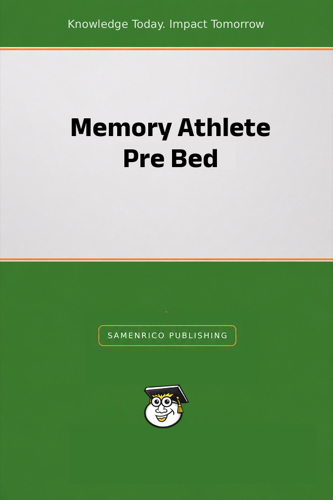
Memory Athlete Pre Bed eBook
Last minute recall routine.
Last minute recall routine.
Formats
Free sample
Chapter 1: The Panic Cycle--–- It is 11:47 PM on a Sunday night. You are sitting at a desk littered with empty coffee mugs, crumbs from a stressed-eaten granola bar, and 473 Power Point slides that all look exactly the same. Your exam is at 8:00 AM. You have not slept properly in three days. Your eyes burn.
Your heart races every time you flip to a slide you do not recognize—which is most of them. And somewhere in the back of your exhausted mind, you know exactly what is happening. You are cramming. Again.You tell yourself this is the only way. You tell yourself that the information will somehow stick if you just see it one more time.
You tell yourself that sleep is for people who are not as committed as you are. But deep down, in that quiet voice that only speaks during moments of pure exhaustion, you know the truth. This is not working. It has never worked. And yet here you are, doing the same thing you did last semester, last year, and the year before that.This chapter is not about memory techniques.
Not yet. Before you can learn how to remember, you must first understand why your current approach—the all-night cram session—is not just ineffective but actively destructive. You must understand the enemy. And the enemy is not your professor, your textbook, or even your own forgetfulness. The enemy is a three-stage psychological and neurological trap called the Panic Cycle.The Anatomy of the Panic Cycle The Panic Cycle operates like a feedback loop on a broken amplifier.
Each stage makes the next stage worse, and the cycle accelerates until cognitive collapse occurs. Let us walk through it slowly, because recognizing this pattern in yourself is the first step toward breaking free.Stage One: Performance Anxiety The cycle begins with a perfectly reasonable fear. You have an important exam, presentation, or performance event tomorrow. You care about the outcome. That caring produces a low level of anxiety—a physiological arousal state designed by evolution to sharpen focus and increase alertness.
In small doses, this anxiety is helpful. It keeps you from being complacent. It reminds you that the stakes are real.But the Pre-Bed scenario is not a small dose. By 11:00 PM on the night before a high-stakes event, the anxiety has often been building for hours or days. Your brain has been marinating in cortisol, the primary stress hormone, since you opened your first textbook at 2:00 PM.
That afternoon cortisol spike was useful. It kept you studying when you wanted to nap. But cortisol follows a circadian rhythm, and by late evening, your body expects cortisol levels to drop in preparation for sleep. Instead, you are forcing them higher by telling yourself, "I am not ready. I am going to fail.
Everyone else is ahead of me."This is performance anxiety in its purest form. It is not fear of the material. It is fear of the judgment, the grade, the disappointed look on your parent's face, the lost scholarship, the wasted tuition. That fear hijacks your brain's attention systems. Instead of focusing on the content of slide 237, your brain is secretly scanning for threats: Is that a text from my study group?
Did the professor say this would be on the exam? What time is it? How many slides are left?By the time you reach Stage One's conclusion, you are not studying. You are worrying while holding a book.Stage Two: Reduced Cognitive Focus Here is where the neurology becomes critical. Your brain has a limited resource called working memory.
Think of working memory as a small whiteboard in your prefrontal cortex. At any given moment, you can hold approximately four to seven discrete pieces of information on that whiteboard. That is it. Four to seven. Everything else must be stored elsewhere (long-term memory) or discarded.When anxiety enters the picture, it consumes whiteboard space.
The anxious thoughts themselves—"I am going to fail," "I should have started earlier," "Why can't I remember this?"—are pieces of information. They occupy working memory just as surely as facts and formulas do. In a calm state, your whiteboard might hold: "mitochondria," "ATP," "cell membrane," "ribosomes." In an anxious state, your whiteboard holds: "I am going to fail," "mitochondria," "What time is it?", "ATP," "I should have studied more," "cell membrane." You have lost half your capacity to worry about the material itself.This is not a metaphor. Functional MRI studies show that when subjects are placed under time pressure or evaluation threat, the brain's working memory regions show reduced activity while threat-detection regions (the amygdala) show increased activity. You are literally reallocating neural real estate from thinking to panicking.The result?
You read more slowly. You re-read the same sentence three times. You flip back to a previous slide because you cannot remember what it said. The material that should be simple feels impossible. And because it feels impossible, you escalate to Stage Three.Stage Three: Escalating Anxiety The reduced focus of Stage Two produces a predictable outcome: you are not covering material as quickly as you hoped.
That stack of 473 slides is not shrinking. The clock is moving faster than your progress. And now a new thought enters the whiteboard: "I am running out of time."This thought is not neutral. It is a threat signal. Your brain interprets "running out of time before an important evaluation" the same way it interprets "running out of air underwater." It triggers a sympathetic nervous system response.
Your heart rate increases. Your breathing becomes shallow. Your palms sweat. Your pupils dilate. These are useful responses if you are fleeing a predator.
They are catastrophic responses if you are trying to memorize the stages of cellular respiration.Why? Because the sympathetic nervous system prioritizes survival over cognition. When your body believes you are in danger, it diverts blood flow away from the prefrontal cortex (the seat of working memory and deliberate reasoning) and toward the large muscle groups and the amygdala. You become physically capable of running or fighting. You become mentally incapable of nuanced recall.This is the panic that gives the Panic Cycle its name.
Your vision narrows. Time feels like it is accelerating. Every wrong answer during self-testing feels like confirmation of impending doom. You abandon any pretense of strategic studying and default to the most primitive, least effective method available: passive re-reading. You stare at slides hoping that sheer exposure will somehow force the information into your brain.
It will not.The cycle then repeats. Stage Three's escalation produces more anxiety (Stage One, worsened). That anxiety consumes more working memory (Stage Two, worsened). That reduction in focus produces even slower progress and more panic (Stage Three, worsened). The amplifier feedback loop screams louder and louder until the system crashes.Cognitive Overload: When the Brain Breaks The Learning Scientists, a group of cognitive psychologists dedicated to translating research into practice, have a name for the final stage of the Panic Cycle: cognitive overload.
Cognitive overload occurs when the demands placed on working memory exceed its capacity. Not slightly exceed. Dramatically exceed.When you are in cognitive overload, your brain makes a survival…
This is the end of the free sample. Get the eBook to keep going. Buy now
About this book
Details
- Author
- Whitmore Kimberli
- Publisher
- SamEnrico
- Language
- English
- Genre
- Non-Fiction, Self-Help, Championship Prep
- Released
- 2026-06-06
- Pages (approx.)
- 153
- Available as
- eBook, Audiobook

Read better in the ZLOADR app
Your eBooks on your phone or tablet. Sign in with your SamEnrico account and start reading.
More by Whitmore Kimberli
 Parental Boundaries Self Care GuideWhitmore Kimberli$11.99
 Thyroid and MenopauseWhitmore Kimberli$11.99
 Customer Feedback ProxyWhitmore Kimberli$11.99
 Mayor of a SuburbWhitmore Kimberli$11.99
 Small Business Crisis HandbookWhitmore Kimberli$11.99
 Coping With Identity Theft StressWhitmore Kimberli$11.99
 Microbiome Antibiotic RecoveryWhitmore Kimberli$11.99
 The Last Laugh of Camp Crystal LakeWhitmore Kimberli$11.99
 Galileo's Stargazing Adventure: Unlocking the Secrets of the CosmosWhitmore Kimberli$11.99
 Justinian and Theodora: The Golden Reign of ByzantiumWhitmore Kimberli$11.99
 The Mineral Guide to Varieties That Are Not Valid Species:Whitmore Kimberli$11.99
 Korea University of TechnologyWhitmore Kimberli$12.99
You may also like
 Hong Kong Handover 1997Dunn Johnnie$11.99
 Zumba For Postnatal Recovery CourseNeal Christian$11.99
 Zumba for BeginnersLadner Nikia$11.99
 YouTube Comment Mining GuideHumes Pandora$12.99
 Worry Box MeditationCarlin Rudy$11.99
 Workplace Stress MeditationNguyen Lynn$11.99
 Workplace Stress and Sleep RepairHawley Ivory$11.99
 Workplace Perfectionism CureDelaney Jeffry$11.99
 Workplace Injustice Anger GuideWallen Isabelle$11.99
 Work Addiction and Burnout LinkGreenwood Ester$11.99
 Women in Yoga and WellnessBeattie Galina$11.99
 Women in Stand Up ComedyChun Evangeline$11.99