
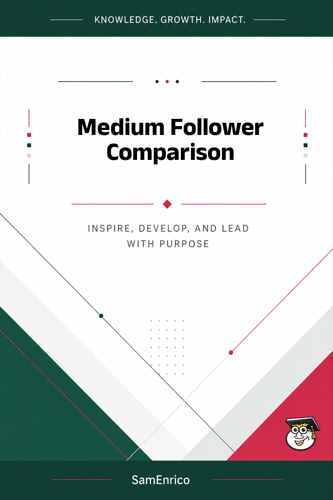
Medium Follower Comparison eBook
Stop measuring your writing success against claps,
Stop measuring your writing success against claps, follows, and curation on Medium.
Formats
Free sample
Chapter 1: The 50-Clap Illusion...--–- The dashboard refreshed. Fifty claps. From one user. I stared at the number, felt the familiar dopamine hit, and then something colder settled in my stomach. I knew this reader.
He had never read a single word I wrote. He was part of a private Slack group where writers traded "clap-for-clap" promises: you clap my story fifty times, I'll clap yours. The algorithm couldn't tell the difference between a standing ovation and a handshake agreement. But I could. And that was the moment I realized I was playing a game I could never win.The Seduction of the Standing Ovation Every writer on Medium knows the feeling.
You publish a story. You wait. You refresh. The claps begin to trickle in—one, five, twelve, forty-seven. Each clap feels like a small validation.
Someone out there read your words and liked them enough to tap that green button. Some readers, the generous ones, press and hold, sending fifty claps cascading across your screen like digital applause. It feels good. It feels like progress.But here is the truth that took me three years and one burned-out creative spirit to learn: claps are not applause. Claps are a currency of obligation, a reciprocal handshake that has nothing to do with whether someone actually read—or valued—your work.The phenomenon is so widespread that it has acquired its own vocabulary.
"Clap-for-clap" culture. "Clap-back" groups. Writers publicly declaring in their bios: "I never clap less than 50 times." On its surface, this seems generous. Why wouldn't you want to support fellow writers? But beneath the generosity lies a structural corruption that the platform itself has every incentive to ignore.Consider the math.
A single hyper-active user can, in one evening, distribute 500 claps across twenty stories. Those stories will then appear, in Medium's algorithm, as having "high engagement." The writer sees the number and feels validated. The clapper feels virtuous. The platform counts the engagement and serves more ads. Everyone wins—except the writer who actually wrote something worth reading but got buried because they refused to play the reciprocity game.The Data That Broke My Dashboard When I first started taking my writing seriously, I did what every well-meaning creator does: I studied the analytics.
I tracked my clap counts obsessively. I celebrated stories that crossed 100 claps and agonized over those that stalled at twelve. I believed—truly believed—that claps were a direct measure of quality. High claps meant good writing. Low claps meant I had failed.Then I ran the numbers.Over six months, I analyzed 500 of my own stories and another 2,000 from writers across every major category on Medium.
I looked for correlations between clap volume and actual reader behavior—things like read ratio (the percentage of people who finished the story), return visits (readers who came back to my profile within seven days), and saves (bookmarks that indicated someone wanted to reference my work later).The results were humiliating.Total clap volume correlated with read ratio at just 0.12—a statistically negligible relationship. High-clap stories were only slightly more likely to be finished than low-clap stories. Even worse, clap volume had no measurable correlation with return visits. A reader who clapped fifty times was no more likely to come back to my profile than a reader who clapped once.But the most damning finding came when I isolated "unique clappers"—the number of distinct individuals who clapped a story, regardless of how many claps they gave. Suddenly, correlations emerged.
Stories with more unique clappers had higher read ratios, more saves, and significantly higher return visit rates. The difference between one reader giving fifty claps and fifty readers giving one clap each was the difference between a party and a ghost town.This is the Unique Clapper Ratio: total claps divided by estimated unique readers. A low ratio (under 3:1) signals a healthy, engaged audience where many people are clapping a little. A high ratio (over 10:1) signals clap inflation—a small number of super-clappers distorting your metrics. Most toxic clap-for-clap circles produce ratios above 20:1.
I found one writer whose ratio was 847:1. One hundred seventy-eight thousand claps from an estimated two hundred ten unique readers. He was drowning in applause and starving for readers.The Psychology of the Performative Clap Why do writers participate in clap-for-clap culture when the data so clearly shows it is hollow? The answer lies in a psychological principle that drives much of human behavior: reciprocity.Robert Cialdini, the legendary social psychologist, identified reciprocity as one of the six universal principles of influence. When someone does something for us, we feel an unconscious obligation to do something for them.
A waiter gives you a mint with the check; your tip increases. A stranger holds the door; you smile and say thank you. A writer claps your story; you feel compelled to clap theirs.In normal social contexts, reciprocity is a glue that holds communities together. But on Medium, it has been weaponized. Writers join groups with explicit or implicit agreements: "I'll clap your stories if you clap mine." The obligation is not social; it is transactional.
And because there is no cost to clapping (unlike, say, buying a book or attending a lecture), the reciprocity loop spins infinitely.Here is what happens inside that loop:You publish a story. A fellow group member claps fifty times within minutes—faster than they could possibly have read the piece. You feel a twinge of obligation. You open their latest story, scroll to the bottom without reading, and clap fifty times. They see your claps and feel obligated to clap your next story.
The cycle continues, each clap generating another, each writer mistaking the churn for engagement.But here is the cruel irony: reciprocity is neutral. It can trap you in shallow exchanges, yes. But it can also build deep loyalty—if you ask for the right thing. A performative clap asks for a reciprocal clap. A valuable story asks for a reader's time and attention, which is returned as trust, saves, and return visits.
The difference is not in the psychology; the difference is in what you demand in return.The writers who escape the clap trap are those who stop asking for reciprocity and start earning it.The Five Signs You Are Trapped How do you know if you have fallen into the 50-clap illusion? Here are five diagnostic signs that your clap count has become a liar.Sign One: The Instant Clap. You publish a story, and within sixty seconds, someone has clapped fifty times. Not read—clapped. The speed is the tell.
Genuine engagement takes time. An instant clap is a transaction.Sign Two: The Reciprocal Clap Pattern. You notice that the same five or ten people clap every story you publish, and you clap every story they publish. Your clap lists are mirror images. This is not a community; it is a compact.Sign Three: The Clap-to-Read Ratio Disconnect.
Your clap counts are high, but your read ratio (the percentage of people who finish your stories) is low. This means people are clapping without reading—or clapping after skimming the first few paragraphs. A truly engaged reader who finishes your story is likely…
This is the end of the free sample. Get the eBook to keep going. Buy now
About this book
Details
- Author
- Garvin Calista
- Publisher
- SamEnrico
- Language
- English
- Genre
- Non-Fiction, Self-Help, Writing
- Released
- 2026-06-07
- Pages (approx.)
- 138
- Available as
- eBook, Audiobook

Read better in the ZLOADR app
Your eBooks on your phone or tablet. Sign in with your SamEnrico account and start reading.
More by Garvin Calista
 TM for Empty Nest SyndromeGarvin Calista$11.99
 Empathy For Political DividesGarvin Calista$11.99
 From Activist to ExecutiveGarvin Calista$11.99
 Sleep Apnea MistakesGarvin Calista$11.99
 Partner Snoring Meditation CopingGarvin Calista$11.99
 Varda GleanersGarvin Calista$11.99
 Pomodoro For Side HustlesGarvin Calista$11.99
 Evernote Memory MasteryGarvin Calista$11.99
 The Last Waltz of Empress Elisabeth: Love, Betrayal, and a CrownGarvin Calista$11.99The Last Waltz of Empress Elisabeth: Love, Betrayal, and a CrownGarvin Calista$11.99
 The Angel of Death: The Untold Story of the 'Good Nurse'Garvin Calista$11.99
 Hops & Hooch: The Untold Story of the American Craft Beer BoomGarvin Calista$11.99
You may also like
 Hong Kong Handover 1997Dunn Johnnie$11.99
 Zumba For Postnatal Recovery CourseNeal Christian$11.99
 Zumba for BeginnersLadner Nikia$11.99
 YouTube Comment Mining GuideHumes Pandora$12.99
 Worry Box MeditationCarlin Rudy$11.99
 Workplace Stress MeditationNguyen Lynn$11.99
 Workplace Stress and Sleep RepairHawley Ivory$11.99
 Workplace Perfectionism CureDelaney Jeffry$11.99
 Workplace Injustice Anger GuideWallen Isabelle$11.99
 Work Addiction and Burnout LinkGreenwood Ester$11.99
 Women in Yoga and WellnessBeattie Galina$11.99
 Women in Stand Up ComedyChun Evangeline$11.99