
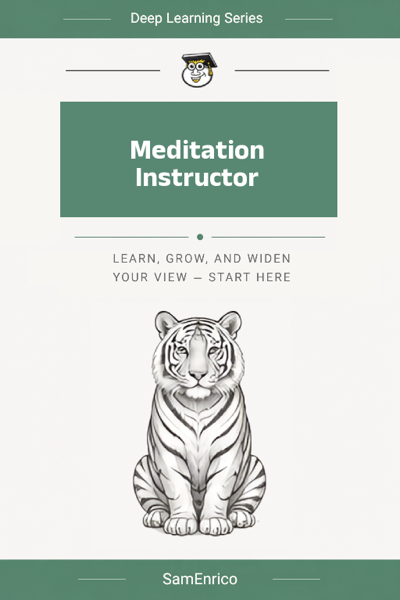
Non-FictionInformativeEducational
Meditation Instructor eBook
A Coursebook on Meditation Instructor
A Coursebook on Meditation Instructor
Formats
Free sample
Chapter 1: The Cushion Lie...--–- You have been sitting on a cushion, eyes closed, breathing carefully, believing that this makes you qualified to teach. It does not.This is the first and most uncomfortable truth this book will ask you to swallow. The meditation industry has sold you a beautiful fantasy: that a consistent personal practice, a peaceful disposition, and a desire to help others are sufficient credentials to stand in front of a room and guide strangers into their own minds. That fantasy has created thousands of well-intentioned, underqualified, and ultimately ineffective meditation teachers. It has also created a marketplace flooded with instructors who cannot answer the most basic professional question: "What specifically are you trained to teach, and to whom?"You are about to discover that becoming a meditation instructor is not the natural extension of being a meditation practitioner.
It is a distinct profession with its own body of knowledge, its own pedagogical skills, and its own ethical obligations. The practitioner asks, "What do I need for my own growth?" The instructor asks, "What does this specific student need at this specific moment?" These are different questions, requiring different competencies, and this chapter will show you exactly why the gap between them is wider than most aspiring teachers ever imagine.Let us begin by shattering the assumption that brought you here.The Practitioner-Instructor Fallacy The meditation world suffers from what I call the "Cushion Lie"—the unspoken belief that hours logged in personal practice translate directly into teaching ability. This would be like assuming that because you have eaten in restaurants for twenty years, you are qualified to run a kitchen. The two activities share a domain but require entirely different skill sets.Consider what a practitioner does: sits, breathes, notices thoughts, returns attention, experiences calm or boredom or insight, then gets up and goes about their day. The practitioner's primary relationship is with their own mind.
The instructor, by contrast, manages a complex social field. They must read a room of ten or twenty or forty nervous strangers, modulate their voice to calm without sedating, time their interventions to land before attention scatters, and respond to unexpected events—a student crying, a student fainting, a student angrily challenging the practice—all while maintaining their own grounded presence. These are not meditation skills. These are teaching skills, and they must be learned separately.The data bears this out. A 2019 survey of mindfulness teacher training programs conducted by the British Medical Journal found that 78 percent of aspiring teachers overestimated their readiness before formal training, and 62 percent reported that their personal practice had not prepared them for common classroom challenges such as managing group dynamics, responding to trauma disclosures, or adapting practices for different learning styles.
One participant wrote, "I had meditated for seven years. I thought I was ready. Then a student had a panic attack in my second class, and I froze. I had no idea what to do."This chapter is not designed to discourage you. It is designed to save you from that freezing moment.
The path from practitioner to instructor is real and navigable, but it requires that you first see the terrain clearly. That begins with understanding the three distinct worlds in which meditation instructors operate.The Three Worlds of the Meditation Instructor Western meditation teaching has fractured into three primary professional streams. Each stream has its own evidence base, its own vocabulary, its own certification pathways, and its own job market. Trying to teach across all three without specialized training is like trying to practice family medicine, neurosurgery, and sports psychology simultaneously—possible only for a rare few, and inadvisable for everyone else.World One: The Clinical Stream The clinical stream emerged from Jon Kabat-Zinn's work at the University of Massachusetts Medical School in the late 1970s. Kabat-Zinn, a molecular biologist with a deep personal meditation practice, recognized that Buddhist mindfulness practices could be stripped of their religious framework and delivered as a secular, evidence-based intervention for chronic pain and stress.
The result was Mindfulness-Based Stress Reduction (MBSR), an eight-week course that has since been studied in hundreds of clinical trials and adopted by hospitals, VA centers, and behavioral health programs worldwide.The clinical stream speaks the language of healthcare. Its practitioners use terms like "intervention," "efficacy," "randomized controlled trial," and "effect size." They track outcomes using standardized measures such as the Five Facet Mindfulness Questionnaire and the Perceived Stress Scale. They work alongside physicians, psychologists, and social workers. They document their sessions, maintain confidentiality in accordance with HIPAA (in the United States) or similar regulations elsewhere, and refer students to therapists when issues arise that exceed their scope of practice.To teach in the clinical stream, you need more than a meditation practice. You need to understand the evidence base for mindfulness—what it can do, what it cannot do, and what the research actually says (rather than what the popular press claims).
You need to recognize contraindications: conditions such as active psychosis, severe post-traumatic stress disorder, and certain seizure disorders, where meditation can worsen symptoms rather than alleviate them. You need to complete a recognized teacher training program, typically affiliated with Brown University (which now houses the MBSR flagship program), the University of California San Diego, or the University of Massachusetts.The job market for clinical instructors includes hospitals (teaching MBSR to chronic pain patients), VA centers (teaching mindfulness for PTSD and depression), behavioral health clinics (integrating mindfulness into treatment plans), and research studies (delivering protocol-based interventions to study participants). Pay ranges from 50to50 to 50to150 per hour for independent instructors, with salaried positions at medical centers typically ranging from 60,000to60,000 to 60,000to90,000.World Two: The Corporate Stream The corporate stream emerged more recently, driven by two forces: the mainstreaming of mindfulness through apps like Headspace and Calm, and a growing body of research showing that mindfulness training can improve focus, reduce burnout, and enhance decision-making under pressure. Companies such as Google, Apple, Goldman Sachs, and General Mills have all implemented mindfulness programs for their employees, creating a demand for instructors who can speak the language of business.The corporate stream speaks the language of return on investment. Its practitioners use terms like "productivity," "retention," "presenteeism," "healthcare costs," and "talent development." They do not talk about chakras, enlightenment, or spiritual awakening.
They talk about measurable outcomes: reduced errors, improved sleep, lower blood pressure, faster recovery from stressful meetings. A successful corporate instructor can translate a body scan into "a technique for resetting attention between high-focus tasks" and loving-kindness meditation into "a practice for reducing reactivity in difficult conversations."To teach in the corporate stream, you need credibility with two skeptical audiences: HR professionals who will decide whether to hire you, and employees who may resent being asked to meditate instead of receiving a raise or a lighter workload. You need to understand how to deliver practices in time-efficient formats (three to ten minutes rather than thirty to forty-five), how to frame mindfulness as a performance tool rather than a spiritual practice, and how to collect and present data demonstrating impact. Many corporate instructors hold an MBSR or MBCT certification plus additional training in organizational psychology, leadership coaching, or human resources.The…
This is the end of the free sample. Get the eBook to keep going. Buy now
About this book
Details
- Author
- Justice Mitsue
- Publisher
- SamEnrico
- Language
- English
- Genre
- Non-Fiction, Informative, Educational
- Released
- 2026-05-11
- Pages (approx.)
- 155
- Available as
- eBook, Audiobook

Read better in the ZLOADR app
Your eBooks on your phone or tablet. Sign in with your SamEnrico account and start reading.
More by Justice Mitsue
 Emotion Regulation For LeadersJustice Mitsue$11.99
 The Distracted Listener CureJustice Mitsue$11.99
 DBT For LGBTQIA IndividualsJustice Mitsue$11.99
 The Swatting Terror GuideJustice Mitsue$11.99
 Dirt to Glory: The Unstoppable Rise of Caroline BuchananJustice Mitsue$11.99
 Understanding Temporomandibular Joint Dysfunction (Tmj)Justice Mitsue$17.99
 WIPO vs ARIPO ComparisonJustice Mitsue$12.99
 Middle East Green Transition GuideJustice Mitsue$12.99
 How to Become a Shaper OperatorJustice Mitsue$11.99
You may also like
 Hong Kong Handover 1997Dunn Johnnie$11.99
 Zumba For Postnatal Recovery CourseNeal Christian$11.99
 Zumba for BeginnersLadner Nikia$11.99
 YouTube Comment Mining GuideHumes Pandora$12.99
 Worry Box MeditationCarlin Rudy$11.99
 Workplace Stress MeditationNguyen Lynn$11.99
 Workplace Stress and Sleep RepairHawley Ivory$11.99
 Workplace Perfectionism CureDelaney Jeffry$11.99
 Workplace Injustice Anger GuideWallen Isabelle$11.99
 Work Addiction and Burnout LinkGreenwood Ester$11.99
 Women in Yoga and WellnessBeattie Galina$11.99
 Women in Stand Up ComedyChun Evangeline$11.99