
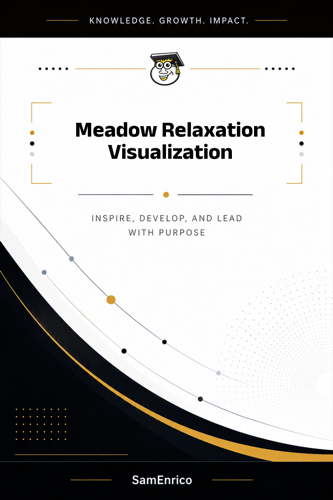
Non-FictionSelf-HelpNature Connection
Meadow Relaxation Visualization eBook
Lie in a wildflower meadow under warm sun to calm
Lie in a wildflower meadow under warm sun to calm the nervous system.
Formats
Free sample
Chapter 1: The Sunlight Lie--You have been told, perhaps for your entire life, that rest is something you earn. That relaxation is a reward for productivity, a pause granted only after the to-do list is empty, the emails are answered, the children are fed, the dishes are washed. And because that moment of complete emptiness never actually arrives, you have learned to live in a state of low-grade vigilance—always waiting, always bracing, always half-listening for the next demand.This is not a moral failure. It is a nervous system that has been trained, through repetition and necessity, to stay on alert.The lie that sunlight and meadows and gentle breezes will somehow fix this is older than the self-help industry. You have seen the images: a woman in loose white linen floating through a field of wildflowers, her face tilted toward the sun, her expression one of effortless bliss.
The implication is clear—if you cannot achieve that state, you are trying too hard, or not enough, or in the wrong way. But here is the truth that those images never tell you: the woman in the photograph is not relaxed. She is posing. Her nervous system is engaged in the very vigilance you are trying to escape. She is holding her jaw at a specific angle.
She is aware of the camera. She is performing rest.This book offers something entirely different. It offers a meadow that does not require you to perform. A sun that does not judge how long you have been away. A ground that holds you whether you deserve it or not.And here is the most important sentence you will read in this chapter:You do not need to believe this will work for it to work.Your nervous system does not operate on belief.
It operates on sensory input, real or imagined. When you close your eyes and imagine warmth on your face—even if you are skeptical, even if you feel foolish, even if your mind is screaming that this is a waste of time—the insula region of your brain (the map-maker of internal body states) begins to process that imagined warmth as if it were real. The vagus nerve, the primary highway of the parasympathetic nervous system, does not check your credentials before it slows your heart rate. It simply responds to the signal.This chapter is the foundation of everything that follows. It will give you the science, the vocabulary, and the first glimmer of experience that will make the remaining eleven chapters not just comprehensible but inevitable.Part One: Why Your Nervous System Is Not Broken (It Is Exactly as Designed)Before we enter the meadow, you must understand why you have struggled to rest.
Not because there is something wrong with you. Because there is something wrong with the environment you have been asked to rest within.The human nervous system evolved over approximately two hundred thousand years in environments that looked nothing like your office, your car, your bedroom with the phone charging six inches from your head. Your ancestors rested in meadows—or the Pleistocene equivalent of meadows: open grasslands with visibility, water sources, and the specific golden-green light of late afternoon. They rested in the presence of warmth and the absence of predators. They rested lying down, with their backs to the earth, because lying down in a safe place is the most ancient signal of security available to a mammal.Consider what happens when a dog lies down in a sunny spot on the floor.
It does not first meditate. It does not light a candle. It does not recite affirmations. It simply feels the warmth, releases its weight to the ground, and within seconds, its breathing slows, its heart rate drops, and its body enters a state of deep rest. The dog is not more spiritually evolved than you.
The dog has not been taught that rest must be earned.You have.Every time you were told to stop daydreaming and focus, every time you were praised for pushing through exhaustion, every time you were shamed for resting while there was still work to do, your nervous system learned a lesson: safety requires vigilance. Rest is dangerous. If you let your guard down, something bad will happen—or worse, someone will see you as lazy.This is not paranoia. This is neuroplasticity. Your brain has physically rewired itself to prioritize alertness over ease, because alertness kept you safe in the environment where that learning occurred.But neuroplasticity cuts both ways.
The same brain that learned vigilance can learn rest. And the most efficient way to teach it—the pathway that bypasses the endless chatter of your conscious mind—is through the sensory simulation of an environment where your nervous system originally learned to feel safe.That environment is the meadow.Not the meadow of postcards and perfumes. The meadow of dry grass, warm earth, dappled light, and the low hum of insects that says, in a frequency your brain understands without translation, nothing here wants to eat you.Part Two: The Vagus Nerve and the Passive Solar Effect You have likely heard of the vagus nerve. It has become something of a celebrity in wellness circles—touted as the secret key to calm, the reset button for anxiety, the off-switch for stress. And like most celebrities, it is both oversimplified and underutilized.The vagus nerve is actually a pair of nerves (left and right) that run from your brainstem down through your neck, branching into your chest, heart, lungs, and digestive tract.
It is the primary conduit of the parasympathetic nervous system—the branch of your autonomic nervous system responsible for rest, digestion, healing, and connection. When the vagus nerve is firing at an optimal rate, your heart rate variability (HRV) improves, your inflammation markers drop, your digestion functions properly, and you feel something that might be unfamiliar to you: safe.But here is the detail most books omit. The vagus nerve does not respond to thoughts about safety. It responds to sensations of safety. And the most powerful sensation you can generate—more powerful than any breathing technique, more powerful than any mantra—is the sensation of passive warmth on the face and neck.This is called the passive solar effect.In the original research, scientists observed that mammals exposed to gentle, passive warmth (not intense heat, not exercise-induced warmth, but the kind of warmth you feel when lying in sunlit grass) showed immediate increases in vagal tone.
Heart rate dropped. Breathing deepened. Cortisol, the primary stress hormone, decreased by an average of twenty-three percent within ten minutes. And here is the astonishing finding: the effect occurred even when the warmth was simulated through visualization.Why does this work? Because the human brain evolved in a world where sunlight was the single most reliable predictor of safety.
Nocturnal predators hunt in darkness. The open sun means visibility, means escape routes, means the absence of threat. Your brain does not need to be convinced of this. It knows it in the same way it knows that water is wet and that falling hurts.When you imagine sunlight on your face, your brain activates…
This is the end of the free sample. Get the eBook to keep going. Buy now
About this book
Details
- Author
- Greiner Akiko
- Publisher
- SamEnrico
- Language
- English
- Genre
- Non-Fiction, Self-Help, Nature Connection
- Released
- 2026-06-09
- Pages (approx.)
- 119
- Available as
- eBook, Audiobook

Read better in the ZLOADR app
Your eBooks on your phone or tablet. Sign in with your SamEnrico account and start reading.
More by Greiner Akiko
 Improv FAQ GuideGreiner Akiko$11.99
 Purpose Factor Longevity GuideGreiner Akiko$11.99
 The Financial Services Cloud OutlookGreiner Akiko$11.99
 Senate Unanimous ConsentGreiner Akiko$11.99
 The Great Doge’s Heist: Venice’s Canine Crime SolverGreiner Akiko$11.99
 Understanding Raynaud's Disease/phenomenonGreiner Akiko$17.99
 How to Become a Pocketed-spring AssemblerGreiner Akiko$11.99
 Historical ReenactmentsGreiner Akiko$11.99
 Fitness Activity GuideGreiner Akiko$12.99
 LLC vs C Corp Non ResidentGreiner Akiko$12.99
You may also like
 Hong Kong Handover 1997Dunn Johnnie$11.99
 Zumba For Postnatal Recovery CourseNeal Christian$11.99
 Zumba for BeginnersLadner Nikia$11.99
 YouTube Comment Mining GuideHumes Pandora$12.99
 Worry Box MeditationCarlin Rudy$11.99
 Workplace Stress MeditationNguyen Lynn$11.99
 Workplace Stress and Sleep RepairHawley Ivory$11.99
 Workplace Perfectionism CureDelaney Jeffry$11.99
 Workplace Injustice Anger GuideWallen Isabelle$11.99
 Work Addiction and Burnout LinkGreenwood Ester$11.99
 Women in Yoga and WellnessBeattie Galina$11.99
 Women in Stand Up ComedyChun Evangeline$11.99