
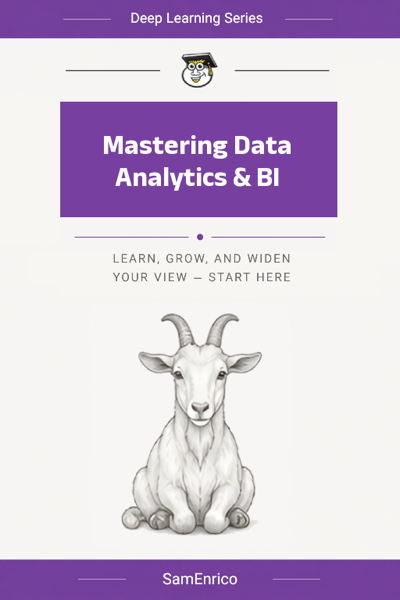
Non-FictionInformativeEducational
Mastering Data Analytics & BI eBook
A Coursebook on Mastering Data Analytics & BI
A Coursebook on Mastering Data Analytics & BI
Formats
Free sample
Chapter 1: The Signal Machine--–- Every morning, Maria Torres walked past a mountain of data and didn’t see it. As the regional sales director for a mid-sized consumer goods company, she received fifty-seven reports every Monday. Fifty-seven. They arrived as PDF attachments, Excel spreadsheets, printed binders, and dashboard links she’d long ago stopped clicking. The reports told her everything and nothing simultaneously.
They told her that sales in the Northeast were up 3.2% year-over-year. They told her that customer acquisition costs had increased by twelve cents per unit. They told her that inventory turnover had slowed by two days. They told her that her team’s average call volume had increased by seven percent. But when Maria sat in the Tuesday morning executive review, she could not answer the question her CEO always asked: “So what should we do differently?”Maria’s problem is not a lack of data.
It is not a lack of reports. It is not a lack of analysts, dashboards, or software subscriptions. Maria’s problem—and it is a problem shared by executives, managers, and analysts across virtually every industry—is that she is drowning in information while starving for wisdom. She has mastered the art of collecting data but not the discipline of converting it into decisions. This book exists to close that gap.Welcome to Mastering Data Analytics & BI.
If you are reading these words, you already suspect that data matters. Perhaps you have seen competitors make faster, smarter moves. Perhaps you have felt the frustration of arguing over opinions instead of evidence. Perhaps you have invested in expensive analytics tools only to wonder why your organization still operates on gut feeling. Whatever brought you here, this chapter will establish the single most important idea in this entire book: Data is not valuable.
Insight is valuable. And insight only becomes valuable when it changes a decision.This chapter will transform how you think about data analytics and business intelligence. We will begin by dismantling the most dangerous myth in modern business—the assumption that more data automatically leads to better outcomes. Then we will build a conceptual framework that distinguishes raw facts from actionable wisdom. We will draw a clear line between Business Intelligence (which tells you what happened) and Data Science (which tells you what will happen and what to do about it).
We will examine the technical architectures that make analytics possible—the difference between systems that capture transactions and systems that enable analysis. And finally, we will confront the uncomfortable truth that Maria discovered after six months of failed analytics projects: Data without decision-making is just expensive noise.By the end of this chapter, you will never look at a spreadsheet the same way again. You will have a mental model for separating signal from noise. You will understand why most analytics initiatives fail—not because of bad technology, but because of bad thinking. And you will be ready to embark on the journey that the remaining eleven chapters will guide you through: the transformation from data-rich, insight-poor to genuinely data-driven.Let us begin.The Great Paradox: Why More Data Often Means Worse Decisions In 2009, a team of researchers at the University of Chicago conducted a deceptively simple experiment.
They gave professional financial analysts a dataset of company financials and asked them to predict quarterly earnings. Half of the analysts received a small, curated set of the most relevant variables. The other half received the same data plus dozens of additional variables—footnotes, supplementary disclosures, historical ratios, and industry comparisons. The researchers expected the group with more information to make more accurate predictions. After all, isn’t more data always better?It was not.
The analysts with more information were actually less accurate than their counterparts with less information. They were also more confident in their wrong predictions. The additional data did not clarify; it distracted. It gave analysts more opportunities to find spurious patterns, to overweight irrelevant factors, and to convince themselves they had uncovered insights that simply were not there.This finding has been replicated across domains. Doctors given more patient data make worse diagnoses when the extra data is irrelevant to the condition.
Jurors given irrelevant evidence are more likely to reach incorrect verdicts. Chess players who study more opening variations—beyond a certain point—perform worse because they second-guess their instincts. The phenomenon even has a name: information overload, or in academic circles, the paradox of choice applied to data.Yet the prevailing assumption in most organizations remains stubbornly opposite. Companies hoard data like squirrels hoarding nuts. They log every click, every transaction, every customer service call, every machine sensor reading, every email, every chat message.
They buy data warehouses to store it all, data lakes to dump it all, and data catalogs to organize it all. And then they wonder why no one can find the one insight that matters.The problem is not storage. The problem is signal-to-noise ratio. When every piece of data is treated as equally important, important data loses its power. When every metric is a key performance indicator, no metric is key.
When every anomaly triggers an alert, alerts become background noise. Organizations that fail to discriminate between what matters and what does not do not become data-driven. They become data-drowned.This book will teach you to discriminate. But before we can discuss how to find signal in noise, we need a shared language for understanding what data actually is, how it moves up the value chain, and why the highest form of data work has nothing to do with technology and everything to do with wisdom.The DIKW Hierarchy: From Raw Noise to Actionable Wisdom If you remember only one framework from this entire book, remember this one. The DIKW Hierarchy—Data, Information, Knowledge, Wisdom—is the single most useful mental model for understanding what analytics actually does.
It explains why some organizations get value from data while others get only headaches. It explains why analysts who only produce reports are replaceable while analysts who produce wisdom are indispensable. And it will serve as your compass throughout every chapter that follows.Let us build the hierarchy from the ground up.Level 1: Data – Raw Facts Without Context Data is the bottom of the pyramid. Data is raw, unprocessed, contextless facts. A number.
A word. A timestamp. A sensor reading. A transaction record. Alone, each piece of data is meaningless.
Consider this: “42.” Is that a temperature? A customer age? A number of units sold? An answer to the meaning of life? Without context, you cannot know.
Data is the what without the why, the where, the when, or the so what.Organizations are exceptionally good at collecting data. Your company likely has data on every customer interaction, every product movement, every employee action, every machine cycle. But raw data sitting in a database is like crude oil sitting in the ground. It has potential value, but it is not yet useful. It must be refined.Level 2: Information – Data with Context and Structure When you add context to data—when you ask who, what, where, when—data becomes information.
“42” becomes “42 units of Product X sold in the Northeast region on January 15.” That is information. It answers…
This is the end of the free sample. Get the eBook to keep going. Buy now
About this book
Details
- Author
- Domingo Suellen
- Publisher
- SamEnrico
- Language
- English
- Genre
- Non-Fiction, Informative, Educational
- Released
- 2026-06-02
- Pages (approx.)
- 160
- Available as
- eBook, Audiobook

Read better in the ZLOADR app
Your eBooks on your phone or tablet. Sign in with your SamEnrico account and start reading.
More by Domingo Suellen
 SMART Recovery for Drug DependencyDomingo Suellen$11.99
 Dream Research ReviewDomingo Suellen$11.99
 Working Caregiver GuideDomingo Suellen$11.99
 Self Hypnosis For Badminton SmashDomingo Suellen$11.99
 Anapanasati for PregnancyDomingo Suellen$11.99
 Moroccan Father Work MigrationDomingo Suellen$11.99
 Networking Through Professional AssociationsDomingo Suellen$11.99
 Financial Stress During HolidaysDomingo Suellen$11.99
 Insomnia Anxiety MeditationDomingo Suellen$11.99
 The Midnight Violin: Harriet Tubman’s Secret Weapon in the Underground RailroadDomingo Suellen$11.99
 The Black Swan of Vienna: Chevalier de Saint-Georges and the Court of Marie AntoinetteDomingo Suellen$11.99
 How to Become a Brush PolisherDomingo Suellen$11.99
You may also like
 Hong Kong Handover 1997Dunn Johnnie$11.99
 Zumba For Postnatal Recovery CourseNeal Christian$11.99
 Zumba for BeginnersLadner Nikia$11.99
 YouTube Comment Mining GuideHumes Pandora$12.99
 Worry Box MeditationCarlin Rudy$11.99
 Workplace Stress MeditationNguyen Lynn$11.99
 Workplace Stress and Sleep RepairHawley Ivory$11.99
 Workplace Perfectionism CureDelaney Jeffry$11.99
 Workplace Injustice Anger GuideWallen Isabelle$11.99
 Work Addiction and Burnout LinkGreenwood Ester$11.99
 Women in Yoga and WellnessBeattie Galina$11.99
 Women in Stand Up ComedyChun Evangeline$11.99