
Non-FictionInformativeEducational
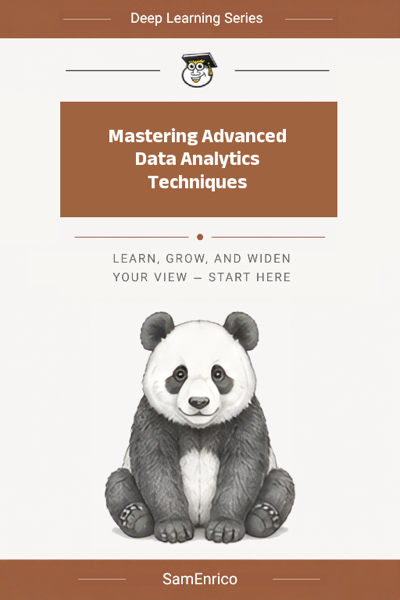
Mastering Advanced Data Analytics Techniques eBook
A Coursebook on Mastering Advanced Data Analytics
A Coursebook on Mastering Advanced Data Analytics Techniques
Formats
Free sample
Chapter 1: The Analytics Chasm...--The email arrived at 11:47 PM on a Tuesday. "Urgent: Customer churn spiked 22% last week. Please run your usual analysis and get back to me by tomorrow morning." Maria, a senior data analyst with seven years of experience, stared at her screen. She knew exactly what "your usual analysis" meant: pull the last six months of customer activity from the data warehouse, calculate average usage patterns before and after the spike, create a few line charts in Tableau, and write a memo describing what happened. She could do that in her sleep.But as she began writing the SQL query, a familiar frustration gnawed at her.
She could describe the churn. She could even predict which customers were likely to churn next month with reasonable accuracy using the logistic regression model she'd built last quarter. What she could not do—what no amount of SQL queries or pandas dataframes would reveal—was answer the question her VP would inevitably ask in the morning meeting: "Why? What caused this? And what do we do about it?"That question, simple as it sounded, required a fundamentally different approach to analytics.
It required moving beyond descriptive statistics into causal inference. It required handling not just gigabytes but terabytes of event logs across multiple systems. It required building models that didn't just predict but explained themselves to skeptical stakeholders. And it required presenting insights not as spreadsheets but as narratives that drove action.This chapter is for everyone who has ever felt like Maria. It is for analysts who have mastered SQL and pandas only to discover that technical fluency is not the same as analytical maturity.
It is for data scientists who can build xgboost models in their sleep but struggle to deploy them into production environments where data arrives in real time from a thousand different sources. It is for technical managers who need to lead teams through this transition without losing their minds—or their budgets.We begin not with code or algorithms but with a map. Because before you can master advanced analytics, you need to understand where you are, where you are going, and why the gap between them is wider than most people realize.The Five Levels of Analytical Maturity Every organization that works with data progresses through five distinct stages of analytical capability. Recognizing your current level is the first step toward advancing beyond it.Level 1: Descriptive Analytics (What Happened?)Descriptive analytics is the foundation. It answers questions about the past: "How many customers churned last week?" "What were our total sales by region?" "Which products had the highest return rates?" The tools are familiar: SQL queries, Excel pivot tables, basic dashboards in Power BI or Tableau.
The outputs are reports, scorecards, and historical summaries.At this level, the analyst's job is accurate measurement. The key challenge is data quality: ensuring that counts are correct, joins are proper, and time ranges are appropriately defined. Most organizations operate here for their first several years. Many never leave.Limitation: Descriptive analytics tells you what happened but not why. When churn spikes, you can quantify the spike but not explain its cause.
When sales dip, you can measure the dip but not identify whether it resulted from price changes, competitive pressure, seasonal effects, or random variation.Level 2: Diagnostic Analytics (Why Did It Happen?)Diagnostic analytics adds context and comparison. It answers questions like: "Did churn spike more among new customers or long-term customers?" "Was the sales dip concentrated in one region or across all regions?" "How does this quarter compare to the same quarter last year, adjusting for seasonality?"The tools become more sophisticated: drill-down dashboards, cohort analysis, trend decomposition. Analysts start using techniques like segmentation (Chapter 6) and basic statistical tests (t-tests, chi-square). The outputs are interactive dashboards that allow users to explore dimensions of the data.Limitation: Diagnostic analytics can identify correlations and patterns but still struggles with causation. You might discover that churned customers had lower login frequency in the preceding weeks.
But did low login frequency cause churn, or did customers who had already decided to leave simply stop logging in? Diagnostic analytics cannot answer this.Level 3: Predictive Analytics (What Will Happen?)Predictive analytics uses historical data to forecast future outcomes. It answers questions like: "Which customers are most likely to churn in the next 30 days?" "What will our sales be next quarter?" "Which transactions are likely to be fraudulent?"This is where machine learning enters the picture. Techniques include logistic regression, random forests, xgboost (Chapter 8), and time series forecasting (Chapter 9). The outputs are risk scores, probability estimates, and forward-looking forecasts.Limitation: Predictive models excel at forecasting but still do not explain causality.
A model might accurately predict churn using login frequency as a feature, but that does not mean increasing login frequency would reduce churn. The relationship could be spurious, driven by a third variable (like customer engagement with support), or even reversed (churn causes decreased logins). As the old saying goes, "Correlation does not imply causation"—and predictive models are fundamentally correlation machines.Level 4: Prescriptive Analytics (What Should We Do?)Prescriptive analytics goes beyond prediction to recommendation. It answers questions like: "Which discount should we offer to each customer to minimize churn?" "How should we route deliveries to minimize fuel costs while meeting time windows?" "What price should we set to maximize revenue given demand elasticity?"Techniques include optimization (linear programming, integer programming), simulation (Monte Carlo methods), and reinforcement learning (sequential decision making under uncertainty). The outputs are action recommendations, often personalized at the individual customer or transaction level.Limitation: Prescriptive analytics requires not just predictive models but also a clear understanding of the causal structure of the problem.
You cannot prescribe optimal actions without knowing how those actions affect outcomes. If you do not know whether discounts actually reduce churn (or simply give money to customers who would have stayed anyway), your prescription is built on sand.Level 5: Cognitive Analytics (How Do We Learn and Adapt?)Cognitive analytics represents the frontier: systems that continuously learn from new data, adapt to changing conditions, and generate novel insights without explicit programming. This includes generative AI (Chapter 11), autonomous agents, and self-improving pipelines that update models in real time as new data arrives (Chapter 10).At this level, analytics is not a periodic exercise but an ongoing process embedded into operations. Churn detection models retrain daily. Pricing algorithms adjust to competitor moves within minutes.
Fraud detection systems adapt to new attack patterns in real time.Limitation (for now): Cognitive analytics is still emerging. Techniques exist but require significant engineering investment, careful governance, and robust validation. Many organizations are not ready for Level 5—but understanding its contours helps guide long-term strategy.The Modern Data Stack: Where Your Analytics Lives Moving up the analytical maturity ladder requires more than better algorithms. It requires a fundamentally different infrastructure for storing, processing, and accessing data. The "modern data stack" has evolved dramatically over the past decade, and understanding its components is essential for anyone doing advanced analytics.Data Lakes: The Raw Repository A data lake stores data in its native, raw format.
Unlike traditional databases that require data to be structured into tables before ingestion (schema-on-write), data lakes allow you to dump…
This is the end of the free sample. Get the eBook to keep going. Buy now
About this book
Details
- Author
- Soria Angeline
- Publisher
- SamEnrico
- Language
- English
- Genre
- Non-Fiction, Informative, Educational
- Released
- 2026-06-02
- Pages (approx.)
- 160
- Available as
- eBook, Audiobook

Read better in the ZLOADR app
Your eBooks on your phone or tablet. Sign in with your SamEnrico account and start reading.
More by Soria Angeline
 Nobel Prize X Ray Crystallography GuideSoria Angeline$11.99
 Kobuk Valley MysteriesSoria Angeline$11.99
 Back to School Spending AddictionSoria Angeline$11.99
 Watch Checking as ImpatienceSoria Angeline$11.99
 Living Will Healthcare DirectiveSoria Angeline$11.99
 The Nobel Laureate Industry TiesSoria Angeline$11.99
 Mindful Parenting BeginnersSoria Angeline$11.99
 Hobby Reclamation for WorkaholicsSoria Angeline$11.99
 The Queen’s Last Goodbye: A Nation in MourningSoria Angeline$11.99
 The Doppelgänger Dilemma: When Two Cleopatras Ruled EgyptSoria Angeline$11.99
 Sun Tzu: The Art of War in Blood and InkSoria Angeline$11.99
 Growing Cortaderia (Pampas Grass, Tussock Grass)Soria Angeline$11.99
You may also like
 Hong Kong Handover 1997Dunn Johnnie$11.99
 Zumba For Postnatal Recovery CourseNeal Christian$11.99
 Zumba for BeginnersLadner Nikia$11.99
 YouTube Comment Mining GuideHumes Pandora$12.99
 Worry Box MeditationCarlin Rudy$11.99
 Workplace Stress MeditationNguyen Lynn$11.99
 Workplace Stress and Sleep RepairHawley Ivory$11.99
 Workplace Perfectionism CureDelaney Jeffry$11.99
 Workplace Injustice Anger GuideWallen Isabelle$11.99
 Work Addiction and Burnout LinkGreenwood Ester$11.99
 Women in Yoga and WellnessBeattie Galina$11.99
 Women in Stand Up ComedyChun Evangeline$11.99