
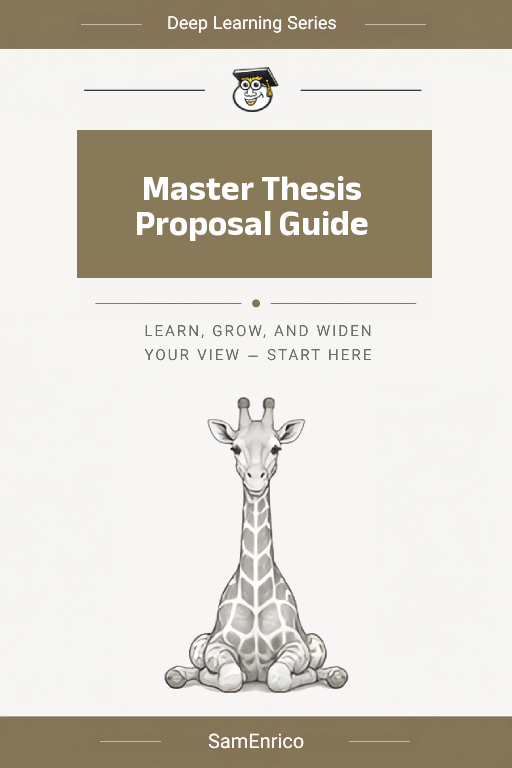
Non-FictionStudent's ShortcutMaster ThesisProposal Scope
Master Thesis Proposal Guide eBook
Write a master thesis proposal that satisfies your
Write a master thesis proposal that satisfies your committee with manageable scope and clear research design.
Formats
Free sample
Chapter 1: The Goldilocks Zone--–- Every failed master’s thesis proposal begins the same way: with a topic that seemed brilliant at 10 PM but felt impossible by 10 AM. You know the feeling. You start with a genuine curiosity—something that actually interests you—and then, under the vague guidance of “think bigger” or “find a gap,” you expand it until it becomes a doctoral dissertation disguised as a master’s project. Or worse, you panic and shrink it until you’re studying something so tiny and trivial that even you don’t care about the answer. Either way, you end up stuck, staring at a blank page, wondering why no one told you that choosing a topic is not about finding the right answer but about finding the right-sized question.This chapter exists because the single most common point of failure in master’s proposal writing happens before a single word of the proposal is written.
You cannot fix a bad topic with good writing. You cannot rescue an over-scoped question with elegant prose. And you cannot defend a trivial project with passionate conviction. What you can do is learn a systematic method for identifying what this book calls the Goldilocks Zone—the narrow but navigable range where a topic is specific enough to be completed in a reasonable timeframe, significant enough to interest your committee, and flexible enough to survive the inevitable surprises of actual research.By the end of this chapter, you will have a one-paragraph topic statement that is ready to show your advisor. More importantly, you will understand the four dimensions of scope that will serve as your compass for the entire proposal process.
You will have completed Level 1 of the Feasibility Ladder (a concept introduced in this book’s Introduction and revisited in Chapters 5 and 9). And you will never again fall into the trap of asking “Is this topic good?” without also asking “Is this topic the right size for me, here, now?”Let’s begin by understanding why most students get this wrong.The Cemetery of Great Ideas: Three Cautionary Tales Before we build your topic, let’s visit three students who built theirs incorrectly. Their names have been changed. Their mistakes have not.The Savior. Maria wanted to study “the impact of climate change policy on economic inequality in Southeast Asian coastal cities.” She had six months for her master’s thesis.
Her committee said “interesting” (which, as Chapter 2 will explain, is often academic code for “I’m worried”). Maria spent three months reading, two months panicking, and one month trying to survey five countries simultaneously. She did not finish. Her topic was not wrong; it was just too big for the time, resources, and single-person labor she had available.The Microscope. James wanted to study “the effect of one specific keyboard shortcut on the typing speed of left-handed graduate students in one computer lab on one Tuesday afternoon.” His committee asked, “So what?” He had no answer.
His study was perfectly feasible—he could have done it in an afternoon—but it failed the significance test. No one, including James, cared about the answer. His topic was not wrong; it was just too small to matter.The Ghost. Priya could not choose. She had three topics: a qualitative study of workplace dynamics, a quantitative survey of social media use, and a historical analysis of policy documents.
She went to three different advisors and got three different opinions. Six months later, she had three half-finished literature reviews and zero proposal drafts. Her problem was not scope or significance; it was commitment. She had never learned how to test a topic for feasibility before falling in love with it.These three students represent the three failure modes of topic selection: over-scoping (too big), under-scoping (too small), and scope paralysis (no commitment). The Goldilocks Zone exists in the narrow space between them.
Your job in this chapter is to find that space for your unique combination of interests, resources, constraints, and timeline.Defining the Four Dimensions of Scope (A Formal Introduction)Throughout this book, the word “scope” will appear hundreds of times. Before we go further, you need a precise definition that you can use as a diagnostic tool. Scope is not a vague feeling of “bigness.” It is a set of four concrete dimensions that you can measure, adjust, and defend.Dimension 1: Population. Who or what are you studying? This could be human participants, organizations, texts, artifacts, data points, or events.
Every population decision includes an implicit exclusion: if you study urban community college students, you are not studying rural four-year university students. If you study tweets from 2024, you are not studying Facebook posts from 2020. The Goldilocks question for population is: “Is this group specific enough to access, but broad enough that finding enough cases is realistic?”Dimension 2: Time. What is your temporal window? This includes both the timeframe of the phenomenon you are studying (e.g., “the COVID-19 pandemic years 2020–2022”) and the duration of your data collection (e.g., “a two-week observation period”).
The Goldilocks question for time is: “Is this window long enough to observe meaningful patterns, but short enough to fit within my master’s timeline (typically 6–12 months)?”Dimension 3: Variables. What factors are you measuring, manipulating, or analyzing? Every variable you add multiplies your complexity. A study with one independent variable and one dependent variable is manageable. A study with four independent variables, three moderators, and two dependent variables is a doctoral dissertation.
The Goldilocks question for variables is: “Have I included only the variables I can realistically operationalize (see Chapter 7) and analyze (see Chapter 6)?”Dimension 4: Generalizability. What claims will you make about populations, settings, or times beyond your direct study? Master’s theses rarely, if ever, should claim broad generalizability. The Goldilocks question for generalizability is: “Am I claiming only what my design can support, and explicitly excluding what it cannot?”These four dimensions will reappear in Chapter 8 when you write your formal scope statement. For now, use them as a checklist.
Any topic you consider should be able to state, however provisionally, its boundaries on all four dimensions. If you cannot name your population, define your timeframe, list your variables, or qualify your generalizability claims, your topic is not yet ready for committee consideration.The Goldilocks Zone Defined (With Examples)The Goldilocks Zone is the intersection of three constraints: feasibility (can you do it?), significance (does it matter?), and commitment (do you care enough to finish?). A topic in the Goldilocks Zone satisfies all three. A topic outside fails at least one.Let’s see how this works with real (anonymized) topics from actual master’s students.Too Big (Outside the Zone): “An analysis of gender bias in performance reviews across all Fortune 500 companies.” Feasibility fails immediately—no master’s student has access to that many companies. Significance is high, but feasibility is zero.
The four dimensions: population (500 companies) is impossible; time (unknown) is unbounded; variables (gender bias) is under-specified; generalizability (implied to all corporations) is overclaimed.Too Small (Outside the Zone): “The favorite coffee order of three people in my apartment building.” Feasibility is trivial. Significance is zero. The four dimensions: population (three people) is too small for…
This is the end of the free sample. Get the eBook to keep going. Buy now
About this book
Details
- Author
- Hailey Dalene
- Publisher
- SamEnrico
- Language
- English
- Genre
- Non-Fiction, Student's Shortcut, Master Thesis, Proposal Scope
- Released
- 2026-06-01
- Pages (approx.)
- 159
- Available as
- eBook, Audiobook

Read better in the ZLOADR app
Your eBooks on your phone or tablet. Sign in with your SamEnrico account and start reading.
More by Hailey Dalene
 Depreciation Amortization GuideHailey Dalene$11.99
 Bariatric Surgery Anesthesia Risks HandbookHailey Dalene$11.99
 LBO Model Assumptions RegisterHailey Dalene$11.99
 Diamond Heist Podcast Tie InHailey Dalene$11.99
 Lactose Free Fermented Foods CourseHailey Dalene$11.99
 Frozen Fury: The Day the Thames Turned to IceHailey Dalene$11.99
 From Rags to Riches: The Unlikely Rise of the Dollar Shave ClubHailey Dalene$11.99
 How to Become a Mixing-roll OperatorHailey Dalene$11.99
 Understanding Cataract Hypertrichosis Mental RetardationHailey Dalene$17.99
 AI Financial Data Automation GuideHailey Dalene$12.99
 PS Authentic ConsultantHailey Dalene$11.99
You may also like
 Hong Kong Handover 1997Dunn Johnnie$11.99
 Zumba For Postnatal Recovery CourseNeal Christian$11.99
 Zumba for BeginnersLadner Nikia$11.99
 YouTube Comment Mining GuideHumes Pandora$12.99
 Worry Box MeditationCarlin Rudy$11.99
 Workplace Stress MeditationNguyen Lynn$11.99
 Workplace Stress and Sleep RepairHawley Ivory$11.99
 Workplace Perfectionism CureDelaney Jeffry$11.99
 Workplace Injustice Anger GuideWallen Isabelle$11.99
 Work Addiction and Burnout LinkGreenwood Ester$11.99
 Women in Yoga and WellnessBeattie Galina$11.99
 Women in Stand Up ComedyChun Evangeline$11.99