
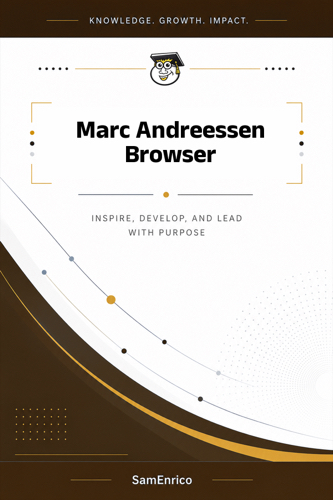
Marc Andreessen Browser eBook
Chronicles the Netscape founder turned VC who back
Chronicles the Netscape founder turned VC who backed Airbnb and Twitter.
Formats
Free sample
Chapter 1: The Cornfield Code...--–- The cornfields of Iowa stretch to the horizon in every direction, flat and endless, like a green ocean frozen in time. In the small town of New Lisbon, population 1,500, the tallest structures are the grain silos and the steeple of the Methodist church. This is not where you expect to find the person who will change how the world communicates. And yet, in 1979, eight-year-old Marc Andreessen sits in his bedroom, reading a science fiction novel by flashlight long after his parents have gone to sleep. The book is about space travel, about other worlds, about the idea that humanity is not trapped by its circumstances.
That idea will never leave him.The Andreessen household is modest. His father, Lowell, works for a seed company, selling corn and soybean genetics to local farmers. His mother, Patricia, works at a clothing retailer. Neither of them knows anything about computers. Neither of them has ever sent an email or written a line of code.
But they have a subscription to National Geographic, and in one issue, young Marc sees a photograph of a mainframe computer—a room-sized machine with blinking lights and spinning tape reels. He asks his father what it is. Lowell tells him it’s a computer, the kind that universities use to solve math problems. Marc asks if he can get one. His father laughs.
That laugh, gentle and unintentionally dismissive, becomes fuel.The Geography of Ambition There is a reason that so many technological revolutions begin in places far from the centers of power. Steve Jobs grew up in Mountain View, but his adoptive father was a machinist who taught him that craftsmanship mattered. Bill Gates grew up in Seattle, but his childhood was defined by the solitude of a library. The pattern is not accidental: when you are far from the action, you develop a hunger that proximity kills. Andreessen’s Iowa childhood gives him two gifts that will define his career.The first is time.
New Lisbon has one stoplight, one diner, and one movie theater that shows films six months after they leave the cities. There is nothing to do except read, think, and imagine. By the time Marc reaches high school, he has read every science fiction novel in the county library. Isaac Asimov, Robert Heinlein, Arthur C. Clarke—he devours them all.
These books teach him something that no school curriculum can: the future is not something that happens to you. It is something you build.The second gift is perspective. The farmers of Iowa are practical people. They understand weather, soil chemistry, and the brutal mathematics of commodity prices. They do not understand computers.
When Marc tells his classmates that he wants to work with machines that can think, they look at him like he has announced a plan to move to Mars. This isolation is clarifying. He learns early that most people will not see what you see. That is not a reason to stop seeing it.In 1983, when Andreessen is twelve years old, his father brings home a Commodore 64. It is a primitive machine by modern standards—64 kilobytes of memory, a cassette tape drive, a screen that displays only uppercase letters by default.
But to Marc, it is a portal. He teaches himself BASIC programming from a book. He writes his first program: a simple calculator that adds two numbers and prints the result. The screen glows green. The numbers appear.
He has commanded a machine to do his bidding. He is hooked.The Accidental Education High school for Marc Andreessen is a study in contradiction. He is a good student but not a great one. He earns As in math and science, Bs in English and history. His teachers describe him as "bright but unfocused." What they mistake for unfocused is actually selective attention: Marc pours his energy into the subjects that matter to him and coasts through the rest.
This is a pattern that will repeat throughout his life. He does not care about being well-rounded. He cares about being deep.The turning point comes in his junior year. A local community college offers a computer programming course, and Marc enrolls. The instructor is a recent graduate from the University of Iowa, a thin man with thick glasses who teaches Pascal and basic data structures.
Marc finishes the semester's curriculum in six weeks. The instructor, impressed and slightly unnerved, hands him a textbook on C programming. Marc finishes that in three weeks.By the time he graduates from high school in 1989, Marc Andreessen has written more than twenty programs, taught himself four programming languages, and built a small reputation among the few Iowans who know what a computer is. His classmates vote him "Most Likely to Succeed" in the yearbook. He looks at the caption and thinks: They have no idea.He applies to several colleges.
His first choice is Stanford, the epicenter of the emerging tech world. But Stanford rejects him. His second choice is MIT. MIT rejects him. He ends up at the University of Illinois at Urbana-Champaign (UIUC), a solid state school with a strong engineering program but no Silicon Valley cachet.
At the time, this feels like failure. Later, he will understand it as fate.The Land Grant University The University of Illinois is a land grant institution, founded in 1867 with a mission that sounds almost quaint today: to teach agriculture, engineering, and military science to the children of farmers. By 1990, when Marc Andreessen arrives on campus, it has grown into a research powerhouse. Its computer science department is not Stanford or MIT, but it is respectable. More importantly, the university is home to the National Center for Supercomputing Applications (NCSA), a federally funded facility that houses some of the most powerful computers in the world.The NCSA is a strange place.
It sits in a beige building on the edge of campus, unremarkable from the outside. Inside, the air hums with the sound of cooling fans. Rows of supercomputers fill the floor—Cray, IBM, Thinking Machines—each one capable of calculations that would have required entire rooms a decade earlier. Graduate students shuffle between terminals, their faces illuminated by the glow of monochrome monitors. Marc Andreessen, now a sophomore, gets a job there as a student assistant.
His title is unglamorous: "computer operator." His job is to change tapes, reboot crashed systems, and answer help desk calls from professors who cannot figure out how to log in.But he has access. At night, after the senior staff go home, Marc has the run of the facility. He teaches himself Unix, the operating system that powers most of the world's servers. He learns the arcane commands of FTP (File Transfer Protocol) and Telnet, the tools that allow computers to talk to each other across long distances. He discovers Usenet, a global discussion system that feels like a primitive version of Reddit.
And he encounters Gopher, a text-based system for organizing and sharing files across the internet.Gopher is the state of the art in 1991. Created at the University of Minnesota, it allows users to navigate a menu of documents, moving from one file to another by typing numbers. It…
This is the end of the free sample. Get the eBook to keep going. Buy now
About this book
Details
- Author
- Putnam Sterling
- Publisher
- SamEnrico
- Language
- English
- Genre
- Non-Fiction, Biography, VC
- Released
- 2026-06-05
- Pages (approx.)
- 125
- Available as
- eBook, Audiobook

Read better in the ZLOADR app
Your eBooks on your phone or tablet. Sign in with your SamEnrico account and start reading.
More by Putnam Sterling
 IKEA Effect In BusinessPutnam Sterling$11.99
 Organization of African UnityPutnam Sterling$11.99
 Central India CampaignPutnam Sterling$11.99
 Emotion Apps GuidePutnam Sterling$11.99
 Anger And Bullying ChildrenPutnam Sterling$11.99
 Trauma Impact Relationship GuidePutnam Sterling$11.99
 The Assertiveness Elevator PitchPutnam Sterling$11.99
 Persuasive Crisis Response PlanPutnam Sterling$11.99
 The Velvet Coup: How a Secret Society Almost Toppled the White HousePutnam Sterling$11.99
 Dancing on the Edge of Scandal: The Radical Moves of Modern Dance's Forgotten RebelPutnam Sterling$11.99
 The 1971 Dollar Bill Heist: When Counterfeiters Almost Broke the U.S.Putnam Sterling$11.99
 The Mineral Guide to PericlasePutnam Sterling$11.99
You may also like
 Arthur Rock FairchildThomson Margit$11.99
 Chris Sacca LowercaseBarrows Yessenia$11.99
 Tom Perkins KleinerFugate Deneen$11.99
 Mitch Kapor LotusHutto Dominique$11.99
 Bill Gurley BenchmarkBaird Josephina$11.99
 Fred Wilson Union SquareLongoria Danita$11.99
 Don Valentine SequoiaCass Kyra$11.99
 David Sacks CraftFreund Tyree$11.99
 Ann Winblad HummerLudwig Norah$11.99
 Reid Hoffman GreylockRichie Albertine$11.99
 Ben Horowitz HardKnoll Xuan$11.99
 Peter Thiel PayPalEspinal Lavelle$11.99