
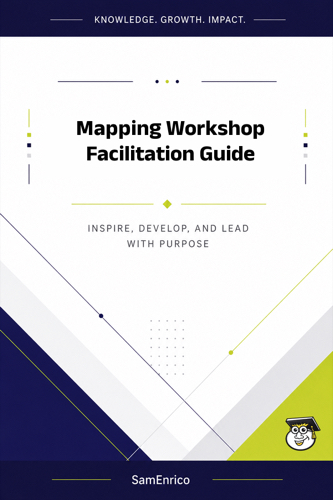
Non-FictionStrategic AtlasWorkshop Facilitation
Mapping Workshop Facilitation Guide eBook
Facilitate cross functional workshops to build con
by Ricks Jude
Facilitate cross functional workshops to build consensus positioning maps with executive teams.
Formats
Free sample
Chapter 1: The Hidden Price--–- The conference room smelled of stale coffee and desperation. Twelve executives sat around a polished mahogany table that cost more than most people's cars. The CEO had flown in from Singapore. The CTO had rearranged a product launch. The Head of Sales had canceled client meetings in three time zones.
The collective hourly rate in that room was $8,400. The workshop was scheduled for six hours. That meant $50,400 of executive attention was about to be lit on fire, and no one in the room knew it yet.The facilitator—let us call her Sarah, though her real name could be yours—stood at the front with a laser pointer and a Power Point deck she had stayed up until 2:00 AM perfecting. Slide one: "Strategic Alignment Workshop: Q3 Priorities." Slide two: a bar chart. Slide three: another bar chart.
By slide four, the CFO was checking email under the table. By slide six, the Head of Product was drawing a spaceship on his notepad. By slide eight, the CEO interrupted."Can we skip to the part where we actually decide something?"Sarah froze. She had prepared content, not a process. She had slides, not a map.
She had a title, not a consensus. The next three hours were a slow-motion disaster. The CTO and Head of Sales argued about customer priorities. The CFO interrupted to ask about budget implications of every suggestion. The CEO finally slammed his hand on the table and said, "I am not leaving this room until we have a decision," which is the executive equivalent of announcing you have no idea how to facilitate a decision.
They left at 7:00 PM with a vague agreement to "align more closely" and a shared headache. The $50,400 bought nothing except proof that a room full of brilliant people can produce collective stupidity when there is no map.Sarah was never invited back.The Spaghetti Bowl Problem Here is what happened in that room. Sales wanted velocity—close deals faster, reduce friction, say yes to customers. Product wanted perfection—build the right thing, maintain quality, say no to distractions. Finance wanted cost control—protect margins, minimize risk, say maybe to everything.
Marketing wanted brand consistency—control the message, protect the story, say carefully to everyone.None of these goals are wrong. All of them are legitimate. Together, they form what this book calls the Spaghetti Bowl of Conflicting Goals—a tangled mess of competing priorities where every department pulls in a different direction, not because anyone is malicious, but because no one has a shared map of where the organization is actually going.The Spaghetti Bowl has a cost. Let us quantify it. A 2023 study by the Project Management Institute found that misaligned teams waste 12 percent of their total effort on rework, duplicated work, or work that is simply abandoned.
For a mid-sized company with a $50 million operating budget, that is $6 million per year evaporated. For a Fortune 500 company, it is tens of millions. These are not hypothetical numbers. These are salaries, product launches, customer acquisitions, and competitive advantages that disappear into the gap between what one department thinks the strategy is and what another department is actually doing.The Spaghetti Bowl manifests in predictable symptoms. Teams that cannot agree on what "done" looks like.
Executives who leave meetings with different interpretations of the same conversation. Projects that launch with fanfare and fail silently because no one aligned on success metrics. Strategy documents that sit on hard drives, unread and unloved. And workshops—so many workshops—that produce exactly nothing except fatigue and cynicism.This book exists because the Spaghetti Bowl has a cure. That cure is called mapping.What Mapping Actually Means The word "map" is overloaded.
Geographic maps show you where roads go. Data maps show you where numbers cluster. The kind of map this book is about is something different: a strategic positioning map that answers one specific question about your organization's present and desired future.A strategic positioning map is a visual artifact that makes visible the invisible assumptions, priorities, and trade-offs that executives carry in their heads. It is a tool for consensus-building because it externalizes internal mental models. When the Head of Sales believes the company competes on price and the Head of Product believes the company competes on features, those two executives can sit across from each other for months without ever surfacing that fundamental disagreement.
Put a 2x2 matrix on the wall with "Price" on one axis and "Features" on the other, ask them to place the company, and suddenly the disagreement is visible, tangible, and resolvable.That is the magic of mapping. It takes abstract conflict and makes it concrete. It turns circular debate into a shared puzzle. It gives executives something to point at, disagree about, move around, and finally agree upon—not because someone won the argument, but because the map revealed a path forward that no one had seen when the logic was trapped inside individual skulls.Mapping is not brainstorming. Brainstorming generates ideas.
Mapping organizes them into relationships. Mapping is not strategic planning. Strategic planning sets goals. Mapping reveals the trade-offs required to achieve them. Mapping is not facilitation in the generic sense.
Generic facilitation keeps the conversation moving. Mapping builds a visual artifact that persists after the conversation ends.Here is the distinction that separates expert facilitators from amateurs: a standard meeting produces notes. A facilitated workshop produces a map. Notes get forgotten. Maps get used.The Cost of Not Mapping Before we go further, let us confront the uncomfortable truth that most facilitators avoid.
The cost of not mapping is not abstract. It is not theoretical. It is a line item on a profit and loss statement, and it is likely larger than you think.Consider the following scenario, drawn from a real engagement that this author observed. A mid-sized technology company spent eight months developing a new product feature. The Product team built it.
The Engineering team deployed it. The Marketing team announced it. Then the Sales team refused to sell it because it conflicted with a pricing model they had never been consulted on. Eight months of work. Six figures of development cost.
Zero revenue.Where was the map? If the company had built a simple Value Map—a canvas showing what the feature delivered, who it delivered it to, and at what cost—the pricing conflict would have surfaced in a two-hour workshop, not eight months later. The absence of a map did not cause the failure directly. The absence of a map caused the invisibility of the failure until it was too late to fix.Here are five specific costs of not mapping, each drawn from real organizational autopsies:Cost One: Wasted Executive Attention. A one-day workshop with twelve senior leaders costs between $30,000 and $120,000 in fully loaded personnel costs, depending on seniority.
Without a map, the probability of a concrete, actionable output drops below 30 percent. That means 70 percent of executive workshop budgets are being incinerated. Multiply that across the thousands of offsites held every quarter, and the waste is staggering.Cost Two: Duplicated Effort. When teams are not aligned on a shared map, they build redundant capabilities, pursue…
This is the end of the free sample. Get the eBook to keep going. Buy now
About this book
Details
- Author
- Ricks Jude
- Publisher
- SamEnrico
- Language
- English
- Genre
- Non-Fiction, Strategic Atlas, Workshop Facilitation
- Released
- 2026-06-09
- Pages (approx.)
- 151
- Available as
- eBook, Audiobook

Read better in the ZLOADR app
Your eBooks on your phone or tablet. Sign in with your SamEnrico account and start reading.
More by Ricks Jude
 Time Freedom Through DelegationRicks Jude$11.99
 Executive Business Plan SummaryRicks Jude$11.99
 Testosterone and Heart Health GuideRicks Jude$11.99
 Deep Work for Fitness TrainersRicks Jude$11.99
 The Phantom of Monte Carlo: Inside the $20 Million Bugatti HeistRicks Jude$11.99
 The Quantum Split: What If the 2020 US Election Had a Do-Over?Ricks Jude$11.99
 Retail Credit Card RetentionRicks Jude$12.99
 Letter Of Credit GuideRicks Jude$12.99
 Understanding Chromosome 10, Trisomy 10pter P13Ricks Jude$17.99
 Social Media Marketing ManagerRicks Jude$11.99
 How to Start a Hobby in TattingRicks Jude$11.99
You may also like
 Hong Kong Handover 1997Dunn Johnnie$11.99
 Zumba For Postnatal Recovery CourseNeal Christian$11.99
 Zumba for BeginnersLadner Nikia$11.99
 YouTube Comment Mining GuideHumes Pandora$12.99
 Worry Box MeditationCarlin Rudy$11.99
 Workplace Stress MeditationNguyen Lynn$11.99
 Workplace Stress and Sleep RepairHawley Ivory$11.99
 Workplace Perfectionism CureDelaney Jeffry$11.99
 Workplace Injustice Anger GuideWallen Isabelle$11.99
 Work Addiction and Burnout LinkGreenwood Ester$11.99
 Women in Yoga and WellnessBeattie Galina$11.99
 Women in Stand Up ComedyChun Evangeline$11.99