
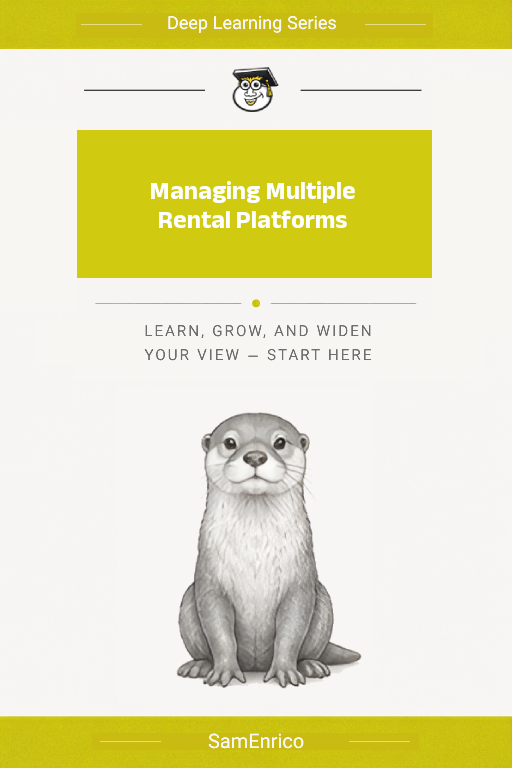
Non-FictionPlatform ManagementInventory Sync
Managing Multiple Rental Platforms eBook
Sync inventory across ShareGrid, KitSplit, and Fat
Sync inventory across ShareGrid, KitSplit, and Fat Llama while preventing double bookings using calendar integration and immediate removal upon rental.
Formats
Free sample
Chapter 1: The Three-Tab Nightmare...--It was 6:47 PM on a Friday when I watched a freelance cinematographer lose $10,000 in under sixty seconds.His name was Alex (not his real name, but he gave me permission to tell the story this way). He had been building his camera rental business for three years. He owned about $85,000 worth of gear — a RED Komodo, a set of Sigma primes, a DJI RS3 Pro gimbal, and enough batteries and cases to fill the back of his Honda Civic. He listed everything on Share Grid, Kit Split, and Fat Llama. Three platforms.
Three tabs. One exhausted human.That Friday, Alex had a regular client — a production company he had worked with for over a year. They needed his RED Komodo for a weekend commercial shoot starting Saturday morning. The client had booked through Share Grid at 6:15 PM. Alex saw the notification on his phone.
He marked the camera as "unavailable" on his mental checklist. He would update the other platforms later.But "later" never came.At 6:47 PM — just thirty-two minutes after the Share Grid booking — a different renter clicked "Instant Book" on Fat Llama for the exact same RED Komodo. Fat Llama's system did not know about the Share Grid booking because Alex had not manually blocked the dates yet. The Fat Llama renter's credit card was authorized. The confirmation email was sent.
The gear was double-booked.Alex discovered the conflict at 9 PM when he finally sat down to update his calendars. He stared at his screen. Two bookings. One camera. Saturday morning.He called the Fat Llama renter first.
No answer. He left a voicemail. He called the production company second. They were already on their way to his pickup location. He called the Fat Llama renter again.
Voicemail. He called Share Grid support. Closed. He called Kit Split support. Closed.
He called Fat Llama support. Closed.At 11 PM, Alex made the only decision he could. He would rent an identical RED Komodo from a competitor — at a premium — and deliver it to the production company. The competitor charged him 450foraweekendrental.Alexwaschargingtheproductioncompany450 for a weekend rental. Alex was charging the production company 450foraweekendrental.Alexwaschargingtheproductioncompany350.
He lost $100 on the rental itself, plus the cost of driving across Los Angeles to pick up the replacement camera.The Fat Llama renter finally responded at 7 AM Saturday morning. He was angry. He had driven to Alex's pickup location and found no one there. He left a one-star review on Fat Llama. He called Fat Llama support to complain.
Fat Llama put Alex's account under review for "failure to fulfill a confirmed booking."Alex lost the production company as a client. They never booked with him again. He lost three weekends of future bookings while Fat Llama investigated his account. He lost about $10,000 in total revenue from that single double-booking.And all because of thirty-two minutes.The Refresh Cycle Alex's story is not unique. I have heard versions of it from dozens of renters.
A filmmaker in Chicago who double-booked a Sony FX6 because he forgot to close one browser tab. A podcast equipment renter in Austin who lost a $2,000 booking because Kit Split's calendar didn't sync with his Google Calendar fast enough. A drone operator in Denver who had to drive three hours to source a replacement Mavic 3 after a double-booking on Share Grid and Fat Llama.These stories all share a common enemy. I call it The Refresh Cycle.The Refresh Cycle is the compulsive, exhausting pattern of manually checking multiple platforms for new bookings, then manually blocking those dates on other platforms, then checking again, then blocking again, every hour of every day.Here is what the Refresh Cycle looks like in practice:7:00 AM — Wake up. Check Share Grid notifications on phone.
No new bookings.8:30 AM — Arrive at work. Open Share Grid tab, Kit Split tab, Fat Llama tab. Refresh all three. A booking came in on Kit Split at 7:45 AM. Block those dates on Share Grid and Fat Llama.10:00 AM — Meeting ends.
Refresh all three tabs. A booking came in on Fat Llama at 9:30 AM. Block those dates on Share Grid and Kit Split.12:00 PM — Lunch. Refresh all three tabs. No new bookings.
But wait — did you block the Kit Split booking from this morning correctly? Check. Yes. Good.2:00 PM — Refresh. A booking came in on Share Grid at 1:15 PM.
Block those dates on Kit Split and Fat Llama.4:00 PM — Refresh. No new bookings.6:00 PM — Leave work. Refresh one more time before closing your laptop.9:00 PM — Check your phone. A booking came in on Fat Llama at 8:30 PM. Open your laptop.
Block those dates on Share Grid and Kit Split.11:00 PM — One last check before bed. Clear.Now multiply this by seven days a week. By fifty-two weeks a year. By the number of items you rent. By the number of platforms you use.The Refresh Cycle is not just exhausting.
It is financially dangerous. Every minute between a booking on Platform A and a block on Platform B is a minute of vulnerability. During that window, a second renter can book the exact same item on a different platform.That window has a name. I call it The Double-Booking Horizon.The Double-Booking Horizon The Double-Booking Horizon is the dangerous gap between when a customer clicks "Book" on Platform A and when that rental appears as "Blocked" on Platform B.For a manual operator — someone who relies on the Refresh Cycle — the Double-Booking Horizon is measured in hours. You might check your platforms at 10 AM.
A booking comes in at 10:30 AM. You don't see it until 12 PM. That is ninety minutes of vulnerability.For a renter using basic calendar sync (i Cal — more on this in Chapter 2), the Double-Booking Horizon is measured in minutes. Most i Cal refreshes take 20 to 40 minutes. A booking comes in at 1:00 PM.
Platform B won't see the block until 1:20 PM or 1:40 PM. That is twenty to forty minutes of vulnerability.For a renter using real-time API connections (the gold standard, covered in Chapter 4), the Double-Booking Horizon is measured in milliseconds. A booking comes in. The system pushes a block to all other platforms instantly. The vulnerable window is effectively zero.Here is the problem: most renters do not know what their Double-Booking Horizon is.
They have never calculated it. They assume that because they have i Cal set up, they are safe. They are not safe. They are just less unsafe than they were before.Let me give you a concrete example of how the Double-Booking Horizon creates financial risk.Imagine you rent a high-end cinema camera for $500 per day. It is your most popular item.
You have it listed on Share Grid, Kit Split, and Fat Llama. You have i Cal set up between all three platforms. Your Double-Booking Horizon is 30 minutes.On a busy Friday, you receive a booking for that camera on Share Grid at 1:00 PM. The system will block the camera on Kit Split and Fat Llama at approximately 1:30 PM.Between 1:00 PM and 1:30 PM, a second renter sees the camera available on Fat Llama and clicks "Instant Book." Their booking is confirmed at 1:15 PM.Now you have a double-booking.Your options are limited. You can…
This is the end of the free sample. Get the eBook to keep going. Buy now
About this book
Details
- Author
- Mccollum Katlyn
- Publisher
- SamEnrico
- Language
- English
- Genre
- Non-Fiction, Platform Management, Inventory Sync
- Released
- 2026-06-01
- Pages (approx.)
- 120
- Available as
- eBook, Audiobook

Read better in the ZLOADR app
Your eBooks on your phone or tablet. Sign in with your SamEnrico account and start reading.
More by Mccollum Katlyn
 Highway Anger De escalationMccollum Katlyn$11.99
 Postpartum Constipation GuideMccollum Katlyn$11.99
 Teens Anticipatory Grief GuideMccollum Katlyn$11.99
 Customer Persona SnapshotMccollum Katlyn$11.99
 Breast Ultrasound ExplainedMccollum Katlyn$11.99
 Boundary Setting for MilitaryMccollum Katlyn$11.99
 OCD and Intrusive ThoughtsMccollum Katlyn$11.99
 Constraints for SalespeopleMccollum Katlyn$11.99
 The Silk Road Ambush: The Han Dynasty's Clash of EmpiresMccollum Katlyn$11.99
 The Dragonmaster’s Gambit: A Spy Among the ScaledMccollum Katlyn$11.99
 How to Produce Packaging TraysMccollum Katlyn$11.99
 How to Produce Contact Lens Care KitsMccollum Katlyn$11.99
You may also like
 Hong Kong Handover 1997Dunn Johnnie$11.99
 Zumba For Postnatal Recovery CourseNeal Christian$11.99
 Zumba for BeginnersLadner Nikia$11.99
 YouTube Comment Mining GuideHumes Pandora$12.99
 Worry Box MeditationCarlin Rudy$11.99
 Workplace Stress MeditationNguyen Lynn$11.99
 Workplace Stress and Sleep RepairHawley Ivory$11.99
 Workplace Perfectionism CureDelaney Jeffry$11.99
 Workplace Injustice Anger GuideWallen Isabelle$11.99
 Work Addiction and Burnout LinkGreenwood Ester$11.99
 Women in Yoga and WellnessBeattie Galina$11.99
 Women in Stand Up ComedyChun Evangeline$11.99