
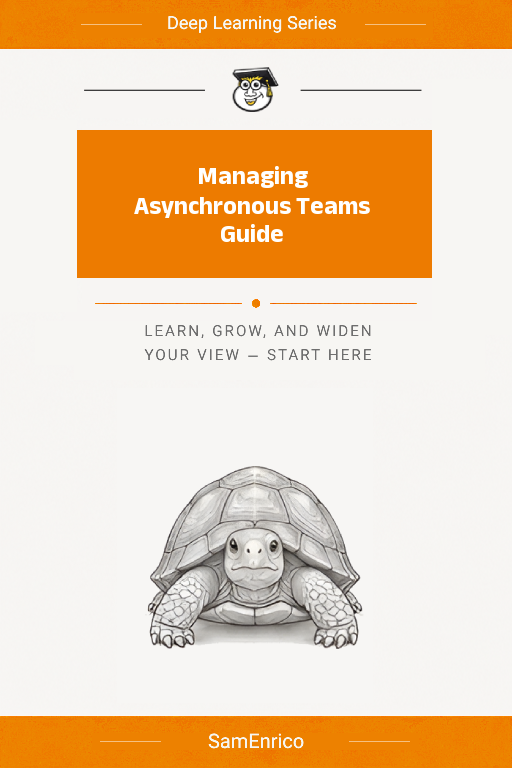
Non-FictionBusiness BriefAsync Work
Managing Asynchronous Teams Guide eBook
Use Loom, Slack, and project management tools to c
by Adams Traci
Use Loom, Slack, and project management tools to collaborate effectively without real-time meetings.
Formats
Free sample
Chapter 1: The Meeting Hangover--–- The first time I realized meetings were the problem, I was sitting in my eighth hour of back-to-back Zoom calls, staring at my own face in a gallery of eighteen other exhausted humans, and I could not remember a single decision we had made that day. My calendar showed ten hours of "collaboration." My to-do list showed nothing completed. My team was burnt out, my inbox had exploded, and somewhere in the chaos, I had lost an entire day to what I now call the meeting hangover.This chapter is the diagnosis. Before we can build an asynchronous team that thrives with Loom, Slack, and project management tools, we must first understand the disease we are curing. The meeting hangover is not merely the exhaustion of too many calls.
It is the systemic destruction of deep work, the illusion of productivity theater, and the hidden tax that modern knowledge work has normalized as inevitable. It is not inevitable. And naming it is the first step toward eliminating it.The Anatomy of the Meeting Hangover The meeting hangover has three distinct symptoms, each more damaging than the last. Understanding them requires us to look honestly at how most teams operate today.Symptom One: The Fragmented Day Picture a typical knowledge worker's calendar. A thirty-minute standup at 9:00 AM.
A forty-five-minute project sync at 10:30 AM. An hour-long design review at 1:00 PM. A thirty-minute client call at 2:30 PM. A fifteen-minute "quick check-in" at 4:00 PM that always runs to forty-five minutes. Between these calls are gaps of twenty, thirty, or forty-five minutes—too short to start anything meaningful, too long to do nothing.What actually happens in those gaps?
The worker checks email. Skims Slack. Opens a document, reads two paragraphs, then closes it because the next call starts in twelve minutes. They never enter deep work. They never achieve flow.
They spend their day in a state of perpetual shallow readiness, always preparing for the next interruption, never fully present in any single task.This is not productivity. This is fragmentation masquerading as busyness.Symptom Two: The Context Switching Tax Every time you switch from one task to another, your brain must perform a complex neurological process called "goal shifting" (disengaging from the previous task) and "rule activation" (loading the rules and parameters of the new task). This is not instantaneous. Research from the University of California, Irvine, found that after an interruption, it takes an average of twenty-three minutes and fifteen seconds to return to the original task with the same level of focus.Now apply this to a day with six meetings. Each meeting interrupts whatever you were doing before it.
Each meeting requires a ramp-up (the first five to ten minutes of confusion while you remember what the meeting is about) and a ramp-down (the twenty-three minutes after the meeting while you try to find where you left off). A single thirty-minute meeting therefore consumes not thirty minutes but closer to sixty minutes of productive time when you account for the mental switching costs on both ends.Six meetings. Six hours of calendar time. Twelve hours of actual cognitive cost. Do the math on your own week.Symptom Three: Productivity Theater Perhaps the most insidious symptom is what I call productivity theater—the performative busyness that replaces actual output.
In meeting-heavy cultures, appearing busy becomes more important than being productive. Responding instantly to Slack messages. Attending every call. Back-to-back calendaring as a status symbol.I have watched teams celebrate a week of "great collaboration" when all they did was meet. No code shipped.
No designs finalized. No decisions documented. Just hours of talking, nodding, and scheduling follow-ups. The meetings themselves become the work, and the actual work becomes what you do late at night or on weekends when no one is watching.This is not collaboration. This is theater.
And the audience is exhausted.The Data That Cannot Be Ignored Let me share three research findings that fundamentally changed how I think about meetings.Finding One: The 11-Minute Cycle Gloria Mark, a professor at the University of California, Irvine, has spent decades studying attention in the workplace. Her research shows that the average knowledge worker switches tasks every eleven minutes. Think about that. Every eleven minutes, without any external interruption, the human brain naturally seeks novelty. Now add meetings, Slack notifications, and email pings to that natural tendency, and you have a recipe for constant, debilitating fragmentation.When workers are left uninterrupted, they can sustain focus for ninety to one hundred twenty minutes—the natural ultradian rhythm of human attention.
But in a meeting-heavy environment, that deep focus becomes impossible. The calendar itself becomes an interruption machine.Finding Two: The 40 Percent Burnout Reduction In a study of over five hundred companies that transitioned from sync-heavy to async-first operations, researchers found that teams reported forty percent lower burnout rates after the transition. Forty percent. That is not a marginal improvement. That is a transformation.The primary driver?
Control over time. In async-first teams, workers decide when they engage with communication. They batch process messages. They schedule deep work blocks. They are not constantly reacting to the whims of a calendar invite.
This sense of agency—the feeling that you control your time rather than your time controlling you—is one of the strongest predictors of job satisfaction and mental health.Finding Three: The Three-to-Five Hour Deep Work Gap When researchers compared sync-heavy teams (six or more hours of meetings per day) to async-first teams (two or fewer hours of meetings per day), they found that async teams achieved three to five hours of uninterrupted deep work per day. Sync-heavy teams achieved less than one hour.Three to five hours of deep work is enough to complete meaningful, complex tasks. Writing a proposal. Architecting a feature. Analyzing a dataset.
Designing a user flow. Less than one hour of deep work is enough to reply to emails and attend meetings. That is the difference between progress and stagnation.Why We Tolerate the Hangover If meetings are so destructive, why do we keep having them? The answer is not laziness or stupidity. It is a combination of cognitive biases and structural inertia that every team must understand before they can escape.The Mere Urgency Effect Humans are wired to prioritize tasks that feel urgent over tasks that are important.
A meeting invitation with a looming start time feels urgent. A deep work block with no deadline feels diffuse and optional. We choose the meeting not because it is more valuable but because it is louder.This bias is so powerful that even when people know it exists, they still fall victim to it. The ding of a calendar notification triggers a dopamine response. The act of joining a call feels like action.
The meeting becomes a substitute for progress.The Fear of Missing Out No one wants to be the person who skipped the meeting where the critical decision was made. Even though critical decisions are rarely made in meetings (they are made in the hallway conversations, the Slack threads, and the document comments that happen around the meeting), the fear persists.This fear is amplified by the meeting culture itself. When…
This is the end of the free sample. Get the eBook to keep going. Buy now
About this book
Details
- Author
- Adams Traci
- Publisher
- SamEnrico
- Language
- English
- Genre
- Non-Fiction, Business Brief, Async Work
- Released
- 2026-05-29
- Pages (approx.)
- 121
- Available as
- eBook, Audiobook

Read better in the ZLOADR app
Your eBooks on your phone or tablet. Sign in with your SamEnrico account and start reading.
More by Adams Traci
 Alcohol Recovery Gratitude PracticeAdams Traci$11.99
 The Inner Child Guided JournalAdams Traci$11.99
 SEAL Sniper TrainingAdams Traci$11.99
 Phenibut Withdrawal GuideAdams Traci$11.99
 The Grand Jeté: Pioneers of Black Ballet and Choreographic BrillianceAdams Traci$11.99
 How to Produce Cleaner and DegreaserAdams Traci$11.99
 Ultimate Handbook Guide to Zhanjiang : (China) Travel GuideAdams Traci$11.99
 Stolzite MiningAdams Traci$11.99
You may also like
 Hong Kong Handover 1997Dunn Johnnie$11.99
 Zumba For Postnatal Recovery CourseNeal Christian$11.99
 Zumba for BeginnersLadner Nikia$11.99
 YouTube Comment Mining GuideHumes Pandora$12.99
 Worry Box MeditationCarlin Rudy$11.99
 Workplace Stress MeditationNguyen Lynn$11.99
 Workplace Stress and Sleep RepairHawley Ivory$11.99
 Workplace Perfectionism CureDelaney Jeffry$11.99
 Workplace Injustice Anger GuideWallen Isabelle$11.99
 Work Addiction and Burnout LinkGreenwood Ester$11.99
 Women in Yoga and WellnessBeattie Galina$11.99
 Women in Stand Up ComedyChun Evangeline$11.99