
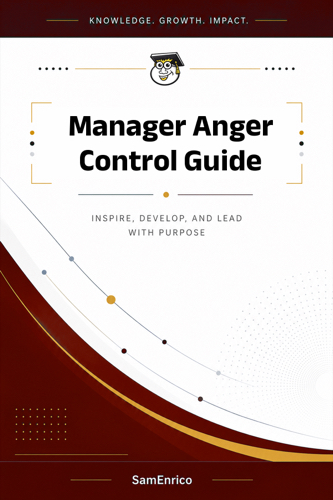
Manager Anger Control Guide eBook
Lead without intimidation using this practical exe
by Good Collene
Lead without intimidation using this practical executive emotional regulation handbook.
Formats
Free sample
Chapter 1: The Stoic Lie--Every Monday morning at 8:47 AM, David closed his office door, leaned his forehead against the cool glass of the window, and asked himself the same question: How many more years of this can I survive?David was a forty-three-year-old regional vice president at a mid-sized logistics company. He had been promoted four times in twelve years because he delivered results. He was known as "the guy who could turn around any failing team." What no one knew—not his wife, not his boss, not the HR director who had just given him a glowing review—was that David spent his Sundays dreading Mondays and his Mondays replaying the damage from the previous week.Last Tuesday, his direct report Maria had missed a client deadline. Not a big one, in retrospect. A quarterly report that arrived at 5:02 PM instead of 5:00 PM.
The client didn't even notice. But David had noticed. He had called Maria into his office, closed the door, and in a voice he barely recognized as his own, asked her: "Do you have any idea how this makes us look? Do you have any idea what I have to do to clean up after you? I am tired of being the only person here who gives a damn."Maria didn't cry.
That was worse. She went silent, nodded, and for the rest of the week, she didn't speak to him unless spoken to. She completed her work perfectly—too perfectly, mechanically. The warmth was gone. The spontaneous ideas she used to bring to team meetings had vanished.
David had won the argument and lost the person.That night, driving home, he had screamed in his car. Not at anyone. Just a raw, guttural noise of self-loathing. I am not this person, he thought. I am not my father.But his father had also been a manager.
His father had also yelled. His father had also watched talented people leave and told himself it was because "they couldn't handle the pressure."David pulled into his driveway, sat in the dark for ten minutes, and then went inside to kiss his children goodnight. He told his wife he was fine. She knew he wasn't, but she had stopped asking.This book is for David. And for the thousands of managers like him who have been told that the only two options are to explode or to suppress—and who are discovering, often too late, that neither works.The False Binary That Is Destroying Leaders For the past forty years, leadership literature has offered managers a poisoned choice.
On one hand, the "tough love" school tells you that anger is a tool—that yelling shows passion, that intimidation commands respect, that fear drives performance. On the other hand, the "emotional intelligence" school tells you that any display of anger is a failure—that the ideal leader is unflappable, endlessly patient, and serenely above frustration.Both schools are wrong. And both are quietly destroying careers, teams, and families.Let us examine the evidence for each claim, because once you see how both approaches fail, the path forward becomes clear.The Case Against Explosion The "anger as a tool" approach has a certain seductive logic. After all, some of the most celebrated business figures in modern history were known for their tempers. Steve Jobs threw tantrums.
Jack Welch was called "Neutron Jack" for a reason. Gordon Ramsay built an empire on screaming. Surely, if anger were purely destructive, these people would have failed.But here is what the highlight reels do not show you. According to a longitudinal study of 14,000 managers conducted by the Center for Creative Leadership, the single best predictor of executive derailment—of being fired, demoted, or sidelined—was not lack of technical skill, not poor strategic thinking, but volatile interpersonal behavior. Managers who were described by subordinates as "explosive," "intimidating," or "unpredictable" had a 73% higher likelihood of being terminated within five years compared to their calmer peers, even when their objective performance metrics were identical.Why?
Because anger has hidden costs that compound over time.First, there is the cost of silent attrition. When a manager explodes at a subordinate, that subordinate rarely quits the next day. Instead, they quit psychologically. They stop volunteering ideas. They stop taking risks.
They do exactly what is asked and nothing more. Research by Christine Porath at Georgetown University found that employees who experience incivility from their boss reduce their discretionary effort by 66% within two weeks. They do not leave. They stay and disengage. And a team of disengaged employees produces worse results than a team of half as many engaged employees.Second, there is the cost of information starvation.
When managers respond to bad news with anger, they train their teams to hide bad news. A study published in the Journal of Applied Psychology found that managers with high anger reactivity received 58% less negative information from their direct reports than managers with low reactivity. This means they make decisions based on sanitized, filtered, incomplete data. They think things are going well until the crisis is too large to hide.Third, there is the cost of reputational gravity. One explosive outburst can undo years of relationship building.
Neuroimaging studies show that when a person experiences public humiliation, the same brain regions activate as during physical pain. And like physical pain, the memory of humiliation is slow to fade. Subordinates may forgive a single outburst, but patterns of explosion are remembered and shared. The manager who yells becomes known as "the angry one"—a reputation that follows them into meetings they do not attend and conversations they never hear.In David's case, he had not actually fired anyone in five years. But six talented people had transferred out of his department.
When HR asked why, the answers were polite and generic: "new opportunity," "career growth," "better alignment." No one said, "Your VP screamed at me." No one needed to. The pattern was clear in the data.The Case Against Suppression If explosion is so clearly destructive, then surely the answer is to suppress anger entirely. To smile through frustration. To tell yourself, I am a professional. I do not get angry.This approach also fails—but in ways that are less visible and therefore more insidious.Consider the research of James Gross at Stanford University, who has spent three decades studying emotional suppression.
In one landmark study, participants were asked to watch an emotionally distressing film while either expressing their emotions naturally or suppressing all visible signs of emotion. The suppressors showed normal emotional arousal on physiological measures (heart rate, skin conductance) but dramatically impaired memory for the film's details. Their brains were so busy hiding the emotion that they had no bandwidth left for encoding information.Now translate this to the boardroom. The suppressing manager walks into a tense meeting. A subordinate challenges their decision.
The manager feels a surge of anger but forces themselves to remain calm. While they are doing this emotional labor, they are simultaneously supposed to be listening, analyzing, and responding. Gross's research suggests that under these conditions, cognitive performance drops by the equivalent of losing four IQ points—the same as pulling an all-nighter.But the damage does…
This is the end of the free sample. Get the eBook to keep going. Buy now
About this book
Details
- Author
- Good Collene
- Publisher
- SamEnrico
- Language
- English
- Genre
- Non-Fiction, Self-Help, Leadership
- Released
- 2026-06-06
- Pages (approx.)
- 148
- Available as
- eBook, Audiobook

Read better in the ZLOADR app
Your eBooks on your phone or tablet. Sign in with your SamEnrico account and start reading.
More by Good Collene
 TM and EEG Coherence GuideGood Collene$11.99
 Creative Deprivation MethodGood Collene$11.99
 The Postpartum Bleeding GuideGood Collene$11.99
 The Assertiveness for Nurses GuideGood Collene$11.99
 The Iron Navigators: How Portugal Unlocked the WorldGood Collene$11.99
 Understanding Phacomatosis PigmentovascularisGood Collene$17.99
 How to Become a Commutator AssemblerGood Collene$11.99
 CRM Software Battle MapGood Collene$12.99
 One Page Plan for ConsultantsGood Collene$12.99
 Taylor Swift: The Eras Tour Record BreakerGood Collene$11.99
You may also like
 Managerial Stress Reduction WorkbookHolden Heike$11.99
 Emotional Regulation For LeadersWolf Chantel$11.99
 CEO Flow StatesFinnegan Jonah$11.99
 Validation for LeadersLackey Debi$11.99
 The Calm Leader GuideStrand Alverta$11.99
 The Assertiveness for New ManagersThomson Margit$11.99
 Pomodoro for Managers GuideLoftin Page$11.99
 Nonverbal Cues In Leadership CourseTRUE Betsey$11.99
 Navigating Workplace ConflictNoyes Sherly$11.99
 Legacy for LeadersSadler Rusty$11.99
 Improv for LeadershipSkaggs Lura$11.99
 Fear Of Failure In LeadershipHendrickson Lavern$11.99