
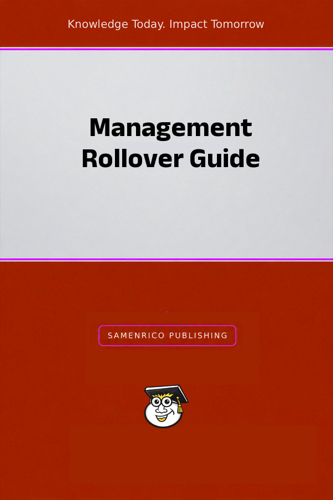
Non-FictionCapital & Valuation Register
Management Rollover Guide eBook
Structures executive equity stakes with vesting sc
Structures executive equity stakes with vesting schedules and performance hurdles.
Formats
Free sample
Chapter 1: The Ten Million Dollar Participation Trophy--–- The conference room on the 47th floor overlooked a grey February skyline, but the mood inside was celebratory. The compensation committee of a Fortune 500 industrial conglomerate had just concluded its annual equity grant meeting. The agenda item that drew the most discussion—a $10 million restricted stock unit award for the Chief Executive Officer—passed unanimously after eleven minutes of polite debate. The lead independent director, a retired bank CEO, offered the closing observation that would later appear in the proxy statement: "This grant ensures our CEO remains focused on long-term value creation."Eight hundred and thirty-one days later, that same CEO retired. He walked away with $11.2 million from the grant—the original $10 million in shares had drifted up to $11.2 million, a 12% total return.
Over the same period, the S&P 500 returned 31%, and the company's closest peer group returned an average of 28%. The CEO had underperformed the market by 19 percentage points and underperformed his peers by 16 percentage points. He received a full payout anyway. The board called it "retention." The CEO called it "alignment." A dispassionate observer might call it something else: a ten million dollar participation trophy.This chapter exposes the uncomfortable truth at the heart of modern executive compensation. Despite decades of regulatory reform, shareholder activism, and academic research, the vast majority of equity plans reward one thing above all others: the mere passage of time.
The chapter opens with the case study above not as an outlier but as the norm. It then builds the analytical framework that explains why standard equity plans fail, introduces the concept of the "Lottery Ticket Mentality" that drives executive behavior in the wrong direction, and lays the foundation for the Rollover Principle that will guide the rest of this book.The central argument is simple but radical: granting equity is not the same as creating alignment. In fact, poorly structured equity can create perverse incentives that are worse than no equity at all. The chapter concludes by defining the Rollover Principle—the idea that a vested stake must be converted into a new stake with higher hurdles to continue earning—and previews how the remaining chapters will transform this principle into actionable plan design.The Participation Trophy Economy of Executive Pay Let us begin with a uncomfortable observation. In youth sports, participation trophies are widely ridiculed.
They reward presence rather than performance, effort rather than outcome, showing up rather than winning. And yet, in the boardrooms of America's largest companies, the dominant form of equity compensation—time-vesting restricted stock units (RSUs)—is precisely a participation trophy for adults who earn eight-figure salaries.A time-vesting RSU works like this: the company grants an executive a certain number of shares. Those shares are restricted—the executive does not actually own them yet. Over a period of time, typically three to four years, the restrictions lapse, or "vest," in installments. On each vesting date, the executive receives actual shares, which they can sell immediately for cash.
The only condition to receive the shares is continued employment. Not performance. Not growth. Not shareholder return. Just a pulse and a keycard.Consider the mathematics.
A CEO receiving $10 million in RSUs granted at $50 per share receives 200,000 restricted shares. If the stock price goes to $100, those shares are worth $20 million at vesting. If the stock price drops to $30, they are worth $6 million. The executive has downside exposure—that much is true. But critically, the executive has downside exposure only to the extent that they hold the shares after vesting.
And the data shows that most executives sell their vested shares immediately or within days. A 2023 study by researchers at Harvard Law School and the University of Chicago examined trading patterns of executives at S&P 500 companies and found that the median executive sells 87% of vested RSUs within thirty days of vesting.This creates a bizarre incentive structure. The executive cares about the stock price on the specific days that tranches vest. For all other days—the 361 days between vesting events in a typical annual grant cycle—the executive's wealth is not directly tied to the stock price because they have already sold or hedged their position. The executive has a series of narrow windows of alignment, not a sustained commitment to long-term value creation.The case study at the opening of this chapter illustrates the pathology perfectly.
The CEO's RSUs vested in three annual tranches. On each vesting date, the CEO sold 85% of the shares within two weeks. The CEO's actual economic exposure to the company's stock at any given time was less than $2 million—a trivial amount relative to his $50 million net worth. Yet the proxy statement reported that the CEO held "significant equity stakes" and was "aligned with shareholders." The alignment was an illusion, sustained by the fact that unvested RSUs appeared in the ownership table but could not be sold, lost if the executive left, and therefore did not represent real economic ownership.This is the participation trophy economy of executive pay. The trophy is the grant.
The participation is simply staying employed. The shareholders provide the funding. The executives provide their presence. And everyone in the boardroom convinces themselves that this constitutes good governance.Data: The 60% Disconnect The anecdotal evidence of flawed equity plans is troubling. The systematic evidence is damning.
Drawing on the seminal work of Lucian Bebchuk and Jesse Fried in Pay Without Performance (2004) and subsequent updates through 2024, this section presents the empirical case against time-vesting equity.Bebchuk and Fried examined the relationship between CEO pay and Total Shareholder Return (TSR) at 1,500 public companies over a fifteen-year period. Their finding, replicated by multiple subsequent studies, is that over 60% of CEO pay is disconnected from TSR. More specifically, changes in CEO compensation from year to year explain less than 40% of the variation in shareholder returns. The majority of what determines CEO pay is not performance but peer benchmarking, tenure, and the simple mechanical operation of time-based vesting schedules.A more granular analysis reveals the mechanism driving this disconnect. Companies that adopt time-vesting RSUs as their primary equity vehicle show no statistically significant difference in subsequent TSR compared to companies that do not.
In other words, paying executives with time-vesting equity produces no measurable benefit to shareholders relative to paying them in cash. The equity is economically neutral—it transfers wealth from shareholders to executives without creating offsetting value.Why would boards persist in a practice that empirical evidence suggests is ineffective? The answer lies in what behavioral economists call "signal substitution." Boards want to signal that they are aligning executives with shareholders. Granting equity feels like alignment. It is the socially accepted signal of good governance, regardless of whether the specific structure actually produces alignment.
Time-vesting RSUs are the path of least resistance—they are simple to administer, easy to explain, and rarely challenged by proxy advisors. That they do not work is a secondary concern.The data on option grants is even more troubling. Standard stock options—which give executives the right to buy shares at a fixed price for a fixed period—create what this book calls the Lottery Ticket Mentality, explored in depth in the next section. But even setting aside the behavioral distortions, the raw numbers…
This is the end of the free sample. Get the eBook to keep going. Buy now
About this book
Details
- Author
- Manley Rosalia
- Publisher
- SamEnrico
- Language
- English
- Genre
- Non-Fiction, Capital & Valuation Register
- Released
- 2026-06-07
- Pages (approx.)
- 155
- Available as
- eBook, Audiobook

Read better in the ZLOADR app
Your eBooks on your phone or tablet. Sign in with your SamEnrico account and start reading.
More by Manley Rosalia
 Alcoholism and Trauma: Breaking the CycleManley Rosalia$11.99
 Lawyer Burnout GuideManley Rosalia$11.99
 Work Addiction Relapse PreventionManley Rosalia$11.99
 The Quiet Revolution: Janet Frame and the Birth of New Zealand LiteratureManley Rosalia$11.99
 How to Produce AirpotsManley Rosalia$11.99
 Partial Payment Management HandbookManley Rosalia$12.99
 SorterManley Rosalia$11.99
 How to Become a Golf-club WeigherManley Rosalia$11.99
You may also like
 Hong Kong Handover 1997Dunn Johnnie$11.99
 Zumba For Postnatal Recovery CourseNeal Christian$11.99
 Zumba for BeginnersLadner Nikia$11.99
 YouTube Comment Mining GuideHumes Pandora$12.99
 Worry Box MeditationCarlin Rudy$11.99
 Workplace Stress MeditationNguyen Lynn$11.99
 Workplace Stress and Sleep RepairHawley Ivory$11.99
 Workplace Perfectionism CureDelaney Jeffry$11.99
 Workplace Injustice Anger GuideWallen Isabelle$11.99
 Work Addiction and Burnout LinkGreenwood Ester$11.99
 Women in Yoga and WellnessBeattie Galina$11.99
 Women in Stand Up ComedyChun Evangeline$11.99