
Non-FictionInformativeEducational
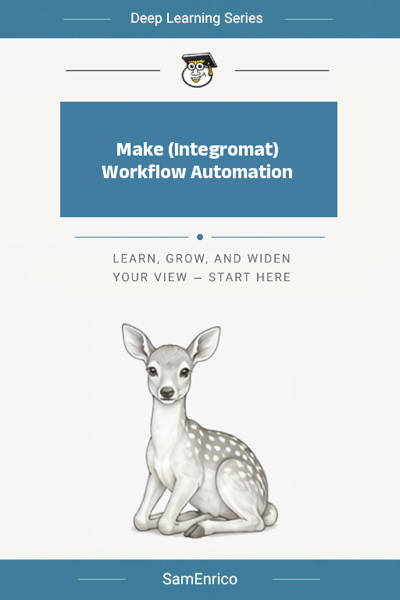
Make (Integromat) Workflow Automation eBook
A Coursebook on Make (Integromat) Workflow Automat
A Coursebook on Make (Integromat) Workflow Automation
Formats
Free sample
Chapter 1: The 3-Hour Rule...--–- The spreadsheet had forty-seven tabs. Each tab represented a different vendor portal. Each portal required a separate login. And every Friday afternoon, Sarah—a sharp, sleep-deprived operations manager at a mid-sized e-commerce company—would begin her ritual. She exported customer data from Salesforce.
She copied the first row. She pasted it into Vendor Portal Number One. She clicked “Submit.” She waited for the confirmation page to load. She copied the confirmation number. She pasted it back into Salesforce.
Then she started again. Forty-seven times. By the time she finished, it was 2:00 AM on Saturday. Her desk was covered in empty coffee cups. Her neck ached.
And she had just spent nine hours doing work that a $19-per-month automation could have completed in under two minutes.This chapter is not about software. It is not about clicking buttons or dragging colorful modules onto a canvas. It is not about API keys or webhooks or JSON payloads. This chapter is about that spreadsheet. It is about the quiet, unpaid, invisible labor that happens after 5:00 PM when everyone else has gone home to their families.
It is about the low-grade dread of knowing that a tedious, repetitive task is waiting for you, and that no one else is going to do it. And it is about a simple, ruthless rule—a rule so sharp that once you learn it, you will never look at your workday the same way again.That rule is the 3-Hour Rule. If a digital task happens more than once per week, and it takes you more than three hours per month to perform manually, you do not have a productivity problem. You do not have a time management problem. You do not need better focus or a more disciplined morning routine.
You have an automation problem. And Make.com is the solution.But before we build a single automation—before we write our first function, configure our first webhook, or connect our first app—we must answer a far more important question. A question that most automation books never bother to ask. A question that separates people who automate from people who merely read about automation. The question is this: Why are you still doing work that a machine could do for you?The Hidden Mathematics of Manual Labor Let us begin by defining our terms with surgical precision.
Manual digital work is any task that requires a human being to move data from one digital location to another, reformat information, trigger a process, or make a repetitive decision that follows a predictable, rule-based pattern. Copying a customer’s name from an email into a CRM. Downloading a CSV file, reformatting the dates from MM/DD/YYYY to YYYY-MM-DD, and uploading it to a different analytics platform. Checking a Google Sheet every hour to see if a new order has arrived, then typing a Slack message to the fulfillment team. Processing an invoice by opening a PDF, reading the total, and typing that number into an accounting system.
These are not “small tasks.” They are death by a thousand paper cuts.The tragedy is that most professionals systematically underestimate the true cost of manual work. They make three cognitive errors, and you have made them too.Error Number One: Measuring only execution time. When Sarah estimates that processing one vendor portal takes two minutes, she multiplies forty-seven portals by two minutes and arrives at ninety-four minutes—about an hour and a half. “Not so bad,” she tells herself. But she is wrong.
She is measuring only the time her fingers are moving. She is not measuring the time it takes to switch contexts. Every time she moves from the spreadsheet to the vendor portal, she loses focus. Research from the University of California, Irvine, found that it takes an average of twenty-three minutes to fully regain focus after an interruption. When you perform forty-seven interruptions in a row, you never regain focus.
The entire afternoon is lost.Error Number Two: Ignoring the error cost. Every manual data entry step has a non-zero error rate. The average human typist makes a mistake in one out of every three hundred keystrokes. That might sound acceptable until you realize that a single transposed digit in a customer’s phone number means a lost sale. A single incorrect decimal point in an invoice means angry clients and hours of reconciliation.
When Sarah manually copies confirmation numbers, she will make a mistake roughly once every thirty portals. Those mistakes each require twenty minutes to find and fix. The error cost is real, and it is invisible.Error Number Three: Forgetting the cognitive load tax. The human brain is not designed for repetitive, rule-based tasks. Performing the same action over and over generates mental fatigue.
That fatigue reduces creativity, increases irritability, and spills over into every other part of your work. The hour you spend copying data is not just an hour lost. It is an hour that degrades the quality of the next three hours of strategic work. Cognitive load is a tax on everything else you do.When you add these three hidden costs together—context switching, error correction, and cognitive load—a “two-minute task” performed forty-seven times consumes not ninety-four minutes but closer to five hours. The 3-Hour Rule emerged from studying over two hundred automation projects across e-commerce, marketing agencies, law firms, healthcare clinics, and software companies.
The pattern was unmistakable: the threshold at which automation becomes economically inevitable is three hours per month per recurring task.Let us do the math together. A task that consumes three hours per month of manual labor costs your organization roughly 1,800peryear,assumingaconservative1,800 per year, assuming a conservative 1,800peryear,assumingaconservative50 per hour fully burdened labor rate (salary, benefits, overhead). A Make.com subscription starts at 10permonth.Thatis10 per month. That is 10permonth.Thatis120 per year. The automation pays for itself in the first month and delivers a 1,400% return on investment in the first year alone.But the 3-Hour Rule is not really about money.
Money is just the unit we use to measure what actually matters. The 3-Hour Rule is about opportunity cost. Every hour you spend on manual data entry—every hour you spend copying, pasting, reformatting, checking, and re-checking—is an hour you do not spend on strategy, creativity, client relationships, product improvement, team development, or rest. The most successful automation practitioners do not think of automation as a cost-saving measure. They think of it as a time-creation machine.
They ask not “How much money will this save?” but rather “What will I do with the forty hours I get back this month? What will I build? Who will I spend time with? What problem will I solve that no one else has solved?”The Landscape: Why Make and Why Now You have options for automation. Many options.
An overwhelming number of options. Every week, a new no-code automation tool announces itself with a splashy Product Hunt launch and a pastel-colored website. Before we commit to Make—before we invest our precious learning hours—we owe it to ourselves to survey the landscape honestly. Each tool exists for a reason. Each has a context where it shines…
This is the end of the free sample. Get the eBook to keep going. Buy now
About this book
Details
- Author
- Gilley Elanor
- Publisher
- SamEnrico
- Language
- English
- Genre
- Non-Fiction, Informative, Educational
- Released
- 2026-05-09
- Pages (approx.)
- 149
- Available as
- eBook, Audiobook

Read better in the ZLOADR app
Your eBooks on your phone or tablet. Sign in with your SamEnrico account and start reading.
More by Gilley Elanor
 EQ For Creative Professionals GuideGilley Elanor$11.99
 Stimulant Recovery PlanGilley Elanor$11.99
 Mindfulness Meditation for Students HandbookGilley Elanor$11.99
 The Graduate Application StressGilley Elanor$11.99
 Boundary Setting for MinistersGilley Elanor$11.99
 Palace for To Do ListsGilley Elanor$11.99
 Digital Nomad Tax ComplianceGilley Elanor$11.99
 Self Worth And Dysfunctional FamilyGilley Elanor$11.99
 Mixed Episode Recognition PrimerGilley Elanor$11.99
 Shadows Over Ukraine: The Drone Wars That Changed EverythingGilley Elanor$11.99
 The Last Waltz: How Two Childhood Prodigies Defied Fate in Soviet BalletGilley Elanor$11.99
 The Four Days' Bloodbath: The Dutch Smash the Spanish ArmadaGilley Elanor$11.99
You may also like
 Hong Kong Handover 1997Dunn Johnnie$11.99
 Zumba For Postnatal Recovery CourseNeal Christian$11.99
 Zumba for BeginnersLadner Nikia$11.99
 YouTube Comment Mining GuideHumes Pandora$12.99
 Worry Box MeditationCarlin Rudy$11.99
 Workplace Stress MeditationNguyen Lynn$11.99
 Workplace Stress and Sleep RepairHawley Ivory$11.99
 Workplace Perfectionism CureDelaney Jeffry$11.99
 Workplace Injustice Anger GuideWallen Isabelle$11.99
 Work Addiction and Burnout LinkGreenwood Ester$11.99
 Women in Yoga and WellnessBeattie Galina$11.99
 Women in Stand Up ComedyChun Evangeline$11.99