
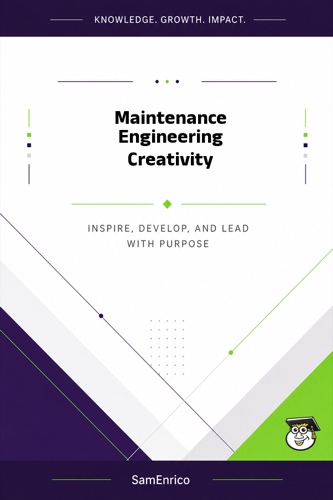
Maintenance Engineering Creativity eBook
Generate novel predictive maintenance and repair s
Generate novel predictive maintenance and repair strategies using creative methods.
Formats
Free sample
Chapter 1: The Million-Dollar Grease Gun--–- On a Tuesday morning in a sprawling automotive plant in the Midwest, a production line stopped. Not with a dramatic explosion or a shower of sparks, but with a soft, almost polite silence. The conveyor carrying engine blocks had simply… ceased. The maintenance team, twelve people strong, rushed in. They swapped sensors.
They rebooted programmable logic controllers. They called the original equipment manufacturer, who quoted a $40,000 service visit and a two-week lead time. Six hours into the crisis, with downtime costs already exceeding $200,000 in lost production and overtime pay, a young technician named Elena noticed something the vibration sensors had missed, the computer logs had ignored, and the senior engineers had walked past a dozen times. A small, quarter-sized grease fitting on an idler bearing was dry. Not broken.
Not worn. Dry. She reached for a $12 grease gun, pumped it three times, and the line restarted.The room went quiet. Then the plant manager turned to the reliability engineer and asked the question that no one wanted to answer: "Why did a $12 fix take six hours and two hundred thousand dollars to find?"That question is the reason you are holding this book.The Hidden Catastrophe of Routine Failure Every day, in factories, power plants, refineries, data centers, transit systems, and hospitals around the world, a silent crisis unfolds. Machines fail.
Technicians respond. Production stops. And then, almost invariably, the organization does the same thing it did the last time. It replaces the part. It reboots the system.
It calls the vendor. It pays the expedited freight bill. And it never, ever asks the question that would save it millions: Why did we not see this coming, and why did we only have one way to fix it?The global cost of unplanned downtime is staggering. According to industry studies that have become the bedrock of maintenance literature, the average industrial plant loses between 5% and 20% of its productive capacity to unplanned stoppages. For a mid-sized manufacturing facility, that translates to $1 million to $5 million per year in direct costs alone—not counting the softer, more insidious expenses: eroded customer trust, missed delivery windows, rushed overtime work that leads to injuries, and the slow, grinding demoralization of a workforce that has come to expect failure as normal.We have built magnificent technologies to predict these failures.
We have vibration sensors that can detect a bearing defect two months before it fails. We have thermal cameras that see hot spots invisible to the human eye. We have oil analysis that can count metal particles down to parts per million. We have computerized maintenance management systems, enterprise resource planning software, and more dashboards than any human could reasonably monitor. And yet, the failures keep coming.
The downtime keeps accumulating. The grease gun remains forgotten in a drawer while million-dollar sensors blare false alarms.The problem is not a lack of technology. The problem is a lack of creativity.The Silent Revolution You Have Already Missed Before we go any further, let me name the shift that has already begun, whether you have noticed it or not. The maintenance world is in the middle of what I call the Silent Revolution—a gradual but irreversible movement away from time-based maintenance and toward condition-based, predictive, and finally prescriptive strategies.A generation ago, maintenance was simple. You changed the oil every 100 hours.
You replaced the belt every six months. You rebuilt the pump every winter shutdown. This was time-based maintenance, and it worked reasonably well when machines were simpler, labor was cheaper, and downtime was merely inconvenient.Then came condition-based maintenance. You installed a vibration sensor. You monitored temperature.
You waited for a threshold to be crossed, and then you acted. This was a genuine improvement. It reduced unnecessary part changes and caught failures earlier.Then came predictive maintenance. You collected historical data, built statistical models, and estimated remaining useful life. You knew, with some probability, that Motor 47 would fail in 45 days, plus or minus a week.
This was the state of the art five years ago.But the Silent Revolution has moved past prediction. The new frontier is prescriptive and inventive maintenance. Not just "when will it fail?" but "what should we do about it that we have never tried before?" Not just "replace the bearing" but "could we redesign the housing to make lubrication easier? Could we change the lubricant type to extend life by 300%? Could we train the operator to listen for the early warning sound that our sensors keep missing?"The organizations winning today are not the ones with the most expensive sensors.
They are the ones with the most curious minds. They have realized that predictive analytics without creative problem-solving is like having a weather forecast without an umbrella—useful information that changes nothing.The Gray Tsunami: Why Your Experts Are Walking Out the Door There is another force accelerating this crisis, one that every maintenance leader knows but few have named honestly. The Baby Boomer generation—the men and women who learned maintenance on mechanical systems, who can diagnose an engine by sound alone, who have a mental map of every quirk in every machine installed since 1985—is retiring.Not gradually. Not gracefully. In waves.I call this the Gray Tsunami.
Over the next five to seven years, an estimated 40% to 60% of senior maintenance technicians in industrialized countries will leave the workforce. They will take with them decades of tacit knowledge: the funny noise that means a belt is misaligned, the specific way to tension a chain so it lasts twice as long, the secret about using a penny as a feeler gauge in a pinch, the knowledge that the vibration sensor on Pump 9 has always read 20% high because of its mounting location.This knowledge has never been written down. It has never been entered into a database. It lives only in the heads of people who are now planning their retirements.Here is where most books and consultants get it wrong. They treat this knowledge loss as a crisis of replacement.
Their solution is to hire younger technicians and train them in the same old methods. But that approach fails for two reasons. First, you cannot compress forty years of experience into a six-week training course. Second, the methods themselves are often outdated. The goal is not to replace the knowledge.
The goal is to capture, structure, and augment it so that it outlives the retiree and becomes something better: a foundation for creative problem-solving rather than a museum of old tricks.This book will show you exactly how to do that. Chapter 11, in particular, details the "Guided Repair" model and the use of AI to capture retiring experts' knowledge before it walks out the door. For now, simply understand this: the Gray Tsunami is not a reason to panic. It is a reason to change.Redefining Creative Maintenance (A Single, Usable Definition)Before we go any further, let me give you a definition that will appear at the start of every part of this book. You will memorize it.
You will teach it to your team. You will post it on your maintenance shop wall.Creative Maintenance is the disciplined practice of asking better…
This is the end of the free sample. Get the eBook to keep going. Buy now
About this book
Details
- Author
- Casillas Ruthann
- Publisher
- SamEnrico
- Language
- English
- Genre
- Non-Fiction, Self-Help, Maintenance Engineering
- Released
- 2026-06-11
- Pages (approx.)
- 157
- Available as
- eBook, Audiobook

Read better in the ZLOADR app
Your eBooks on your phone or tablet. Sign in with your SamEnrico account and start reading.
More by Casillas Ruthann
 Mediterranean FAQCasillas Ruthann$11.99
 Working a Twelve-Step Program for Sex AddictionCasillas Ruthann$11.99
 The Fruit and Vegetable LongevityCasillas Ruthann$11.99
 Rhetorical Questions PersuasionCasillas Ruthann$11.99
 The Ghost of Zanzibar: The Prison Breaks That Defied Colonial RuleCasillas Ruthann$11.99
 Understanding Tsao–ellingson SyndromeCasillas Ruthann$17.99
 How to Start a Dolls (wholesale) Business (Beginners Guide)Casillas Ruthann$11.99
 YC Application Deadline AfricaCasillas Ruthann$12.99
 VAT on Imports GuideCasillas Ruthann$12.99
 ConvertKit Creator Email MarketingCasillas Ruthann$11.99