
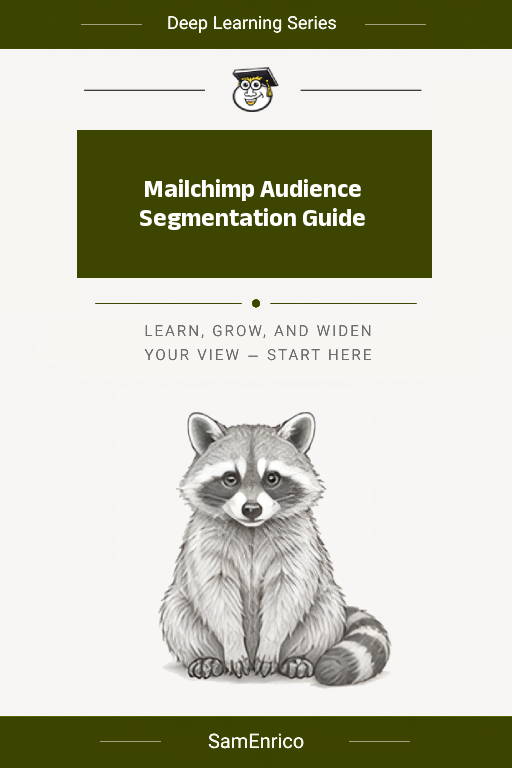
Mailchimp Audience Segmentation Guide eBook
Tag subscribers by interest and create groups befo
Tag subscribers by interest and create groups before sending first campaign to target content.
Formats
Free sample
Chapter 1: The 2 AM Confession–- The email sat in my drafts folder for three hours. Forty-seven thousand subscribers. One subject line. I had convinced myself that “Summer Sale – 20% Off Everything” was going to save the quarter. My finger hovered over the send button.
I clicked it at 2:13 PM on a Tuesday. By 2:17 PM, the first unsubscribe arrived. By 6 PM, four hundred and twelve people had left. By midnight, I was lying awake, staring at my ceiling, wondering if I had just burned a brand that took three years to build.That was seven years ago. I have not sent a broadcast blast since.
And I am never going back.This book exists because of that night. Not because I figured everything out immediately, but because I finally understood the question I should have been asking all along. It was never “How do I write better emails?” It was never “How do I get more opens?” It was never “What subject line works best on Tuesdays?”The question was: “Why am I saying the same thing to everyone?”If you are reading this, you already suspect that something is broken. Your open rates have been declining for eighteen months. Your click-through rate is a flat line.
You keep being told to “clean your list” and “improve your subject lines” and “test your send times.” You have done all of those things. Nothing changed.That is because you are treating the symptom, not the disease. The disease is sameness. The cure is segmentation. And the time to build that cure is not after you have collected ten thousand email addresses.
It is before you have collected ten.The Confession Every Marketer Hides Let me tell you a truth that most email marketing courses will not admit: Your audience does not hate your emails. They hate emails that feel like they were written for someone else.I learned this the hard way. After the 2:13 PM disaster, I rebuilt my list from scratch. I had exactly 847 subscribers. I was terrified.
I could not afford to lose a single one. So I sent an email to those 847 people. But this time, I did not send one email. I sent eleven.That sounds insane. Let me explain.
I had been tracking what each subscriber had clicked on my website before they signed up. I knew which ones had looked at pricing pages. I knew which ones had read blog posts. I knew which ones had downloaded my free guide. So I wrote eleven different versions of the same core message.
One for each interest group.The result? A 68% open rate. A 23% click-through rate. And zero unsubscribes.That was the day I realized that segmentation is not a feature of Mailchimp. Segmentation is a philosophy.
It is the act of admitting that your subscribers are not a crowd. They are individuals who arrived at your doorstep for different reasons, at different times, with different problems. And if you treat them like a crowd, they will leave like a crowd—quietly, quickly, and permanently.The Statistics That Should Scare You (And Inspire You)Let me put some numbers on the table. These are not my numbers. These are aggregated from multiple industry studies, including data from Mailchimp’s own research division, the Email Marketing Benchmarks Report, and independent analysis of over thirty billion emails.Statistic One: Non-segmented, broadcast-style campaigns experience a 50% drop in open rates within the first ninety minutes of sending.
After twenty-four hours, open rates are effectively flat. This is not because people are busy. It is because inbox algorithms (Gmail, Outlook, Apple Mail) learn from recipient behavior. When a large percentage of your list ignores your email, the algorithm concludes that your email is irrelevant and routes future emails to spam or the promotions tab.Statistic Two: Segmented campaigns improve click-through rates by an average of 100% to 150% compared to non-segmented campaigns. Some industries see lifts of over 300%.
The reason is simple: relevance begets attention. When someone receives an email that clearly speaks to a problem they have or an interest they expressed, they are not just more likely to click. They are more likely to feel grateful that you remembered.Statistic Three: Marketers who use interest-based segmentation (tagging subscribers by what they care about, not just who they are) report 76% higher revenue per email than those who use only demographic segmentation (age, location, gender). Demographics tell you who someone is. Interest data tells you why they are here.
The second is infinitely more valuable.Statistic Four: Seventy-eight percent of consumers have unsubscribed from a brand’s emails because the content became irrelevant. Not because the frequency was too high. Not because the design was ugly. Because the brand stopped listening. Or more accurately, because the brand never started listening in the first place.Here is what these statistics mean for you: If you are not segmenting before you send, you are not just leaving money on the table.
You are actively training your audience to ignore you.Every email you send to someone who does not care about that topic is a small vote for your irrelevance. Over time, those votes add up. Your deliverability drops. Your sender score falls. And eventually, even the people who do want to hear from you stop seeing your emails because the algorithms have labeled you as spam.This is not a theory.
This is how the inbox works in 2025 and beyond.Why "Better Content" Is Not the Answer At this point, some of you are thinking: “Fine. I need better content. If my emails were more valuable, people would open them.”I understand why you would think that. The entire email marketing industry has spent twenty years telling you that content is king. Write better subject lines.
Improve your design. Add more personality. Use more emojis. Test your send times.None of those things will save you if you are sending the wrong content to the wrong person.Imagine you own a bakery. You make sourdough, croissants, bagels, and gluten-free muffins.
A customer walks in. You have never met them before. You ask, “What can I get for you?” They say, “I’m just looking.”Now imagine that instead of asking what they want, you simply hand them a croissant. Every single customer. Every single time.
The person who is gluten-free leaves. The person who wanted a bagel is disappointed. The person who came for sourdough takes the croissant but does not come back.That is what broadcast email is. It is handing a croissant to everyone and wondering why they are not grateful.Now imagine a different approach. When someone walks into your bakery, you ask one question: “Are you here for breakfast, lunch, or a treat?” Based on their answer, you show them the relevant section of the menu.
The person here for breakfast sees bagels and croissants. The person here for lunch sees sandwiches. The person here for a treat sees muffins and pastries.No one leaves disappointed. Everyone feels seen. And everyone comes back.That is segmentation.
That is what this book will teach you to build—not as an afterthought, but as the foundation of everything you do in Mailchimp.The Intent Inventory: Your First…
This is the end of the free sample. Get the eBook to keep going. Buy now
About this book
Details
- Author
- Rhoades Winfred
- Publisher
- SamEnrico
- Language
- English
- Genre
- Non-Fiction, First 30 Days
- Released
- 2026-06-01
- Pages (approx.)
- 142
- Available as
- eBook, Audiobook

Read better in the ZLOADR app
Your eBooks on your phone or tablet. Sign in with your SamEnrico account and start reading.
More by Rhoades Winfred
 Meth Mouth Restoration HandbookRhoades Winfred$11.99
 1031 Exchange Net Investment Income TaxRhoades Winfred$11.99
 Dual Process Grief Model GuideRhoades Winfred$11.99
 Resume Middle East GuideRhoades Winfred$11.99
 Mobile Home Park InvestingRhoades Winfred$11.99
 Chunking for Medical TerminologyRhoades Winfred$11.99
 Hayloft Nap GuideRhoades Winfred$11.99
 Larry Page EnergyRhoades Winfred$11.99
 Female Combat PilotRhoades Winfred$11.99
 The Visionary and the Void: How Christopher Nolan Redefined Blockbuster FilmmakingRhoades Winfred$11.99
 The Van Gogh Heist That Shook the WorldRhoades Winfred$11.99
 The Banquet of the Timbuktu Scholars: Where Knowledge Feasted on GoldRhoades Winfred$11.99
You may also like
 Hong Kong Handover 1997Dunn Johnnie$11.99
 Zumba For Postnatal Recovery CourseNeal Christian$11.99
 Zumba for BeginnersLadner Nikia$11.99
 YouTube Comment Mining GuideHumes Pandora$12.99
 Worry Box MeditationCarlin Rudy$11.99
 Workplace Stress MeditationNguyen Lynn$11.99
 Workplace Stress and Sleep RepairHawley Ivory$11.99
 Workplace Perfectionism CureDelaney Jeffry$11.99
 Workplace Injustice Anger GuideWallen Isabelle$11.99
 Work Addiction and Burnout LinkGreenwood Ester$11.99
 Women in Yoga and WellnessBeattie Galina$11.99
 Women in Stand Up ComedyChun Evangeline$11.99