
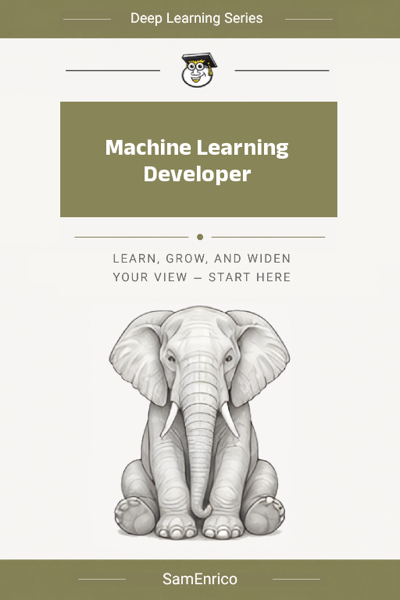
Non-FictionInformativeEducational
Machine Learning Developer eBook
A Coursebook on Machine Learning Developer
by Doss Ouida
A Coursebook on Machine Learning Developer
Formats
Free sample
Chapter 1: The Production Chasm--– In 2019, a multinational bank spent fourteen months and eleven million dollars building a machine learning system to detect money laundering. The team included thirty data scientists, eight software engineers, and three Ph Ds in statistics. They trained models on petabytes of transaction data. They achieved 97% recall on their validation set. They presented their results to the board. The CEO personally congratulated them.The system never processed a single live transaction.Not because it was inaccurate. Not because it was slow. Because the data scientists had built the model in a Jupyter notebook that assumed the data arrived in a specific CSV format with specific column names and no missing values. The production data stream, which came from forty-three different legacy banking systems across seventeen countries, never matched those assumptions. The model crashed on the first real transaction. The engineering team, which had been brought in only at the final month, looked at the notebook and said: we cannot deploy this. The project was written off as a "research experiment."The bank wrote off eleven million dollars. The data scientists updated their resumes. The money laundering continued.This is not an isolated failure. It is the norm. Across the technology industry, leading analysts estimate that over ninety percent of trained machine learning models never reach production. Ninety percent. For every model that actually serves a customer request, nine others die in what engineers call the "valley of death" between notebook and deployment.The problem is not bad algorithms. The problem is not insufficient data. The problem is not underpowered hardware. The problem is a chasm—a deep, wide, invisible chasm—between how data scientists work and how production systems operate. Data scientists explore. Production requires predictability. Data scientists iterate. Production requires stability. Data scientists optimize for accuracy. Production requires reliability, latency, cost efficiency, and maintainability. These are not the same thing.This book exists to build a bridge across that chasm. You are going to learn how to be an ML Developer—someone who can take a model from a notebook and turn it into a running system that serves requests, handles failures, degrades gracefully, and creates business value. You will not just learn about MLOps. You will build it. By the final chapter, you will have a production-ready fraud detection system called Fraud Guard, complete with automated testing, continuous deployment, drift monitoring, and an LLM-powered investigator.But first, you need to understand the chasm. You need to see why ninety percent of models fail. And you need to accept that the skills that made you a successful data scientist—or a successful software engineer—are not sufficient to make you a successful ML Developer. You need a new role, new tools, and a new mindset.The Three Hats: Data Scientist, ML Engineer, ML Researcher Before you write a single line of code, you must understand which hat you are wearing. The industry conflates these roles constantly. Job postings ask for "data scientists" who can also deploy Kubernetes clusters. Companies hire "ML engineers" and then ask them to run A/B tests on user behavior. This confusion creates burnout, failed projects, and the ninety percent statistic.Let us separate them clearly.The Data Scientist wears the explorer's hat. Their job is to find signal in noise. They ask: what patterns exist in this data? Which features predict the target? How accurate can a model be? Their tools are Jupyter notebooks, pandas, matplotlib, scikit-learn, and statistical tests. They optimize for insight and accuracy. They work in iterations, often running hundreds of experiments before finding a promising approach. Their output is a notebook, a presentation, or a model pickle file that proves a concept. A data scientist who cannot write clean code is still a good data scientist. A data scientist who cannot deploy a model is still a data scientist.The ML Researcher wears the inventor's hat. Their job is to push the boundaries of what is possible. They ask: can we design a new architecture that beats the state of the art? What theoretical properties does this algorithm have? Their tools are Py Torch, Tensor Flow, academic papers, and GPU clusters. They optimize for novelty and benchmark performance. Their output is a paper, a repository, and sometimes a model that achieves 0.5% better accuracy on Image Net. Most ML developers will never work as researchers. That is fine. The world needs far more builders than inventors.The ML Developer—this is you—wears the builder's hat. Your job is to take a model—any model, from any source—and turn it into a reliable, scalable, maintainable system. You ask: how does this run twenty-four hours a day without falling over? What happens when the input data arrives with missing fields? How do we know if the model is getting worse? How do we roll back to a previous version? How much does it cost to run? Your tools are Docker, Kubernetes, Fast API, DVC, MLflow, Prometheus, Grafana, Great Expectations, and cloud infrastructure. You optimize for reliability, latency, throughput, cost, and maintainability. Your output is not a model. Your output is a running system that contains a model.These are three distinct roles requiring three distinct skill sets. A brilliant data scientist can be a terrible ML developer. A brilliant ML developer can struggle to find signal in noise. Both are valuable. Neither is a junior version of the other.The problem is that most companies do not know this. They hire a data scientist and ask them to deploy a model. The data scientist, being talented and ambitious, tries. They struggle. They learn Docker. They learn Kubernetes. They spend six months becoming a mediocre ML developer while not doing data science. The project fails. The data scientist leaves. The company hires another data scientist. The cycle repeats.This book is for the data scientist who wants to cross into deployment. It is for the software engineer who wants to add ML to their skills. It is for the student who wants to build systems, not just notebooks. By the end, you will not just understand the tools. You will have used them to build something real.Why Software Engineering Rules Do Not Apply If you come from traditional software engineering, you are used to a clean world. You write code. You test it. You deploy it. If it has a bug, you fix the code and deploy again. The artifact—the code—is the only thing that changes. Your testing frameworks assume this. Your deployment pipelines assume this. Your monitoring assumes this.Machine learning breaks every assumption.In an ML system, three distinct things can change independently, and each one can cause the system to fail without any code change at all. Let us call this the Production Trinity: Code, Data, and Model.First: Code. This is the familiar one. Your preprocessing logic, your model architecture, your API endpoints—these live in version control. When they change, you expect behavior to change. You can write unit tests. You can run integration tests. You can roll back to a previous commit. This is software engineering as you know it.Second: Data. This is where things get strange. Your model was trained on data from six months ago. Today, it is receiving data from today. But the world has changed. Your e-commerce site has new users with different behavior.…
This is the end of the free sample. Get the eBook to keep going. Buy now
About this book
Details
- Author
- Doss Ouida
- Publisher
- SamEnrico
- Language
- English
- Genre
- Non-Fiction, Informative, Educational
- Released
- 2026-05-04
- Pages (approx.)
- 155
- Available as
- eBook, Audiobook

Read better in the ZLOADR app
Your eBooks on your phone or tablet. Sign in with your SamEnrico account and start reading.
More by Doss Ouida
 Radical Acceptance Of Childhood Self GuideDoss Ouida$11.99
 EQ For Client RelationsDoss Ouida$11.99
 Eating Disorder Body Image GuideDoss Ouida$11.99
 Polish Zegota Council for JewsDoss Ouida$11.99
 The EQ for Healthcare Professionals GuideDoss Ouida$11.99
 Hannibal's Gambit: The Alps, Cannae, and the Art of WarDoss Ouida$11.99
 How to Start a Hobby in Spud gunDoss Ouida$11.99
 Understanding Magnesium Wasting RenalDoss Ouida$17.99
 Strategy Meeting Time ManagementDoss Ouida$12.99
 Purchase Requisition to Order GuideDoss Ouida$12.99
You may also like
 Hong Kong Handover 1997Dunn Johnnie$11.99
 Zumba For Postnatal Recovery CourseNeal Christian$11.99
 Zumba for BeginnersLadner Nikia$11.99
 YouTube Comment Mining GuideHumes Pandora$12.99
 Worry Box MeditationCarlin Rudy$11.99
 Workplace Stress MeditationNguyen Lynn$11.99
 Workplace Stress and Sleep RepairHawley Ivory$11.99
 Workplace Perfectionism CureDelaney Jeffry$11.99
 Workplace Injustice Anger GuideWallen Isabelle$11.99
 Work Addiction and Burnout LinkGreenwood Ester$11.99
 Women in Yoga and WellnessBeattie Galina$11.99
 Women in Stand Up ComedyChun Evangeline$11.99