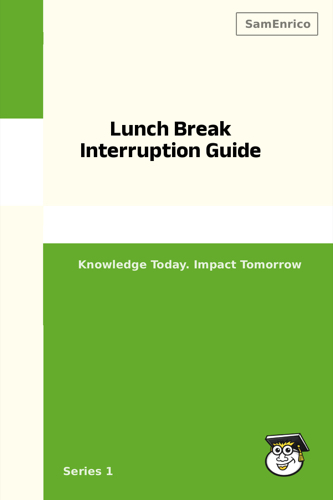
Lunch Break Interruption Guide eBook
Protect your meal break from work intrusions using
Protect your meal break from work intrusions using this practical boundary setting handbook.
Formats
Free sample
Chapter 1: The Silent Thief--–- The first time Sarah ate lunch in the bathroom, she told herself it was a one-time thing. The open office was too loud, her deadline was too tight, and the break room smelled like burnt popcorn. She balanced her Tupperware on the paper towel dispenser, ate her turkey sandwich in three bites, and returned to her desk within eleven minutes. No one noticed she had left. No one asked where she went.
And that, she later realized, was the problem.What began as a temporary solution became a quiet ritual. By the third week, Sarah was eating in the bathroom stall every day. She knew which stall had the most stable toilet paper dispenser (stall two). She knew that the sink ran for exactly eight seconds after you pressed the handle (just enough time to rinse a fork). She knew that if she waited until 12:47 PM, the lunch crowd cleared out and she could stand in the corner without anyone walking in on her mid-bite.Sarah was a senior marketing manager at a mid-sized tech firm.
She had a graduate degree, twelve years of experience, and a reputation for being "unflappable." She also had not eaten a seated, uninterrupted meal in four hundred and seventeen days.She is not alone.Chapter 1: The Silent Thief--–- Every day, millions of professionals do what Sarah did. They hide. They skip. They multitask. They answer "just one quick question" that becomes three emails and a fifteen-minute detour.
They tell themselves that tomorrow will be different. And then tomorrow arrives, and the same thing happens again.This chapter is about naming the enemy. Before you can protect your lunch break, you have to understand what you are protecting it from—not just the obvious interrupters (colleagues, bosses, Slack notifications), but the invisible architecture of modern work that has trained you to believe that a break is a weakness, that busyness is a virtue, and that your own basic human need for rest is somehow negotiable.We call this enemy the Silent Thief.The Silent Thief does not announce itself. It does not wear a name tag or send a calendar invite. It operates through cultural conditioning, workplace norms, and the quiet voice inside your head that says, "It is fine.
Just this once. Everyone else is working through lunch, too."By the end of this chapter, you will understand exactly what the Silent Thief is, how it operates, and why the cost of doing nothing is far higher than you think. You will learn the cognitive science behind why skipping your lunch break does not make you more productive—it makes you less productive, more resentful, and closer to burnout than you realize. And you will take the first step toward reclaiming what is rightfully yours: thirty minutes of uninterrupted peace.The Great Lie of the Working Lunch--–- Let us begin with a lie. It is a lie so pervasive, so deeply embedded in workplace culture, that most people do not even recognize it as a lie anymore.
They repeat it to themselves. They repeat it to their colleagues. They repeat it to their direct reports. And every time they repeat it, the lie becomes harder to see.The lie is this: Skipping your lunch break is a sign of dedication.If you work through lunch, the lie suggests, you are committed. You are a team player.
You are willing to do whatever it takes. The person who eats at their desk, answering emails with one hand and holding a fork with the other, is the person who gets promoted. The person who walks away at noon, closes their laptop, and does not return for thirty minutes? That person is lazy. Entitled.
Not a culture fit.This lie has been repeated so often that it has become invisible. We do not question it any more than we question the color of the sky. But here is the truth that the lie hides: Working through lunch does not make you more productive. It makes you less productive. It does not signal dedication.
It signals poor energy management. And it does not earn you respect. It earns you resentment—from yourself, first, and eventually from everyone around you.Let us look at the data.A landmark study from the University of Illinois examined the relationship between lunch breaks and afternoon productivity. Researchers tracked knowledge workers across multiple industries, measuring their cognitive performance before and after lunch under different conditions. The results were unequivocal: Workers who took a full, uninterrupted thirty-minute break performed significantly better in the afternoon than those who ate at their desks or skipped lunch entirely.
The gap was largest in the final two hours of the workday—exactly when most people experience the infamous 3:00 PM crash.Why does this happen? Because the human brain is not a machine. It cannot sustain high-level cognitive performance for eight consecutive hours without rest. Decision fatigue, attentional depletion, and willpower erosion are real neurological phenomena. Every decision you make, every email you answer, every problem you solve draws from a finite reservoir of mental energy.
By lunchtime, that reservoir is significantly depleted. A true break—one in which you disengage from work entirely—allows your brain to replenish its resources. Eating at your desk while continuing to work does not count as a break. It is simply working with a sandwich.The researchers called this the "attentional restoration effect." When you step away from your work—physically and mentally—your brain enters a different mode. It stops actively problem-solving and begins passively consolidating.
This is when creativity happens. This is when solutions to morning problems suddenly become obvious. This is when you return to your desk with fresh eyes and renewed energy.But here is the catch: The attentional restoration effect only works if you actually disengage. Checking email counts as engagement. Answering a Slack message counts as engagement.
Thinking about the meeting you have at 1:30 counts as engagement. For a break to restore your cognitive resources, it must be what psychologists call a "complete cessation of work-related activity."In other words, you cannot half-break. You cannot break while still being available. You cannot break while telling yourself, "I will just answer one quick thing." That one quick thing resets the clock. It keeps your brain in work mode.
And you return from your so-called break exactly as depleted as when you left.The Hidden Cost of the Interrupted Break--–- The lie about dedication is only half the problem. The other half is what happens when you try to take a break but get interrupted anyway.Imagine this scenario: You block your calendar from 12:00 to 12:30. You put on headphones. You close your office door. You are finally, actually, truly taking a lunch break.
Fifteen minutes in, a colleague knocks. "Quick question," they say. "It will only take a second."You answer. It does take only a second. You return to your sandwich.
But something has changed. You are no longer relaxed. Your brain is now thinking about the question, the task that prompted it, and the three follow-up items you just remembered you need to do. The rest of your…
This is the end of the free sample. Get the eBook to keep going. Buy now
About this book
Details
- Author
- Billups Soraya
- Publisher
- SamEnrico
- Language
- English
- Genre
- Non-Fiction, Self-Help, Work Boundaries
- Released
- 2026-06-06
- Pages (approx.)
- 142
- Available as
- eBook, Audiobook

Read better in the ZLOADR app
Your eBooks on your phone or tablet. Sign in with your SamEnrico account and start reading.
More by Billups Soraya
 Chunking and Spaced RepetitionBillups Soraya$11.99
 Food Addiction Recovery Yoga CourseBillups Soraya$11.99
 The Anger Exit StrategyBillups Soraya$11.99
 Fitness for Seniors StartBillups Soraya$11.99
 Codebreakers of the Bronze Age: The Lost Algorithms of Ancient MesopotamiaBillups Soraya$11.99
 The Ice Hotel Experiment: Challenging the Laws of Energy in the ArcticBillups Soraya$11.99
 Understanding Endocarditis, InfectiveBillups Soraya$17.99
 How to Start a Precision Balance (non-electronic) Business (Beginners Guide)Billups Soraya$11.99
 Two Pizza Scrum for AmazonBillups Soraya$12.99
 AI Art Tags For RedbubbleBillups Soraya$12.99
 Front Counter AttendantBillups Soraya$11.99