
Non-FictionTrue CrimePolitical BiographyLegal Drama
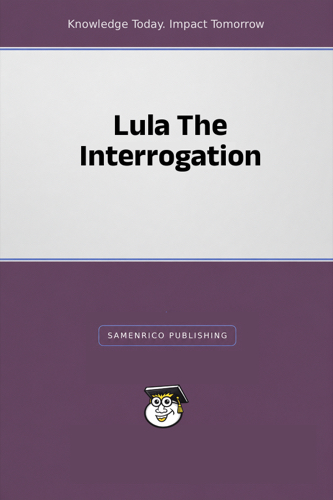
Lula The Interrogation eBook
Reconstruct the dramatic testimony, arrest, and im
Reconstruct the dramatic testimony, arrest, and imprisonment of former President Lula da Silva.
Formats
Free sample
Chapter 1: The Man in the Box...--The first thing you notice about the cell is the silence. Not the quiet of a library or the hush of a church—but the dense, suffocating absence of sound that presses against the eardrums like water pressure in a deep dive. No traffic hum. No voices. No wind.
Just the low, mechanical thrum of the ventilation system, a sound so constant that after a few hours the brain stops registering it altogether.The second thing you notice is the smell. Industrial cleaning fluid, sharp and chemical, layered over decades of institutional neglect. Concrete dust. The faint ghost of sweat from the previous occupant. There is no window that opens, no cross-breeze, no relief.The third thing you notice is the man.He sits on the edge of the concrete bed—a slab really, barely elevated from the floor, covered by a thin mattress that might as well be cardboard.
His hands rest on his knees. His back is straight despite the seventy-two years it carries. His eyes are open, fixed on the gray wall opposite, but they are not seeing the gray wall. They are seeing something else entirely.Luiz Inácio Lula da Silva—the most popular president in Brazilian history, the man who lifted thirty million people out of extreme poverty, the union leader who faced down a military dictatorship, the left-wing icon who reshaped Latin American politics—has been reduced to a number, a file, a body in a box.Fifteen square meters of concrete, steel, and silence.It is April 8, 2018. He has been here for approximately fourteen hours.
He will remain here for another fourteen months, twelve days, and a handful of hours—precisely 580 days, though he does not know that yet. All he knows at this moment is the cell, the silence, and the slow, terrible realization that the machinery of the state has swallowed him whole.The question that hovers in the stale air is the same one that will haunt this book from the first page to the last: How did the man in the box get here? How did a president who left office with an 87 percent approval rating—a number that would make any democratically elected leader weep with envy—end up in a federal prison in Curitiba, handcuffed, humiliated, erased?The answer is not simple. It involves corruption and crusades, genuine criminality and prosecutorial overreach, a beachfront apartment that may or may not have been a bribe, and a judge who may or may not have been a hero. It involves the collision of two men—Lula and Sergio Moro—who saw themselves as protagonists in very different stories, each convinced of his own righteousness, each willing to bend the rules to win.But before we can understand the fall, we must first understand the rise.
Before we can judge the interrogation, we must know the man who sat in the chair.The Garanhuns Boy The story begins not in a prison cell but in a dirt-floor shack in the arid interior of Brazil's Northeast. Garanhuns, Pernambuco—a town of dusty streets, scorching sun, and the constant threat of drought. It is 1945, the final year of World War II, though the war might as well be happening on another planet. For the da Silva family, the only battles are the daily ones against hunger, disease, and despair.Lula is the seventh child of an illiterate peasant couple. His father, Aristides, is a man of violent temper and wandering feet—the kind of father who appears and disappears like a bad weather system, leaving chaos in his wake.
His mother, Dona Lindu, is the opposite: fierce, resilient, determined to keep her children alive in a world that seems determined to kill them.The family lives in a house made of mud and sticks. There is no electricity, no running water, no floor beneath their feet except packed earth. They eat when there is food, which is not always. Lula learns to walk on dirt and sleep on straw and understand from the earliest age that the world is divided into those who have and those who do not—and that he belongs firmly in the second category.When Lula is seven years old, Aristides abandons the family. He simply leaves one day—for another woman, another town, another life—and does not return.
Dona Lindu, pregnant with her eighth child, faces an impossible choice: stay in Garanhuns and watch her children starve, or walk to São Paulo and try to find work in the industrial south.She walks.The journey takes weeks. She carries what little they own in bundles on her back, leading her children along dirt roads and through unfamiliar towns, sleeping in doorways when they must, begging for food when hunger becomes unbearable. Lula remembers the blisters on his mother's feet, the weight of the bundles, the way she never stopped moving even when she was clearly exhausted.São Paulo in the 1950s is a furnace of industry and immigration. Millions of Brazilians are leaving the rural Northeast for the factories of the south, seeking a better life that usually does not materialize. The da Silva family finds a small room in the back of a bar owned by a Portuguese immigrant.
It is not a home—it is barely shelter—but it is better than the road.Lula, now eight years old, goes to work. He shines shoes on the streets of São Paulo. He sells peanuts at the local cinema. He learns to count by making change for customers, to read by deciphering movie posters, to survive by being small and fast and invisible. He does not go to school—there is no money for school, no time for school, no expectation that a boy from Garanhuns needs an education.The shoeshine boy, the peanut seller, the factory worker's son—these are the identities that will later become political weapons, proof that Lula understands poverty not as an abstraction but as a lived experience.
But at the time, they are simply survival. There is no political consciousness yet, no sense of injustice beyond the dull ache of hunger. There is only the next meal, the next coin, the next day.The Factory Floor At fourteen, Lula follows his older brother into the factories. He becomes a metalworker—a torneiro mecânico, a lathe operator—joining the industrial working class that will eventually become his political base. The factory is a world of noise, heat, and danger.
Machines roar and clatter. Metal shavings fly through the air. Men lose fingers, hands, sometimes lives.Lula is good at the work. He is smart, quick, careful. He learns the machines the way a musician learns an instrument—with attention, respect, and a kind of intuitive feel for their rhythms and moods.
His supervisors notice. He is promoted, given more responsibility, trusted with more complex tasks.But the factory is also a classroom. Here, Lula learns the brutal math of industrial capitalism: the worker produces value, the owner keeps the profit. The man at the lathe works ten, twelve, fourteen hours a day, and at the end of the week he…
This is the end of the free sample. Get the eBook to keep going. Buy now
About this book
Details
- Author
- Painter Booker
- Publisher
- SamEnrico
- Language
- English
- Genre
- Non-Fiction, True Crime, Political Biography, Legal Drama
- Released
- 2026-06-09
- Pages (approx.)
- 146
- Available as
- eBook, Audiobook

Read better in the ZLOADR app
Your eBooks on your phone or tablet. Sign in with your SamEnrico account and start reading.
More by Painter Booker
 Single Parent LonelinessPainter Booker$11.99
 Abandoned Cart Email StrategyPainter Booker$11.99
 Partner Assisted Stretching GuidePainter Booker$11.99
 Frostbound Hearts: The Troll King and the Elven MaidenPainter Booker$11.99
 The Phantom of the Underground: The Hunt for the Tube TerrorPainter Booker$11.99
 How to Become a Chucking-machine Set-up OperatorPainter Booker$11.99
 Area Field ManagerPainter Booker$11.99
 Global Remote Payroll ManualPainter Booker$12.99
 Autonomous Delivery VehiclesPainter Booker$12.99
 Understanding Hypokalemic Alkalosis With HypercalcinuriaPainter Booker$17.99
You may also like
 Hong Kong Handover 1997Dunn Johnnie$11.99
 Zumba For Postnatal Recovery CourseNeal Christian$11.99
 Zumba for BeginnersLadner Nikia$11.99
 YouTube Comment Mining GuideHumes Pandora$12.99
 Worry Box MeditationCarlin Rudy$11.99
 Workplace Stress MeditationNguyen Lynn$11.99
 Workplace Stress and Sleep RepairHawley Ivory$11.99
 Workplace Perfectionism CureDelaney Jeffry$11.99
 Workplace Injustice Anger GuideWallen Isabelle$11.99
 Work Addiction and Burnout LinkGreenwood Ester$11.99
 Women in Yoga and WellnessBeattie Galina$11.99
 Women in Stand Up ComedyChun Evangeline$11.99