
Non-FictionHistoryDRC Art History
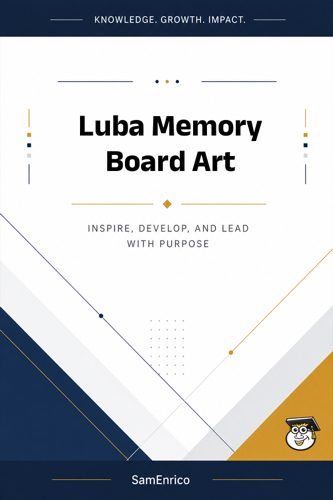
Luba Memory Board Art
Deciphers Luba lukasa memory boards used to recall
by Shin Coletta
Deciphers Luba lukasa memory boards used to recall royal genealogies and court protocols.
Formats
About this book
Free sample
Chapter 1: The Silent Archive...--–- Imagine holding an object that contains everything a kingdom knows. Not a book with its linear march of sentences, not a computer screen with its flickering pixels, but a carved wooden board the size of your open hand, studded with beads and shells. In your palm, it feels warm. The wood is smooth on the back, polished by generations of thumbs tracing its surface. The front is a dense constellation of colored glass—red, white, black, blue—arranged in patterns that seem at first like chaos.
Your eye searches for order and finds none. A cowrie shell here. A small carved face there. A zigzag line incised into the wood. What is this thing?
A game board? A ceremonial object? Decorative art?For most of the twentieth century, Western museums answered that last question. They placed the lukasa—for that is what this object is called—in glass cases labeled "Ritual Object" or "Divination Board" or simply "Congo, 19th century." They admired its craftsmanship, noted its aesthetic qualities, and moved on. The lukasa was art.
And in calling it art, they made it silent.This book exists to undo that silence. The lukasa is not merely art. It is a technology—specifically, an intellectual technology for storing, encoding, and retrieving vast amounts of complex, non-linear information. A single lukasa can function simultaneously as a political map of the Luba kingdom, a historical chronicle of dynastic succession, a legal code of court protocols, a territorial deed proving ownership of land, a philosophical treatise on the nature of power, and a spiritual device for contacting ancestors. It is, in the fullest sense, an archive.
But an archive unlike any you have encountered.The difference begins with reading. A book sits on a shelf, indifferent to its reader. You can open it anywhere, skip chapters, read backward. The information is fixed. The lukasa is the opposite.
Without a trained initiate to read it, the lukasa is mute. Its beads and carvings remain decoration. But in the hands of a member of the Mbudye Society—the "men and women…
This is the end of the free sample. Get the eBook to keep going. Buy now
Contents
- Chapter 1
- Chapter 2
- Chapter 3
- Chapter 4
- Chapter 5
- Chapter 6
- Chapter 7
- Chapter 8
- Chapter 9
- Chapter 10
- Chapter 11
- Chapter 12
Details
- Author
- Shin Coletta
- Publisher
- SamEnrico
- Language
- English
- Genre
- Non-Fiction, History, DRC Art History
- Released
- 2026-06-06
- Pages (approx.)
- 141
- Available as
- eBook, Audiobook

Read better in the ZLOADR app
Your eBooks on your phone or tablet. Sign in with your SamEnrico account and start reading.
More by Shin Coletta
 The Teen Positive Affirmations GuideShin Coletta$11.99
 Medical Grand Rounds FearShin Coletta$11.99
 Divorce and In LawsShin Coletta$11.99
 The Family Recovery Companion GuideShin Coletta$11.99
 The Blood, Sweat, and Science: Mexico's Olympic Doping Scandal of 1968Shin Coletta$11.99
 Chard HarvestingShin Coletta$11.99
 HARO Personal Story Pitch GuideShin Coletta$12.99
 CPG Pricing Strategy GuideShin Coletta$12.99
 A Beginners Guide to Eskrima (Volume 1)Shin Coletta$11.99
 Understanding Popliteal Pterygium Syndrome Lethal TypeShin Coletta$17.99
You may also like
 Hong Kong Handover 1997Dunn Johnnie$11.99
 Zumba For Postnatal Recovery CourseNeal Christian$11.99
 Zumba for BeginnersLadner Nikia$11.99
 YouTube Comment Mining GuideHumes Pandora$12.99
 Worry Box MeditationCarlin Rudy$11.99
 Workplace Stress MeditationNguyen Lynn$11.99
 Workplace Stress and Sleep RepairHawley Ivory$11.99
 Workplace Perfectionism CureDelaney Jeffry$11.99
 Workplace Injustice Anger GuideWallen Isabelle$11.99
 Work Addiction and Burnout LinkGreenwood Ester$11.99
 Women in Yoga and WellnessBeattie Galina$11.99
 Women in Stand Up ComedyChun Evangeline$11.99