
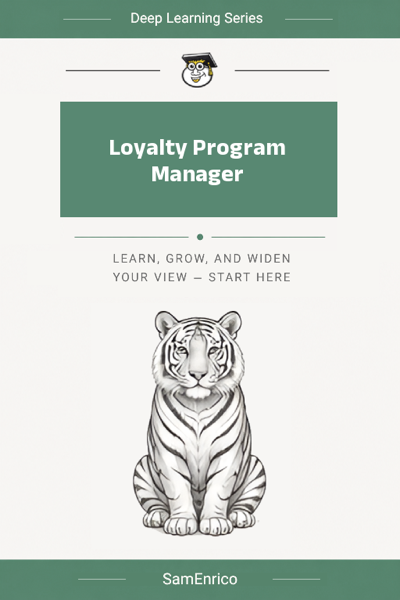
Non-FictionInformativeEducational
Loyalty Program Manager eBook
A Coursebook on Loyalty Program Manager
A Coursebook on Loyalty Program Manager
Formats
Free sample
Chapter 1: The Loyalty Delusion--–- In a windowless conference room on the thirty-second floor of a glass tower in downtown Chicago, a marketing director named Sarah presented her quarterly loyalty program results to the executive team. She had spent six months and $2.3 million launching a points-based program that now boasted 1.4 million members. The enrollment curve was beautiful, climbing like a rocketship on a launchpad. She projected the slide with pride: "Member Growth: +340% Year over Year."The Chief Financial Officer, a woman in her fifties who had seen three loyalty program launches come and go, did not applaud. She leaned forward and asked a single question that would haunt Sarah for the rest of her career: "How much incremental profit did those 1.4 million members generate?"Sarah opened her mouth.
Nothing came out. She had enrollment data. She had redemption rates. She had email open rates and click-throughs and average order values. But she did not have an answer to that question.
Because the answer, she would later discover in a brutal post-mortem analysis, was approximately negative four hundred thousand dollars. The program had cost more to run than it had generated in additional profit. The loyalty program was, by any honest accounting, a failure wrapped in a growth chart.This story is not hypothetical. It happens every day in companies large and small. According to a 2023 study by the Loyalty Research Center, seventy percent of loyalty programs fail to deliver a positive return on investment within their first two years.
And yet companies continue to launch them with religious fervor, convinced that points and discounts are the answer to customer churn. This is the Loyalty Delusion: the seductive belief that a simple transactional rewards program creates genuine customer loyalty. It does not. It creates a discount club. And discount clubs attract price-sensitive customers who will leave the moment a competitor offers a better deal.This chapter exists to shatter that delusion.
It will redefine what loyalty actually means, introduce the strategic discipline of Customer Loyalty Management, and establish the foundational principle that will guide every subsequent chapter of this book: loyalty programs are not about points. They are about emotions, economics, and experience.What Loyalty Actually Means The word "loyalty" has been so thoroughly abused by marketers that it has lost nearly all meaningful content. Ask a hundred business leaders to define customer loyalty, and ninety-five will say something like "repeat purchases" or "customers who keep coming back." This definition is dangerously incomplete. Repeat purchases can be driven by many forces that have nothing to do with loyalty: convenience (the only grocery store in town), inertia (too lazy to switch banking providers), or lack of alternatives (the dreaded cable monopoly). These are customers held captive, not customers who love you.True loyalty, as defined by the academic literature on relationship marketing, requires three components that cannot be faked.
First, attitudinal loyalty: the customer holds a positive emotional attitude toward the brand. They like you. They trust you. They would recommend you to a friend without being asked. Second, behavioral loyalty: the customer repeatedly purchases from the brand.
But crucially, this behavior persists even when convenient alternatives exist. The truly loyal customer has options and chooses you anyway. Third, resilience to competitive offers: when a competitor offers a discount or a promotion, the loyal customer does not defect. They might glance at the offer, but they stay.This third component is the one most loyalty programs accidentally destroy. When a program is built entirely on points and discounts, it trains customers to be perpetually shopping for the best deal.
They become loyal to the discount, not to the brand. Starbucks learned this lesson the hard way when it made its rewards program too generous and watched customers game the system, buying the cheapest items to earn stars, then redeeming them for expensive drinks. The company had to restructure the program multiple times to encourage profitable behavior rather than just any behavior.A useful framework for understanding loyalty comes from the academic literature on relationship marketing, which distinguishes between genuine relationship loyalty and what researchers call "spurious loyalty." Spurious loyalty is repeat purchase driven by situational factors like convenience, habit, or switching costs. A customer who stays with a bank because changing direct deposits is annoying is not loyal; they are trapped. A customer who shops at the same grocery store because it is the only one within ten miles is not loyal; they are constrained.
These customers will defect the moment a better option appears. Genuine loyalty, by contrast, is an emotional bond that survives competitive pressure.The book "Hug Your Haters," which draws on decades of customer service research, makes a related point that will echo throughout this chapter: customer satisfaction is a terrible predictor of loyalty. In study after study, eighty percent of customers who defected said they were "satisfied" or "very satisfied" with their previous provider. Satisfaction is a low bar. It means you met expectations, not that you created an emotional connection.
Loyalty requires moving beyond satisfaction into what researchers call "customer delight"—the experience of having expectations exceeded in an unexpected way.The Economics of Keeping Customers The business case for genuine loyalty is overwhelming, but the numbers are often misapplied to justify bad programs. The most frequently cited statistic in loyalty marketing is that acquiring a new customer costs five to seven times more than retaining an existing one. This number comes from a 2014 Bain & Company study that analyzed dozens of industries and found the ratio consistently between five and twenty-five, depending on the industry. For subscription businesses like software or media, the ratio is on the higher end. For low-consideration retail, it is on the lower end.But this statistic is frequently abused.
It does not mean that every retained customer is profitable or that every retention effort pays off. Retention, like acquisition, has costs. Sending a ten-dollar coupon to every customer who has not purchased in sixty days will retain some of them, but if the coupon is applied to purchases that would have happened anyway, the program is simply giving away margin. The relevant measure is not retention rate but incremental profit from retained customers.The more useful statistic, and the one that should be tattooed on every loyalty program manager's forearm, is this: a five percent increase in customer retention can increase profits by twenty-five to ninety-five percent. This number comes from the same Bain research, but it is often misunderstood.
The increase in profit comes not just from keeping customers longer, but from three compounding effects. First, retained customers buy more over time (the "share of wallet" effect). Second, they cost less to serve because they understand the product and require less support. Third, they refer new customers at no cost. A retained customer who also becomes an advocate is worth exponentially more than a retained customer who simply continues to buy.The challenge is that these benefits accrue only to genuinely loyal customers, not to those who stay because of a points program.
A customer who stays because they have two thousand unredeemed points is not an advocate. They are not referring friends. They are not forgiving when you make…
This is the end of the free sample. Get the eBook to keep going. Buy now
About this book
Details
- Author
- Mcmaster Felisa
- Publisher
- SamEnrico
- Language
- English
- Genre
- Non-Fiction, Informative, Educational
- Released
- 2026-06-02
- Pages (approx.)
- 145
- Available as
- eBook, Audiobook

Read better in the ZLOADR app
Your eBooks on your phone or tablet. Sign in with your SamEnrico account and start reading.
More by Mcmaster Felisa
 Female Ruler Imposter SurvivalMcmaster Felisa$11.99
 Walking Meditation Journal WorkbookMcmaster Felisa$11.99
 Divorce Disappointment GuideMcmaster Felisa$11.99
 Caregiver Burnout and Physical HealthMcmaster Felisa$11.99
 The Queen of the Underworld: Widad Kamel al-Qaddafi’s Shadow EmpireMcmaster Felisa$11.99
 UN Assessment Center Prep GuideMcmaster Felisa$12.99
 How to Produce Aviation PartsMcmaster Felisa$11.99
 How to Start a Drug (medicinal) Business (Beginners Guide)Mcmaster Felisa$11.99
You may also like
 Hong Kong Handover 1997Dunn Johnnie$11.99
 Zumba For Postnatal Recovery CourseNeal Christian$11.99
 Zumba for BeginnersLadner Nikia$11.99
 YouTube Comment Mining GuideHumes Pandora$12.99
 Worry Box MeditationCarlin Rudy$11.99
 Workplace Stress MeditationNguyen Lynn$11.99
 Workplace Stress and Sleep RepairHawley Ivory$11.99
 Workplace Perfectionism CureDelaney Jeffry$11.99
 Workplace Injustice Anger GuideWallen Isabelle$11.99
 Work Addiction and Burnout LinkGreenwood Ester$11.99
 Women in Yoga and WellnessBeattie Galina$11.99
 Women in Stand Up ComedyChun Evangeline$11.99