
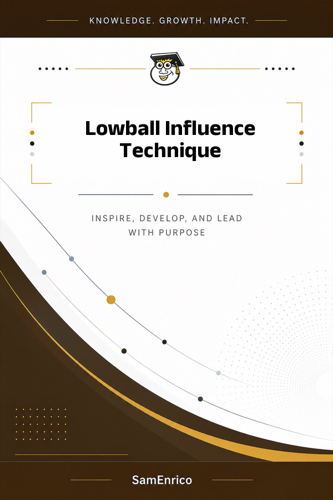
Non-FictionSelf-HelpSales Psychology
Lowball Influence Technique eBook
Secure agreement then change terms, leveraging com
by Watts Kirk
Secure agreement then change terms, leveraging commitment psychology.
Formats
Free sample
Chapter 1: The $600 Handshake--The car salesman didn't raise his voice. He didn't change his smile. He simply disappeared behind a frosted glass door marked "Manager," stayed there for exactly four minutes, and returned with bad news delivered in a sympathetic tone. "I'm really sorry," he said, shaking his head slowly. "My manager just told me the best I can do on that model is twelve-six.
The twelve flat was a misprint on the website. I tried, but he won't budge."The psychology student sitting across the desk had already shaken hands on $12,000. He had already imagined himself driving this metallic blue sedan to campus. He had already told his roommate, "I'm getting a great deal." Now, faced with a $600 increase, he did something that would haunt him for years. He nodded.
He signed. He paid.Weeks later, in a Social Psychology 301 lecture, the professor projected a familiar-looking sales floor onto the screen. "That dealership," the professor announced, "was running a study. You were a subject." The student's face burned as the professor explained the lowball technique—how the initial agreement changes the psychology of the target, how the delay and the fake manager create the illusion of negotiation, how the $600 increase was planned before the student ever walked through the door. The student had been manipulated not by a master salesman, but by a sophomore research assistant following a script.This book exists because that student was me.
And this chapter exists because the $600 handshake is happening to you, right now, more often than you realize.The Anatomy of a $600 Mistake The lowball technique, first systematically studied by social psychologist Robert Cialdini and his colleagues in 1978, operates on a deceptively simple sequence. Step one: secure a voluntary agreement to an attractive offer. Step two: after the agreement, change the terms to something less favorable. Step three: watch as a significant percentage of people comply anyway.In the original experiment, Cialdini's team asked college students to participate in a psychology study. In the control condition, students were told upfront that the study would begin at 7:00 AM.
Only 24 percent agreed. In the lowball condition, students were first asked if they wanted to participate in a study—no time mentioned. After they agreed, the researcher "discovered" that the only available time was 7:00 AM. Compliance jumped to 56 percent. More than double.The $600 handshake follows the exact same pattern.
The attractive offer ($12,000) secures the yes. The change ($12,600) triggers a psychological cascade. And the victim, now committed, finds it easier to pay the extra money than to walk away and admit that they were wrong, or that they had been fooled, or that the handshake meant nothing.This chapter is not merely a story about car sales. It is an introduction to a psychological force that shapes decisions worth billions of dollars every year. Before we can defend against the lowball, before we can use it ethically, before we can understand why smart people make seemingly irrational choices, we must first see the pattern clearly.
The $600 handshake is the pattern. Everything else in this book is commentary.Why Your Brain Betrays You The lowball technique works because it exploits a fundamental feature of human cognition: the drive for consistency. This drive is not a weakness. It is, in most contexts, a strength. Consistency allows us to function in a complex world.
If we had to reevaluate every decision from scratch every time circumstances changed, we would never get anything done. We rely on our past commitments as cognitive shortcuts. "I said I would do this, so I will do this" is an efficient rule of thumb.But efficiency becomes vulnerability when the commitment is based on incomplete information. The lowball technique weaponizes consistency by securing the commitment before revealing the full cost. Your brain, having already committed, now faces an unpleasant choice.
Option one: admit that the new terms make the deal less attractive and walk away, thereby admitting that your initial agreement was ill-informed or that you were manipulated. Option two: revise your assessment of the deal to accommodate the new terms, telling yourself that it's still worth it, that the extra cost is reasonable, that you're still getting a good value.The brain overwhelmingly chooses option two. This is not stupidity. It is cognitive dissonance reduction, a process first identified by Leon Festinger in the 1950s. When two beliefs conflict—"I am a smart person" and "I just agreed to a bad deal"—the brain experiences psychological discomfort.
To resolve that discomfort, the brain changes one of the beliefs. It is almost always easier to change the belief about the deal ("It's still a good deal") than to change the belief about oneself ("I am not as smart as I thought").The $600 handshake is a perfect laboratory for watching this process unfold in real time. The student in the dealership did not carefully recalculate the value of the car after the price increase. He rationalized. "The blue book value is probably higher." "The dealer has to make a profit somehow." "I already drove forty minutes to get here." Each rationalization was a small rewrite of reality, each one making the deal feel more acceptable, each one pushing him closer to the signature line.The Three Pillars of the Lowball Understanding the lowball technique requires understanding three interconnected psychological mechanisms.
These pillars will appear throughout every chapter of this book, so we establish them here with clarity and precision.The first pillar is commitment. When a person makes a voluntary, active, public commitment to a course of action, that commitment takes on a life of its own. It becomes a psychological entity that resists change. Research consistently shows that written commitments are stronger than verbal commitments, public commitments are stronger than private ones, and voluntary commitments are stronger than coerced ones. The lowball technique secures all three: the initial yes is voluntary, it is spoken aloud to another person, and it is often accompanied by a handshake or other ritual that signals seriousness.The second pillar is cognitive dissonance.
As introduced above, dissonance is the discomfort that arises from holding contradictory cognitions. In the lowball sequence, the contradiction is between the self-concept ("I am a consistent, rational decision-maker") and the behavior ("I agreed to terms that have now become worse"). The resolution almost always favors the behavior over the original self-concept. The person does not change their behavior; they change their beliefs about the behavior. The deal becomes better in retrospect.
The extra cost becomes justified. The changed terms become acceptable.The third pillar is consistency. Consistency is the behavioral expression of the commitment and dissonance processes. Once a person has committed and resolved the dissonance, they will behave consistently with that resolution. They will sign the contract.
They will pay the extra $600. They will recommend the dealership to a friend. Consistency is the output of the lowball machine, and it is remarkably durable. Studies have shown that lowball-induced compliance persists even when the original justification for the commitment is removed. The person continues to behave consistently because the commitment has become internalized.These three pillars do not operate in sequence like assembly line stations.
They operate in parallel, reinforcing each other. Commitment creates the raw material. Dissonance provides the motivation to resolve contradictions. Consistency…
This is the end of the free sample. Get the eBook to keep going. Buy now
About this book
Details
- Author
- Watts Kirk
- Publisher
- SamEnrico
- Language
- English
- Genre
- Non-Fiction, Self-Help, Sales Psychology
- Released
- 2026-06-06
- Pages (approx.)
- 130
- Available as
- eBook, Audiobook

Read better in the ZLOADR app
Your eBooks on your phone or tablet. Sign in with your SamEnrico account and start reading.
More by Watts Kirk
 Mediterranean Cancer PreventionWatts Kirk$11.99
 Values And Mission Alignment Public Relations CourseWatts Kirk$11.99
 The Commute Stress FixWatts Kirk$11.99
 The SAD and Sleep GuideWatts Kirk$11.99
 The Siege of Chittorgarh: Blood and Honor in the Rajput ResistanceWatts Kirk$11.99
 Understanding Tricho–dento–osseous Syndrome Type 1Watts Kirk$17.99
 Assistant TechniqueWatts Kirk$11.99
 Digital One Page Business PlanWatts Kirk$12.99
 Digital Business Plan StorageWatts Kirk$12.99
 How to Start a Drafting Service BusinessWatts Kirk$11.99
You may also like
 Hong Kong Handover 1997Dunn Johnnie$11.99
 Zumba For Postnatal Recovery CourseNeal Christian$11.99
 Zumba for BeginnersLadner Nikia$11.99
 YouTube Comment Mining GuideHumes Pandora$12.99
 Worry Box MeditationCarlin Rudy$11.99
 Workplace Stress MeditationNguyen Lynn$11.99
 Workplace Stress and Sleep RepairHawley Ivory$11.99
 Workplace Perfectionism CureDelaney Jeffry$11.99
 Workplace Injustice Anger GuideWallen Isabelle$11.99
 Work Addiction and Burnout LinkGreenwood Ester$11.99
 Women in Yoga and WellnessBeattie Galina$11.99
 Women in Stand Up ComedyChun Evangeline$11.99