
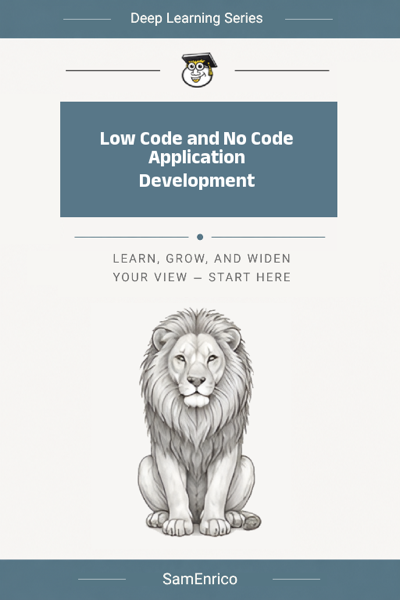
Low Code and No Code Application Development eBook
A Coursebook on Low Code and No Code Application D
A Coursebook on Low Code and No Code Application Development
Formats
Free sample
Chapter 1: The Citizen Developer...--–- In the basement of a mid-sized logistics company in Ohio, a woman named Sarah had just broken the unwritten rule that had governed software development for forty years. She had built an application. Not a spreadsheet macro. Not a fancy Excel dashboard. A real, functioning, multi-user application with a database, business logic, and a user interface.
And she had done it without writing a single line of code.Sarah was not a software engineer. She had never taken a computer science course. She could not tell you the difference between a class and a method, and the word "algorithm" reminded her of high school math anxiety. Sarah was a logistics manager. Her job was to track inventory across three warehouses, coordinate with twelve suppliers, and ensure that 3,000 different products reached the right customers at the right time.
For three years, she had done this using a chaotic combination of email chains, sticky notes, and a shared Excel spreadsheet that crashed every time more than four people opened it simultaneously.The breaking point came on a Tuesday in October. A $200,000 shipment of medical supplies had been delayed because someone had typed "42" instead of "24" in a quantity field. By the time the error was discovered, the entire production schedule had collapsed. Sarah spent the next seventy-two hours manually reconciling spreadsheets, making phone calls, and apologizing to customers who had every right to be furious.That weekend, sitting at her kitchen table with a cup of coffee that had gone cold hours ago, Sarah made a decision. She would not let this happen again.
She opened her laptop, typed "how to build an app without coding" into Google, and began a journey that would transform not only her department but her entire career.Six weeks later, Sarah deployed a custom inventory tracking system built entirely on a no-code platform called App Sheet. The system included a barcode scanner for warehouse staff, automated reorder alerts for suppliers, a real-time dashboard for management, and—most importantly—validation rules that prevented anyone from entering invalid quantities. The total cost of the platform was $450 per month. The total time Sarah spent learning to build it was forty hours. The total lines of code she wrote: zero.Within three months, her department had reduced inventory errors by 82 percent.
Warehouse staff saved an average of four hours per week previously wasted on manual data entry. The $200,000 shipment error never happened again. And Sarah, the logistics manager who had never written a line of code, had become something entirely new: a Citizen Developer.The Quiet Revolution You Have Already Witnessed Sarah's story is not exceptional. It is not a one-in-a-million fluke or a motivational poster dressed up as a case study. Across every industry—healthcare, finance, manufacturing, retail, education, government—millions of people like Sarah are quietly building the software their organizations need to function.
They are not waiting for overworked IT departments. They are not hiring expensive development agencies. They are not learning Java Script, Python, or C#. They are using a new generation of visual tools that replace code with drag-and-drop logic, pre-built components, and increasingly, natural language prompts powered by artificial intelligence.This is the democratization of software. And it is the most significant shift in the technology landscape since the invention of the graphical user interface.Let us pause and consider what software has been for the past forty years.
For most of that time, building software was a craft reserved for an ordained priesthood. You needed years of training. You needed to master arcane syntaxes, debug incomprehensible error messages, and understand the subtle differences between object-oriented and functional programming paradigms. The barriers to entry were not just high; they were deliberately steep. This was not malice.
Software development is genuinely complex. But the consequence was a world where the people with the problems were never the people with the solutions.Think about your own organization. How many times have you heard someone say, "If only we had an app that could do X"? How many spreadsheets are being used as databases right now? How many sticky notes?
How many email chains? How many hours are being wasted on tasks that a simple application could automate in seconds?The answer, across the global economy, is staggering. And it represents both a crisis and an opportunity.The Numbers That Demand Your Attention If you are the kind of person who skips past data to get to the "good stuff," I need you to resist that instinct for just one paragraph. Because the numbers behind low-code and no-code development are not abstract statistics. They are the economic reality that explains why you are reading this book.In 2021, Gartner—the world's most respected technology research firm—made a prediction that raised eyebrows across Silicon Valley.
By 2025, they said, 70 percent of new applications developed by enterprises would use low-code or no-code technologies. Let me repeat that: 70 percent. Not 30 percent. Not half. Seven out of every ten new applications.When this prediction was made, many traditional developers dismissed it as hype.
Two years later, Gartner revised their estimate upward. By 2026, they now project, more than 75 percent of large enterprises will have formal citizen developer programs. The low-code/no-code platform market, valued at approximately 13billionin2020,isexpectedtoexceed13 billion in 2020, is expected to exceed 13billionin2020,isexpectedtoexceed180 billion by 2030.What does this mean in human terms? It means that right now, as you read this sentence, someone in your organization is probably building an application without your knowledge. They might be in marketing, building a customer portal.
They might be in HR, automating onboarding workflows. They might be in operations, creating a real-time dashboard for supply chain tracking. They might be Sarah, sitting at her kitchen table, solving a problem that IT has not gotten around to addressing.This is happening whether your organization has a policy about it or not. And that is either terrifying or exhilarating, depending on your perspective.The Three Forces Driving the Revolution To understand why low-code and no-code development has exploded in the past five years, you need to understand three converging forces: the demand crisis, the talent crisis, and the speed crisis.The Demand Crisis Here is a simple fact: there is more demand for software than there are developers to build it. Much more.
The global shortage of professional software developers is estimated to exceed one million in the United States alone, and forty million worldwide when you count the informal demand for custom applications within organizations. Every company is a software company now—or at least, every company needs software to survive. The local pizza shop needs a delivery app. The dental practice needs a scheduling system. The school district needs a parent communication portal.
The logistics company needs inventory tracking.Traditional development cannot keep up. Even if every computer science program in the world doubled its enrollment tomorrow, it would take years to close the gap. And in the meantime, organizations are drowning in unmet software needs.The Talent Crisis The second force is the changing nature of who best understands what software is needed. For decades, the typical software development process looked like this: a business user described a problem…
This is the end of the free sample. Get the eBook to keep going. Buy now
About this book
Details
- Author
- Beaudoin Sina
- Publisher
- SamEnrico
- Language
- English
- Genre
- Non-Fiction, Informative, Educational
- Released
- 2026-06-02
- Pages (approx.)
- 158
- Available as
- eBook, Audiobook

Read better in the ZLOADR app
Your eBooks on your phone or tablet. Sign in with your SamEnrico account and start reading.
More by Beaudoin Sina
 The Downsell Funnel GuideBeaudoin Sina$11.99
 Behind the Governor's PardonBeaudoin Sina$11.99
 Burnout Stress InoculationBeaudoin Sina$11.99
 IBS Lactose Intolerance OverlapBeaudoin Sina$11.99
 Small Talk for Awkward PeopleBeaudoin Sina$11.99
 The Cosmic Hoax of Halley's Comet: A 17th-Century Astronomical ConspiracyBeaudoin Sina$11.99
 The Silent Architect: How a Forgotten Civil Servant Shaped Modern AmericaBeaudoin Sina$11.99
 Digital Product Customer SupportBeaudoin Sina$12.99
 Sales Strategy Framework OnlineBeaudoin Sina$12.99
 Understanding Ciliary Discoordination, Due to Random Ciliary OrientationBeaudoin Sina$17.99
 A Beginners Guide to Anti-Monopoly (Volume 1)Beaudoin Sina$11.99