
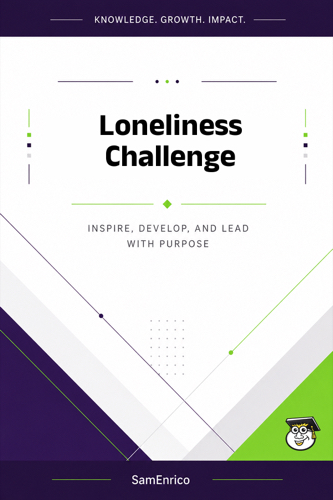
Loneliness Challenge eBook
Thirty days to build social connection habits.
by Dick Kasie
Thirty days to build social connection habits.
Formats
Free sample
Chapter 1: The Gap Nobody Mentions--–- Let me ask you something honest. When was the last time you sat alone in a room and felt completely fine about it? Not distracted. Not numbed out on your phone. Not waiting for someone to text.
Just... still. Quiet. Present. If that feeling is familiar to you, you know what solitude is.
It is voluntary. It is restorative. It is a gift you give yourself.Now let me ask you something harder. When was the last time you sat in a crowded room full of people who knew your name and felt absolutely invisible? When you laughed at a joke you did not find funny so no one would ask what was wrong.
When you smiled while your chest felt hollow. When you went home exhausted not from work but from the performance of being fine. That is not solitude. That is loneliness. And the difference between these two experiences is the single most important distinction you will learn in this entire book.Loneliness is not being alone.
Loneliness is the gap between the connection you want and the connection you have. That is it. A gap. Not a personality disorder. Not evidence that you are fundamentally unlikeable.
Not a life sentence. A gap between where you are and where you want to be. And gaps can be closed.But here is the problem. You have been taught to confuse loneliness with solitude. You have been told that being comfortable alone is the goal, that needing other people is weakness, that you should learn to be "enough" all by yourself.
That advice sounds wise. It is not wise. It is dangerous. Because you are a mammal. And mammals die alone.Your brain did not evolve to thrive in isolation.
It evolved to keep you attached to a group because a group meant food, protection, and survival. Every time you feel lonely, your brain is not attacking you. It is trying to save you. It is sending a signal as real as hunger or thirst. Hunger says eat.
Thirst says drink. Loneliness says connect. The signal is not the problem. The problem is what you have learned to do with the signal.Most people respond to loneliness in one of three ways. None of them work.The first way is numbing.
You feel the ache of isolation, and immediately you reach for something to make it stop. Your phone. A show. Food. Alcohol.
Work. Anything that fills the space where connection should be. And it works, for about thirty seconds. Then the feeling comes back, slightly stronger, because you just taught your brain that loneliness is an emergency requiring immediate anesthesia. You did not close the gap.
You just forgot about it for a moment.The second way is self-blame. You feel lonely, and your inner voice says, "Something is wrong with me. If I were more interesting, people would call. If I were more attractive, people would stay. If I were more successful, people would want to know me." This voice is shame, and shame is a liar.
Shame tells you that your loneliness is evidence of your defectiveness. It is not. Loneliness is evidence that you are a human mammal who needs other human mammals. That is all. But shame convinces you to hide, and hiding guarantees you will stay lonely.The third way is frantic reaching out.
You panic. You text five people. You double-text when they do not reply immediately. You post something vulnerable on social media and then refresh obsessively to see who responds. You show up at someone's door unannounced.
This repels people. Not because you are bad. Because you are broadcasting desperation, and desperation is contagious. People feel it, and they pull away, which confirms your worst fear, which makes you panic more. A vicious cycle with no exit.There is a fourth way.
You can recognize the signal for what it is, pause, and then take one small, deliberate action toward connection without requiring an immediate payoff. That is what this entire book teaches. But before you can learn the actions, you have to accept the reality of the gap. And that means looking at some numbers that will make you uncomfortable.The Quiet Epidemic In 2023, the United States Surgeon General issued an advisory that should have been front-page news everywhere. It was not.
Because loneliness is invisible, and invisible crises do not sell advertising. The advisory stated that loneliness is as lethal as smoking fifteen cigarettes a day. Fifteen. Every day. That is not a metaphor.
That is the mortality data from a meta-analysis of one hundred forty-eight studies covering more than three hundred thousand participants.Social isolation increases the risk of premature death by twenty-six percent. For comparison, obesity increases risk by twenty percent. Air pollution increases risk by six percent. Loneliness is more deadly than obesity. Read that sentence again.
Let it land.The same advisory reported that thirty-six percent of Americans feel seriously lonely. More than one in three. Among young adults aged eighteen to twenty-five, the number jumps to sixty-one percent. Almost two thirds. Before the widespread adoption of smartphones, in the year 2000, the same question yielded about fifteen percent.
Fifteen percent to sixty-one percent in twenty-three years. That is not a gradual decline. That is a public health emergency.And yet. There are no warning labels on social media apps. No public health campaigns about loneliness.
No surgeon general's warning on your phone. Because loneliness is shameful. You would rather admit to an addiction than to having no friends. I have seen this in rooms for years. "I drink too much" is easier to say than "I have no one to call."So let me say it for you.
You are not broken. You are not weak. You are a human being living through a loneliness epidemic that is not your fault. But it is your responsibility to fix, because no one is coming to save you. Not because they do not care.
Because they are lonely too, and they are waiting for someone to save them.The Machine That Eats Connection You have a device in your pocket that is marketed as a connection tool. It is not. It is a loneliness machine disguised as a connection tool. Let me explain how it works, because vague warnings about screen time are useless. You need to understand the mechanism.Every time you post something on social media, you are performing.
You are curating a version of your life that is slightly better, slightly funnier, slightly more together than reality. Everyone does this. Even the people who claim to be "authentic" on social media are performing authenticity, which is a contradiction. The moment you know you are being watched, you change your behavior. That is just human nature.The problem is that you are watching everyone else's performance, and your brain is not good at distinguishing performance from reality.
Your brain evolved to trust what it sees. When you see a friend's vacation photos, your brain does not automatically add the caveat "selected highlights, does not include the fight they had with their partner, the food poisoning, or the flight delay."…
This is the end of the free sample. Get the eBook to keep going. Buy now
About this book
Details
- Author
- Dick Kasie
- Publisher
- SamEnrico
- Language
- English
- Genre
- Non-Fiction, Self-Help, 30 Day
- Released
- 2026-06-08
- Pages (approx.)
- 108
- Available as
- eBook, Audiobook

Read better in the ZLOADR app
Your eBooks on your phone or tablet. Sign in with your SamEnrico account and start reading.
More by Dick Kasie
 Operation Car Wash Curitiba HeadquartersDick Kasie$11.99
 Email Marketing for EcommerceDick Kasie$11.99
 Cerebral Palsy Flexibility PlanDick Kasie$11.99
 The Blood Moon Conspiracy: How a 19th-Century Vampire Panic Shaped Modern MedicineDick Kasie$11.99
 The Golden Notes of Robert Sengstacke Abbott: Building Empires Through Ink and MelodyDick Kasie$11.99
 Understanding Hypoparathyroidism Nerve Deafness NephrosisDick Kasie$17.99
 Exoskeleton Worker AssistanceDick Kasie$12.99
 Cyber Insurance Premium WorkbookDick Kasie$12.99
 How to Become a Chronograph OperatorDick Kasie$11.99
 Clockify Time Tracking for FreelancersDick Kasie$11.99
You may also like
 Hong Kong Handover 1997Dunn Johnnie$11.99
 Zumba For Postnatal Recovery CourseNeal Christian$11.99
 Zumba for BeginnersLadner Nikia$11.99
 YouTube Comment Mining GuideHumes Pandora$12.99
 Worry Box MeditationCarlin Rudy$11.99
 Workplace Stress MeditationNguyen Lynn$11.99
 Workplace Stress and Sleep RepairHawley Ivory$11.99
 Workplace Perfectionism CureDelaney Jeffry$11.99
 Workplace Injustice Anger GuideWallen Isabelle$11.99
 Work Addiction and Burnout LinkGreenwood Ester$11.99
 Women in Yoga and WellnessBeattie Galina$11.99
 Women in Stand Up ComedyChun Evangeline$11.99