
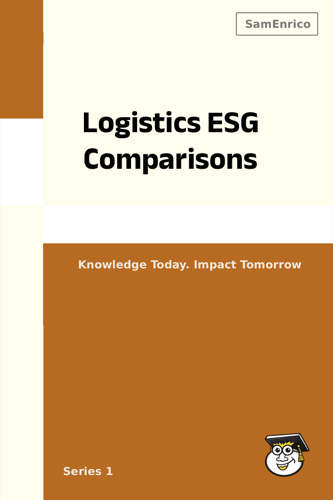
Non-FictionStrategic AtlasLogistics ESG
Logistics ESG Comparisons
Rank fleet electrification and last mile efficienc
by Hinds Luanne
Rank fleet electrification and last mile efficiency among shipping and delivery firms.
Formats
About this book
Free sample
Chapter 1: The Ranking Mandate--The memo arrived on a Tuesday, buried between a fleet utilization report and a reminder about quarterly driver safety training. For most logistics managers, it would have been deleted without a second thought. But for those paying attention—the ones who noticed that their largest shipper had just updated their supplier code of conduct for the third time in eighteen months—the memo was a warning shot. A major retail client was now requiring all third-party logistics partners to disclose their fleet's emissions per package delivered, broken down by zip code, and to provide a public-facing ESG scorecard by the end of the fiscal year. No disclosure meant no contract renewal.
No contract renewal meant the end of a relationship that accounted for nearly forty percent of annual revenue.This is not a hypothetical scenario. It is already happening.The logistics industry stands at a precipice unlike any it has faced since the deregulation waves of the 1980s. But this time, the disruption is not coming from new entrants with cheaper rates or innovative routing algorithms. It is coming from a fundamental redefinition of what constitutes a "good" logistics partner. The metrics that have governed carrier selection for decades—price, speed, reliability—are now being joined by a fourth, more complex, and arguably more consequential dimension: ESG performance.
Environmental, Social, and Governance criteria, once the domain of sustainability officers and corporate social responsibility reports, have become core financial and operational imperatives. And for the first time in the history of freight transport, logistics firms are being ranked, compared, and selected or rejected based on how their fleet electrification and last-mile efficiency stack up against their competitors.This chapter establishes the foundational thesis of this book: comparing ESG performance in logistics is no longer a voluntary exercise for sustainability reports. It is a core financial and operational imperative that will determine which firms survive the next decade and which become cautionary tales taught in business schools. The shift from diesel to electric is inevitable, but more importantly, the ability to rank and be ranked on that transition has become…
This is the end of the free sample. Get the eBook to keep going. Buy now
Contents
- Chapter 1
- Chapter 2
- Chapter 3
- Chapter 4
- Chapter 5
- Chapter 6
- Chapter 7
- Chapter 8
- Chapter 9
- Chapter 10
- Chapter 11
- Chapter 12
Details
- Author
- Hinds Luanne
- Publisher
- SamEnrico
- Language
- English
- Genre
- Non-Fiction, Strategic Atlas, Logistics ESG
- Released
- 2026-06-08
- Pages (approx.)
- 139
- Available as
- eBook, Audiobook

Read better in the ZLOADR app
Your eBooks on your phone or tablet. Sign in with your SamEnrico account and start reading.
More by Hinds Luanne
 Cremation Burial Memorial Planning CourseHinds Luanne$11.99
 Stress And Witness AccuracyHinds Luanne$11.99
 Metta for Family ConflictHinds Luanne$11.99
 The Letting Go of Anger GuideHinds Luanne$11.99
 The Terracotta Warriors: How King Zheng Forged an EmpireHinds Luanne$11.99
 Business Email Credit ImpactHinds Luanne$12.99
 Connection Requests That Get AcceptedHinds Luanne$12.99
 Understanding Say–Meyer SyndromeHinds Luanne$17.99
 Physical ScientistHinds Luanne$11.99
 How to Become a Drying-unit-felting-machine OperatorHinds Luanne$11.99
You may also like
 Hong Kong Handover 1997Dunn Johnnie$11.99
 Zumba For Postnatal Recovery CourseNeal Christian$11.99
 Zumba for BeginnersLadner Nikia$11.99
 YouTube Comment Mining GuideHumes Pandora$12.99
 Worry Box MeditationCarlin Rudy$11.99
 Workplace Stress MeditationNguyen Lynn$11.99
 Workplace Stress and Sleep RepairHawley Ivory$11.99
 Workplace Perfectionism CureDelaney Jeffry$11.99
 Workplace Injustice Anger GuideWallen Isabelle$11.99
 Work Addiction and Burnout LinkGreenwood Ester$11.99
 Women in Yoga and WellnessBeattie Galina$11.99
 Women in Stand Up ComedyChun Evangeline$11.99