
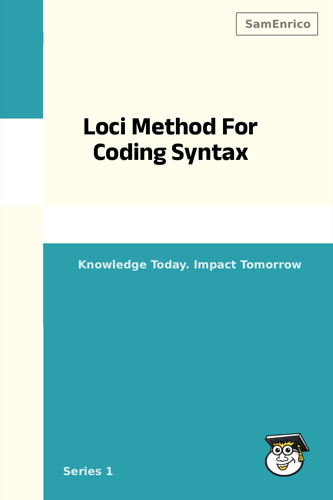
Non-FictionSelf-HelpProgramming
Loci Method For Coding Syntax eBook
Places programming commands in memory palace.
Places programming commands in memory palace.
Formats
Free sample
Chapter 1: The Google Cage--You have typed the same syntax query into Google 47 times this month. Not 47 different queries. The same one. "for loop syntax javascript" stares back at you from your browser history like an accusation. You know a for loop when you see it.
You can debug one in your sleep. But when you sit down to write one from scratch—no IDE, no autocomplete, no Stack Overflow—your fingers hover over the keyboard like a pianist who has forgotten the scales.This is not a failure of intelligence. It is a failure of encoding.Every programmer knows the feeling. You are in an interview. The interviewer slides a whiteboard marker toward you and says, "Write a function that reverses a string." Your mind goes blank.
You know how to reverse a string. You have done it a hundred times. But the syntax—the exact incantation of parentheses, brackets, semicolons, and keywords—evaporates. You write something close. The interviewer nods politely.
You do not get the job.Or you are pair programming. Your senior engineer types at a speed that seems like magic. You watch them write a nested list comprehension in Python, and you understand every character. Then they say, "Your turn," and you cannot produce the same structure without looking at what they just wrote. You are not a fraud.
You are a human being with a human memory, and human memory was not designed for abstract symbols.This book is the escape from that cage.The Recognition Paradox Let us name the problem. You are excellent at recognition. When you read code, you know what it does. You can spot a missing parenthesis from across the room. You can look at a while loop and know immediately whether it will terminate or run forever.
Recognition is passive. It requires a trigger—the code is already in front of you, and your brain simply matches it against stored patterns.But recall is different. Recall is active. It requires you to generate the pattern from nothing, like pulling a specific thread from a tangled ball of yarn without seeing the ends. When you write code from scratch, you are performing recall.
When you debug, you are performing recognition. The gap between these two abilities is the single greatest source of frustration for programmers at every level.Consider this experiment, conducted informally thousands of times in coding bootcamps: Show a programmer a block of code with a syntax error. They will find it in seconds. Then erase the code and ask them to write the same block from memory. They will make errors—sometimes the same error they just corrected in someone else's code.
The recognition-recall gap is not about knowledge. It is about access.You have the knowledge. The syntax rules are in your brain somewhere, like books in a library with no catalog. This book builds the catalog.The Hippocampus: Your Ancient, Powerful, Misunderstood Ally To understand why you struggle with recall, you must understand the organ responsible for memory. The hippocampus is a small, seahorse-shaped structure deep in your brain's temporal lobe.
It is one of the oldest parts of the mammalian brain in evolutionary terms. Your hippocampus is not a general-purpose storage device. It has a specialty: spatial memory.Your hippocampus is why you can close your eyes and walk through your childhood home. You remember the creaky third step. You remember the smell of the kitchen.
You remember the way light falls through the living room window at 4 PM. You have not lived in that house for twenty years, but the route is carved into your neural architecture like a riverbed.Now compare that to your memory of a syntax rule you learned ten minutes ago. The difference is staggering. You can navigate a house you have not seen in decades, but you cannot reproduce a switch statement you just read. This is not a flaw.
It is a design feature. Your brain evolved to remember places and paths because remembering where the water source was and how to get back to the cave kept your ancestors alive. Remembering abstract symbols did not.The Method of Loci—also called the Memory Palace—is a 2,500-year-old technique that exploits this biological fact. It was used by Greek and Roman orators to memorize hours-long speeches without notes. They would mentally walk through a familiar building and place each segment of the speech at a specific location.
When it was time to speak, they would walk the building in their mind and "read" the speech from the walls.You will do the same with code.The Natural Compiler Here is the central insight of this book: Your brain is not a hard drive. You cannot save a syntax rule and expect to load it later. But your brain is a spatial processor. It compiles abstract information into physical locations automatically—if you give it the right input.Think of the Method of Loci as a Natural Compiler. A software compiler takes human-readable source code and transforms it into machine-executable instructions.
Your Natural Compiler takes abstract syntax rules and transforms them into spatial memories that your hippocampus can store and retrieve with near-perfect fidelity.The process has three stages:1. Lexical Analysis (Tokenization). You break a syntax rule into its components. The statement for (let i = 0; i < 10; i++) contains tokens: for, (, let, i, =, 0, ;, i,
This is the end of the free sample. Get the eBook to keep going. Buy now
About this book
Details
- Author
- Bedford Shondra
- Publisher
- SamEnrico
- Language
- English
- Genre
- Non-Fiction, Self-Help, Programming
- Released
- 2026-06-06
- Pages (approx.)
- 139
- Available as
- eBook, Audiobook

Read better in the ZLOADR app
Your eBooks on your phone or tablet. Sign in with your SamEnrico account and start reading.
More by Bedford Shondra
 Time Blocking for Reclaim AIBedford Shondra$11.99
 Teacher Anger Thought ChangeBedford Shondra$11.99
 Body Scan for Better SexBedford Shondra$11.99
 Borneo Jungle Trek MasterBedford Shondra$11.99
 Ukrainian Nanny To Daycare OwnerBedford Shondra$11.99
 Tirzepatide GuideBedford Shondra$11.99
 Atomic Habits For Self TalkBedford Shondra$11.99
 The Shanghai Data Heist: When Secrets Escaped the Walled CityBedford Shondra$11.99
 The Piano King: Steinway & Sons and the Sound of AmericaBedford Shondra$11.99
 Growing CalycanthusBedford Shondra$11.99
 A Collector's Handbook to the Singer BantamBedford Shondra$11.99
 Turkish SIM Card and InternetBedford Shondra$12.99
You may also like
 Hong Kong Handover 1997Dunn Johnnie$11.99
 Zumba For Postnatal Recovery CourseNeal Christian$11.99
 Zumba for BeginnersLadner Nikia$11.99
 YouTube Comment Mining GuideHumes Pandora$12.99
 Worry Box MeditationCarlin Rudy$11.99
 Workplace Stress MeditationNguyen Lynn$11.99
 Workplace Stress and Sleep RepairHawley Ivory$11.99
 Workplace Perfectionism CureDelaney Jeffry$11.99
 Workplace Injustice Anger GuideWallen Isabelle$11.99
 Work Addiction and Burnout LinkGreenwood Ester$11.99
 Women in Yoga and WellnessBeattie Galina$11.99
 Women in Stand Up ComedyChun Evangeline$11.99