
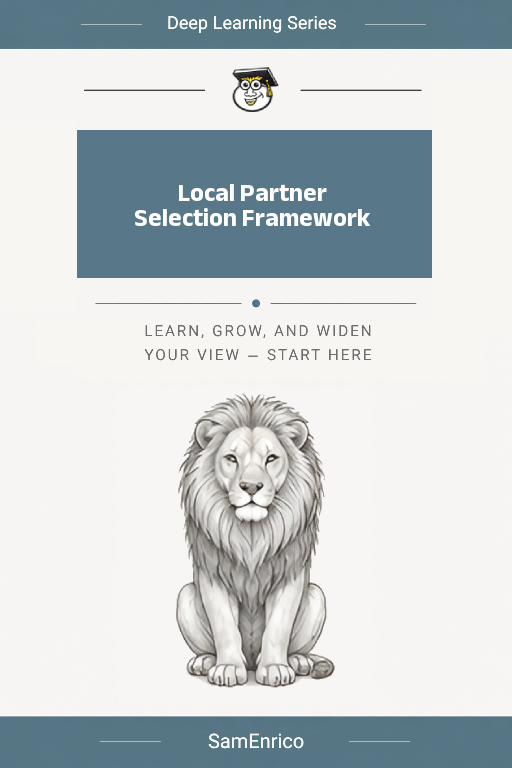
Non-FictionProfessional's Cheat SheetPartner SelectionEvaluation
Local Partner Selection Framework eBook
Evaluate potential local partners using weighted c
Evaluate potential local partners using weighted criteria including infrastructure language and political stability factors.
Formats
Free sample
Chapter 1: The Two-Billion-Dollar Handshake--–- The conference room in Singapore smelled of stale coffee and desperation. Thirty-seven people sat around a mahogany table that cost more than most of their monthly salaries. On the screen was a map of Indonesia, dotted with green pins representing potential local partners. The CEO of Delta Manufacturing, a sixty-two-year-old Midwesterner named Harold Vance, pointed at pin number twelve.–- "This is the one," he said. "Third-generation family business.
Owns the port access we need. The head of the family played golf with the trade minister last month. We have a handshake deal."–- No one in the room asked to see the due diligence report. No one asked for the political risk score, the infrastructure audit, or the liquidity analysis. No one mentioned the word "weighted" or "criteria" or "framework." They had a handshake.
And Harold Vance had been doing business in Asia for twenty-three years. He trusted his gut.–- Eighteen months later, that handshake had cost Delta Manufacturing 427millionindirectlosses.Thepartner′s"portaccess"turnedouttobeasingle,state−controlledterminalthatthegovernmentseizedduringacorruptioncrackdown.The"golfbuddy"tradeministerhadbeenarrested.Thepartner′sfamilyhadfledto Singaporewith427 million in direct losses. The partner's "port access" turned out to be a single, state-controlled terminal that the government seized during a corruption crackdown. The "golf buddy" trade minister had been arrested. The partner's family had fled to Singapore with 427millionindirectlosses.Thepartner′s"portaccess"turnedouttobeasingle,state−controlledterminalthatthegovernmentseizedduringacorruptioncrackdown.The"golfbuddy"tradeministerhadbeenarrested.Thepartner′sfamilyhadfledto Singaporewith80 million of the joint venture's cash.
Delta Manufacturing filed for Chapter 11 reorganization six months after that. Harold Vance retired in disgrace.–- This is not an isolated story. It is not a cautionary tale from the 1990s or a case study buried in an academic journal. It is a template. Every year, companies lose more money to bad local partners than to tariffs, currency fluctuations, or recessions combined.
The cost is not measured in millions but in hundreds of billions. And the root cause is almost never what executives think it is.The Geography Trap–- When companies decide to enter a new market, they obsess over the wrong question. They ask: Which country should we enter? They commission reports on GDP growth, demographic trends, and consumer spending. They hire consultants to rank markets by attractiveness.
They build elaborate financial models with sensitivity analyses for every macroeconomic variable imaginable.–- Then they pick a partner.–- That partner selection—often a rushed, gut-driven, relationship-based decision made over dinners and golf outings—determines success or failure more than any other factor. According to a multi-year study by the Harvard Business Review that analyzed 1,500 international joint ventures, over 80% of JV failures can be traced directly to partner mismatch, not market conditions, not currency fluctuations, not regulatory changes. The partner was the problem. The partner was always the problem.–- Here is the brutal truth that most business books will not tell you: you can choose the perfect market—booming economy, friendly regulations, hungry consumers—and a bad partner will still destroy you. Conversely, you can choose a difficult market—political volatility, weak infrastructure, cultural barriers—and the right partner will protect you.
The geography trap is believing that where you go matters more than who you go with.–- Delta Manufacturing fell into the geography trap. Indonesia was booming. Infrastructure spending was up. The middle class was expanding. Every metric said "enter now." So they entered.
They just never bothered to truly evaluate the person they were entering with.The Two-Billion-Dollar Graveyard–- Let us put a number on this problem. Based on analysis of public company disclosures, World Bank data on foreign direct investment disputes, and arbitration records from the International Chamber of Commerce, the annual cost of failed international partnerships exceeds $2 trillion over the past decade. That is not a typo. Two trillion dollars. More than the GDP of most countries.–- This is the two-billion-dollar handshake—the informal agreement, the relationship-based deal, the "trust me" arrangement that bypasses structured due diligence.
Every handshake like this carries a hidden statistical probability of disaster. And the tragedy is that almost all of these disasters were preventable.–- Consider the following real-world examples (names and specific details altered to protect confidentiality, but the core facts are drawn from actual arbitration cases):–- The Port That Wasn't: A European logistics company partnered with a family-owned firm in Nigeria that claimed to have "exclusive access" to a private port facility. The partner provided photographs, contracts, and a tour of a functioning terminal. Six months after signing, the European company discovered the partner had been leasing the port space week-to-week and had no long-term rights. The actual port owner evicted them both.
The European firm lost $47 million.–- The Power Grid Mirage: A pharmaceutical manufacturer partnered with an Indian company that had state-of-the-art laboratory facilities and audited financials showing three years of profitability. What the balance sheet did not show was that the facility experienced 14 hours of power cuts per day and relied on diesel generators that the partner could not afford to fuel consistently. Production delays cost the joint venture $22 million in the first year alone.–- The Minister's Cousin: A technology firm entered a joint venture in Kazakhstan with a partner who was introduced by a U.S. embassy contact as "well-connected." The partner's cousin was indeed a deputy minister. When that minister fell out of favor in a political reshuffling, the partner lost all regulatory protection.
Permits were revoked. Investigations were launched. The technology firm spent $11 million on legal fees trying to unwind the partnership.–- The Silent Liquidity Crisis: A renewable energy company partnered with a Brazilian firm that showed strong profits on paper. What the balance sheet hid was that the partner had been paying suppliers 120 days late and had maxed out its lines of credit with three banks. When the joint venture needed a capital injection, the partner could not contribute.
The foreign firm had to buy them out at a 40% premium.–- Notice the pattern. In every case, the partner looked good on paper—or in person, or over dinner. The problem was not that the partners were obvious frauds. The problem was that the foreign companies were not asking the right questions. They were not applying a structured, weighted, multi-criteria framework.
They were trusting their gut. And their gut was a liar.The Hidden Liabilities You Cannot See–- Why is partner mismatch so much more dangerous than market mismatch? Because market risks are visible and shared. Everyone knows when a currency devalues. Everyone knows when a recession hits.
These are systemic shocks that affect all competitors roughly equally. They are painful, but they are predictable and insurable.–- Partner risks are hidden and specific. Your partner's political exposure—a cousin in the wrong ministry, a loan from a state-owned bank that is now calling in favors—is invisible until it is catastrophic. Your partner's infrastructure weaknesses—the generator that fails every Tuesday, the warehouse roof that leaks, the "broadband" that is actually a shared DSL line—are not disclosed in any financial statement. Your partner's liquidity crisis—the quiet negotiation with creditors, the delayed supplier payments, the personal loan from the CEO's brother-in-law—is happening right now, and you have no idea.–- These are hidden liabilities.…
This is the end of the free sample. Get the eBook to keep going. Buy now
About this book
Details
- Author
- Hare Ingeborg
- Publisher
- SamEnrico
- Language
- English
- Genre
- Non-Fiction, Professional's Cheat Sheet, Partner Selection, Evaluation
- Released
- 2026-05-30
- Pages (approx.)
- 147
- Available as
- eBook, Audiobook

Read better in the ZLOADR app
Your eBooks on your phone or tablet. Sign in with your SamEnrico account and start reading.
More by Hare Ingeborg
 Remote Retreats Data PrivacyHare Ingeborg$11.99
 Phone Away Study ProtocolHare Ingeborg$11.99
 Positioning Map Automation CourseHare Ingeborg$11.99
 Polish Resistance Armia Krajowa GuideHare Ingeborg$11.99
 Focus Fuel Nutrition GuideHare Ingeborg$11.99
 The Lost Treasures of Meroë: Uncovering Africa's Ancient Scientific LegacyHare Ingeborg$11.99
 The 1975 Rendlesham Forest Incident: The Pentagon’s UFO Cover-UpHare Ingeborg$11.99
 Understanding Chromosome 1, Monosomy 1p32Hare Ingeborg$17.99
 Reworks ClerkHare Ingeborg$11.99
 JEE Foreign Student GuideHare Ingeborg$12.99
 How to Start a Auto Electrical Equipment Business (Beginners Guide)Hare Ingeborg$11.99
You may also like
 Hong Kong Handover 1997Dunn Johnnie$11.99
 Zumba For Postnatal Recovery CourseNeal Christian$11.99
 Zumba for BeginnersLadner Nikia$11.99
 YouTube Comment Mining GuideHumes Pandora$12.99
 Worry Box MeditationCarlin Rudy$11.99
 Workplace Stress MeditationNguyen Lynn$11.99
 Workplace Stress and Sleep RepairHawley Ivory$11.99
 Workplace Perfectionism CureDelaney Jeffry$11.99
 Workplace Injustice Anger GuideWallen Isabelle$11.99
 Work Addiction and Burnout LinkGreenwood Ester$11.99
 Women in Yoga and WellnessBeattie Galina$11.99
 Women in Stand Up ComedyChun Evangeline$11.99