
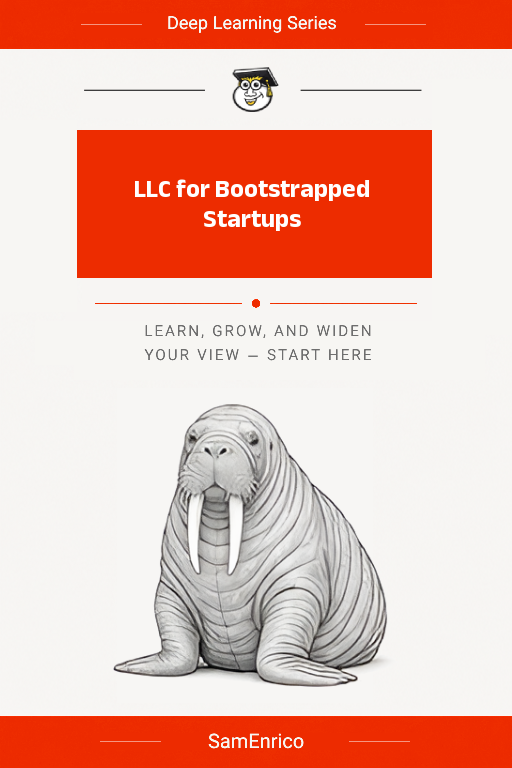
Non-FictionStartup GuideEntity Selection
LLC for Bootstrapped Startups eBook
Form an LLC for flexibility and pass-through taxat
Form an LLC for flexibility and pass-through taxation. Ideal for bootstrapped and lifestyle businesses.
Formats
Free sample
Chapter 1: The Million-Dollar Mistake--Most first-time founders make a $50,000 mistake before they ever make a dollar. They form a Delaware C-Corporation because someone on Twitter said so, because a Y Combinator video mentioned it, or because “that’s what startups do.” Then they spend the next twelve months drowning in franchise taxes, board meeting minutes, and legal fees for a business that hasn’t proven it can sell anything.I have watched this happen more than three hundred times.The pattern is always the same. A talented builder—designer, developer, plumber, consultant—gets excited about an idea. They read a few blog posts. They pay 500to Legal Zoom.Theyfilethose Delaware C−Corppaperswithasenseoflegitimacy.Andthenrealityhits.Thefirstyear’sfranchisetaxis500 to Legal Zoom.
They file those Delaware C-Corp papers with a sense of legitimacy. And then reality hits. The first year’s franchise tax is 500to Legal Zoom.Theyfilethose Delaware C−Corppaperswithasenseoflegitimacy.Andthenrealityhits.Thefirstyear’sfranchisetaxis300, even with zero revenue. The registered agent charges another $150. They need to file an annual report.
They need to track shareholder records. They need to hold board meetings. Alone. In their living room. Documenting minutes for an audience of exactly one person.This is not protection.
This is performance art.And it is bankrupting bootstrapped founders before they even begin.The Hidden Cost of Default Advice Let me tell you about Sarah. She was a marketing consultant with a growing client base. She had five retainer clients paying her 3,000permontheach.Herbusinesswassimple:shewroteemailsequencesandbuiltfunnels.Herexpenseswereherlaptop,her Zoomsubscription,andhercoffeeshopwifi.Shewasnettingabout3,000 per month each. Her business was simple: she wrote email sequences and built funnels. Her expenses were her laptop, her Zoom subscription, and her coffee shop wifi.
She was netting about 3,000permontheach.Herbusinesswassimple:shewroteemailsequencesandbuiltfunnels.Herexpenseswereherlaptop,her Zoomsubscription,andhercoffeeshopwifi.Shewasnettingabout12,000 per month after expenses.Someone told her she needed to “incorporate properly.” So she formed a Delaware C-Corp. She paid 500infilingfees.Shepaidaregisteredagent500 in filing fees. She paid a registered agent 500infilingfees.Shepaidaregisteredagent200 annually. She paid a lawyer 2,000todraftherbylawsandstockcertificates.Shepaid Delaware’s2,000 to draft her bylaws and stock certificates. She paid Delaware’s 2,000todraftherbylawsandstockcertificates.Shepaid Delaware’s300 franchise tax.
Then her home state demanded another 800becauseshewasoperatingthereasaforeignentity.Bythetimeshewasdone,shehadspentnearly800 because she was operating there as a foreign entity. By the time she was done, she had spent nearly 800becauseshewasoperatingthereasaforeignentity.Bythetimeshewasdone,shehadspentnearly4,000 on legal structure for a business that had no employees, no investors, and no debt.Her only mistake was listening to the wrong advice.Sarah should have formed an LLC in her home state. The filing fee would have been 150.Noregisteredagentrequired.Nofranchisetax.Noforeignentityregistration.Noboardminutes.Nostockcertificates.Shewouldhavesaved150. No registered agent required. No franchise tax.
No foreign entity registration. No board minutes. No stock certificates. She would have saved 150.Noregisteredagentrequired.Nofranchisetax.Noforeignentityregistration.Noboardminutes.Nostockcertificates.Shewouldhavesaved3,850 and gotten the exact same liability protection.But Sarah didn’t know what she didn’t know. And that is why I wrote this book.The Great Misalignment Here is the truth that lawyers and venture capitalists will never tell you: the legal structure that works for a funded startup is actively harmful for a bootstrapped one.
These are not just different paths. They are opposing strategies.A venture-backed startup is playing a game of hypergrowth. They raise millions of dollars. They burn cash to acquire users. They need preferred stock, liquidation preferences, and the ability to issue options to engineers who expect a liquidity event.
They file taxes as a C-Corp because investors demand Qualified Small Business Stock treatment. They pay lawyers $20,000 for a Series A financing. This makes perfect sense for them.A bootstrapped startup is playing a completely different game. You are not raising money. You are generating revenue.
Every dollar you spend on legal compliance is a dollar you cannot spend on marketing, development, or your own salary. Your “investors” are your customers. Your “liquidity event” is next month’s profit. Your legal structure should maximize flexibility, minimize taxes, and stay out of your way.An LLC does all three.The C-Corp does none of them.Yet the default advice in every online forum, every startup accelerator, every “how to start a business” article is the same: “Form a Delaware C-Corp.” It is repeated so often that founders stop questioning it. It becomes an unquestioned assumption, like gravity or death.But gravity is real.
The advice to form a Delaware C-Corp for a bootstrapped business is not.Default Alive versus Default Dead Paul Graham, the founder of Y Combinator, coined a phrase that every bootstrapper should tattoo on their forearm: “Default Alive” versus “Default Dead.”A startup is Default Alive if it will generate more money than it spends, without any additional investment. A startup is Default Dead if it will run out of money before reaching profitability, unless it raises more capital.Venture-backed startups are almost always Default Dead by design. They are engineered to burn cash, grow fast, and raise again. Their entire existence depends on the next round of funding. This is fine when the market is hot.
It is terrifying when the market freezes.Bootstrapped startups should be Default Alive from day one. Every decision, every expense, every legal structure should push you toward the simple, beautiful reality of spending less than you earn. The LLC aligns with this goal. The C-Corp actively works against it.Consider the cash flow implications. A Delaware C-Corp pays a minimum franchise tax of 300peryear,evenwithzerorevenue.Youpayaregisteredagent300 per year, even with zero revenue.
You pay a registered agent 300peryear,evenwithzerorevenue.Youpayaregisteredagent100 to 300annuallytoreceivelegalmail.Ifyouoperateinastateotherthan Delaware,youfileasaforeignentityandpaythatstate’sfeestoo.Californiacharges300 annually to receive legal mail. If you operate in a state other than Delaware, you file as a foreign entity and pay that state’s fees too. California charges 300annuallytoreceivelegalmail.Ifyouoperateinastateotherthan Delaware,youfileasaforeignentityandpaythatstate’sfeestoo.Californiacharges800 annually just for the privilege of doing business there as a foreign corporation. New York demands publication fees that can exceed $2,000. These are not hypotheticals.
These are bills that arrive whether you made a single sale or not.An LLC in your home state costs a one-time filing fee of 50to50 to 50to800, depending on where you live. That is often it. No annual franchise tax in most states. No registered agent required (you are the agent). No foreign entity registration if you only operate in your home state.
Your ongoing costs are zero.Which business would you rather run when you are trying to scrape together your first $10,000 in revenue?The Flip Trap“But what if I want to raise money later?” founders always ask.This is the Flip Trap. It is the fear that you might close a door you will need later. So you over-engineer today for a future that may never arrive. You pay thousands in unnecessary fees for an outcome that has a 99 percent chance of not happening.Let me be direct: less than one percent of startups ever raise venture capital. I am not making this number up.
The National Venture Capital Association tracks this data. Out of the millions of businesses started each year, only a few thousand receive institutional funding. The odds that your bootstrapped consulting business or Saa S tool or local service company will be one of them are astronomically low.But let’s say you are the exception. Let’s say you build something extraordinary and a VC…
This is the end of the free sample. Get the eBook to keep going. Buy now
About this book
Details
- Author
- Connell Agripina
- Publisher
- SamEnrico
- Language
- English
- Genre
- Non-Fiction, Startup Guide, Entity Selection
- Released
- 2026-06-01
- Pages (approx.)
- 148
- Available as
- eBook, Audiobook

Read better in the ZLOADR app
Your eBooks on your phone or tablet. Sign in with your SamEnrico account and start reading.
More by Connell Agripina
 John Goodman Sulley VoiceConnell Agripina$11.99
 The Blame Free Vocabulary GuideConnell Agripina$11.99
 Teen Gratitude Self EsteemConnell Agripina$11.99
 Workplace No Smoking Policy SurvivalConnell Agripina$11.99
 The Galantamine Lucid GuideConnell Agripina$11.99
 The Flute of Nectanebo: Music, Politics, and the Last Pharaoh's Olympic GambitConnell Agripina$11.99
 Understanding X-linked Lymphoproliferative SyndromeConnell Agripina$17.99
 User Testing Success StoriesConnell Agripina$12.99
 Space X: The New Space RaceConnell Agripina$11.99
 A Beginners Guide to Hand Ball (Volume 1)Connell Agripina$11.99
You may also like
 Hong Kong Handover 1997Dunn Johnnie$11.99
 Zumba For Postnatal Recovery CourseNeal Christian$11.99
 Zumba for BeginnersLadner Nikia$11.99
 YouTube Comment Mining GuideHumes Pandora$12.99
 Worry Box MeditationCarlin Rudy$11.99
 Workplace Stress MeditationNguyen Lynn$11.99
 Workplace Stress and Sleep RepairHawley Ivory$11.99
 Workplace Perfectionism CureDelaney Jeffry$11.99
 Workplace Injustice Anger GuideWallen Isabelle$11.99
 Work Addiction and Burnout LinkGreenwood Ester$11.99
 Women in Yoga and WellnessBeattie Galina$11.99
 Women in Stand Up ComedyChun Evangeline$11.99