
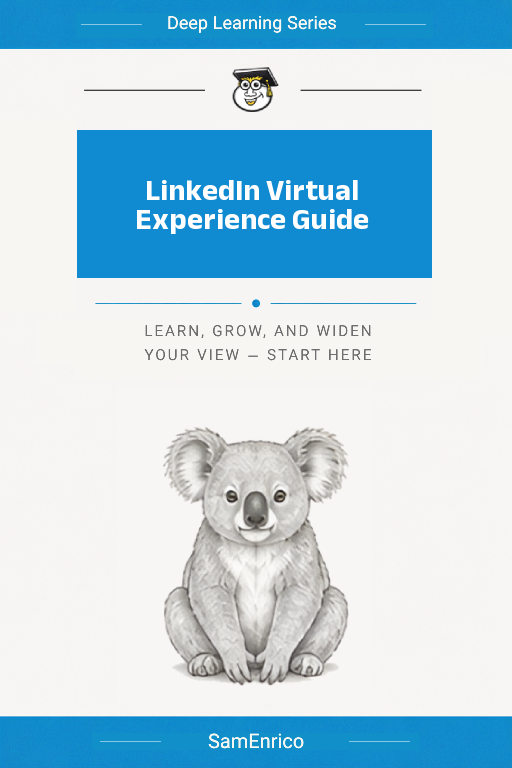
Non-FictionStudent's ShortcutProfessional Networking InternshipLinkedIn Careers
LinkedIn Virtual Experience Guide eBook
Join LinkedIn's remote internship program for prof
Join LinkedIn's remote internship program for professional networking B2B marketing and talent analytics from anywhere.
Formats
Free sample
Chapter 1: Digital Body Language--–- The notification pinged at 7:43 AM on a Tuesday. Sarah, a third-year marketing student, had just started her remote internship at a mid-sized Saa S company. She had spent the previous week completing HR paperwork, watching onboarding videos, and staring at her empty Linked In inbox. Her manager, based in a different time zone, had not messaged her in four days. She had sent three connection requests to team members; two had been ignored.
She felt present—her Slack status was always green, her email was always open—but she felt utterly invisible. That notification, however, was different. It was a connection request from a VP of Sales at a Fortune 500 company. The accompanying message was short: “Saw your comment on the B2B growth thread. You asked a smarter question than most tenured reps I know.
Would love to follow your work.” Sarah had done nothing that week except read Linked In posts and leave two thoughtful comments. Yet that single action—those 47 words she had typed under someone else’s content—had generated more professional momentum than her entire formal internship orientation.This is the paradox of the remote work era. You can be online for twelve hours a day, respond to messages instantly, and maintain a perfect attendance record at Zoom meetings, yet remain completely invisible to the people who matter. Alternatively, you can work asynchronously, check in strategically, and focus entirely on output, and suddenly decision-makers begin seeking you out. The difference between these two outcomes is not luck, not connections, and not pedigree.
It is something far more accessible and far more teachable. It is Digital Body Language.The Invisibility Epidemic Remote work has solved many problems—commute times, geographic restrictions, office politics—but it has created one devastating new problem. In a physical office, your manager can see you working. They can hear you on the phone, notice you staying late, observe you helping a colleague. These visual and auditory cues, however superficial, create a sense of presence and competence.
Remote work strips away all of that. Your manager cannot see your focused face. They cannot overhear your difficult conversation. They cannot watch you struggle through a problem before solving it. All they see is what you deliberately transmit.This is the Invisibility Epidemic.
According to a 2024 study by the Remote Work Analytics Institute, 67 percent of remote interns and early-career employees reported feeling “professionally invisible” within their first month. More concerning, 41 percent believed their managers had no accurate sense of their contributions. When asked to estimate their interns’ output, managers underestimated by an average of 34 percent. In other words, remote interns are doing more than their bosses realize—but because they lack Digital Body Language, their work does not translate into perceived value.The traditional solution to invisibility has been Availability. Stay online.
Keep Slack open. Reply within seconds. Change your status to “Active” at all hours. This approach feels productive because it is visible. You can see the green dot next to your name.
Your manager can see it too. But Availability is a trap. It rewards presence over progress, reaction over initiative, and anxiety over autonomy. The intern who replies to every message within thirty seconds but never completes a project is less valuable than the intern who replies within three hours but delivers a fully researched lead list. Yet the first intern feels safer because they look busy.This book exists to flip that equation.
You will learn to replace Availability with Activity—not random activity, but strategic, measurable, value-generating activity that leaves a trail of data your manager cannot ignore. You will learn to communicate in a way that works across time zones, across seniority levels, and across the inherent friction of remote collaboration.Defining Digital Body Language Digital Body Language is the sum of signals you send through your written communication, your responsiveness patterns, your content contributions, and your proactive updates. It is the remote equivalent of eye contact, open posture, and confident handshake. And like physical body language, it can be learned, practiced, and mastered.Drawing from Jeb Blount’s Fanatical Prospecting and Robert Cialdini’s Influence, we can identify five core components of effective Digital Body Language for remote interns:1. Response Cadence.
Not speed alone, but predictability. The most trusted remote workers do not reply instantly to every message. Instead, they establish a clear pattern: “I check messages at 9 AM, 1 PM, and 4 PM. You will always hear back within one of those windows.” This predictability builds trust because it sets expectations and meets them consistently. Erratic response times—sometimes thirty seconds, sometimes six hours—create anxiety, even when the average response time is fast.2.
Signal-to-Noise Ratio. In remote communication, every message sends two signals: the explicit content and the implicit judgment of whether that content was necessary. High-signal messages provide unique value—a data point, a decision, a solved problem, a clear ask. Low-signal messages simply acknowledge, confirm, or fill silence. “Okay,” “Got it,” “Thanks,” and “Just checking in” are noise.
The remote intern with strong Digital Body Language sends fewer total messages but a higher proportion of signal. Their manager learns to open every message because it is likely to matter.3. Proactive Exception Reporting. In an office, a manager can glance over and see if you are struggling. Remotely, they cannot.
The most valuable habit you can develop is proactive exception reporting: sending a brief update the moment something goes off track, before your manager has to ask. The template is simple: “Heads up—[X] is delayed because [Y]. I am solving by [Z]. Will update by [time].” This single habit signals maturity, ownership, and respect for your manager’s need to plan.4. Written Clarity.
Without tone of voice or facial expression, your words carry immense weight. Strong Digital Body Language requires writing that is unambiguous, concise, and structured. Use bullet points for multiple questions. Number your action items. State deadlines in the body of the message, not the subject line.
Assume nothing is obvious. The remote intern who writes clearly saves their manager hours of follow-up clarification.5. Visible Contribution Trail. Every piece of content you create—every comment, every post, every shared article—is a data point about your thinking. Strategic interns leave a trail that showcases their curiosity, their analytical ability, and their perspective.
This trail is visible to everyone, including senior leaders who would never be in a room with you. A single thoughtful comment on a VP’s post can do more for your career than a month of silent, perfect work.Activity vs. Availability: The Critical Distinction Let us examine the difference between Availability and Activity with concrete examples.Availability-Focused Intern (Alex):Wakes up and turns on Slack at 7:00 AMKeeps the green “Active” dot illuminated until 7:00 PMReplies to every message within 90 seconds Asks “Is there anything you need?” every two hours Never sends a message unless responding to one Never posts on Linked In Never leaves comments on industry content End of week: feels exhausted but has produced little original work Activity-Focused Intern (Jordan):Checks messages at 9:00 AM, 12:00 PM, and 3:00 PM only Spends mornings in deep work building lead lists Sends a single daily summary update…
This is the end of the free sample. Get the eBook to keep going. Buy now
About this book
Details
- Author
- Farrar Tenesha
- Publisher
- SamEnrico
- Language
- English
- Genre
- Non-Fiction, Student's Shortcut, Professional Networking Internship, LinkedIn Careers
- Released
- 2026-06-01
- Pages (approx.)
- 149
- Available as
- eBook, Audiobook

Read better in the ZLOADR app
Your eBooks on your phone or tablet. Sign in with your SamEnrico account and start reading.
More by Farrar Tenesha
 Mastering Emotion Regulation CourseFarrar Tenesha$11.99
 Rabbi Shlomo CarlebachFarrar Tenesha$11.99
 Hearst Comstock Load MineFarrar Tenesha$11.99
 Bangkok Hostage CrisisFarrar Tenesha$11.99
 Online Twelve Step Meeting GuideFarrar Tenesha$11.99
 The Depths of Discovery: Prince Albert's Underwater OdysseyFarrar Tenesha$11.99
 The Unlikely Alliance: How a Spy and a Playboy Saved the WorldFarrar Tenesha$11.99
 How to Become a Car DropperFarrar Tenesha$11.99
 Before School Club AssistantFarrar Tenesha$11.99
 Understanding Bork–stender–Schmidt SyndromeFarrar Tenesha$17.99
 Polish Remote Worker Productivity ToolsFarrar Tenesha$12.99
You may also like
 Hong Kong Handover 1997Dunn Johnnie$11.99
 Zumba For Postnatal Recovery CourseNeal Christian$11.99
 Zumba for BeginnersLadner Nikia$11.99
 YouTube Comment Mining GuideHumes Pandora$12.99
 Worry Box MeditationCarlin Rudy$11.99
 Workplace Stress MeditationNguyen Lynn$11.99
 Workplace Stress and Sleep RepairHawley Ivory$11.99
 Workplace Perfectionism CureDelaney Jeffry$11.99
 Workplace Injustice Anger GuideWallen Isabelle$11.99
 Work Addiction and Burnout LinkGreenwood Ester$11.99
 Women in Yoga and WellnessBeattie Galina$11.99
 Women in Stand Up ComedyChun Evangeline$11.99