
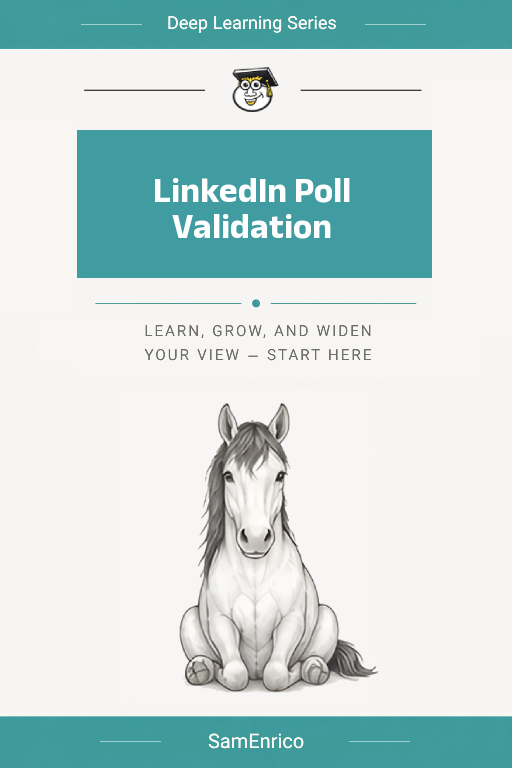
LinkedIn Poll Validation eBook
Validate B2B ideas using free LinkedIn polls. Prof
by Mojica Gavin
Validate B2B ideas using free LinkedIn polls. Professional audience feedback.
Formats
Free sample
Chapter 1: The Validation Paradox--For eighteen months, Sarah had been chasing ghosts.As the founder of a B2B analytics startup, she had done everything right. She had conducted over two hundred discovery calls with potential customers. She had attended fourteen industry conferences. She had built a prototype based on what every single VP of Sales told her they desperately needed: real-time revenue dashboards.The feedback was unanimous. “Yes, we need this.” “When can you ship it?” “Where do I sign up?”So Sarah raised $1.2 million, hired a team of six engineers, and spent nine months building the most beautiful real-time revenue dashboard the world had ever seen.She launched with a splash.
Sent demos to every VP of Sales who had said yes. Posted on Linked In. Ran ads.Zero. Crickets. Nothing.Three people signed up for a free trial.
Zero converted to paid.Sarah had just learned a painful lesson that most B2B founders learn too late: customers lie. Not maliciously. Not even intentionally. But they lie all the same.They lie because they like you. They lie because they want to seem smart.
They lie because saying “no” feels awkward. And they lie because in a live conversation, the social cost of disappointing someone is higher than the cost of giving a vague, hopeful “yes.”Sarah’s story is not unique. It is the rule, not the exception. According to research cited in The Mom Test, nearly 80 percent of positive feedback from direct customer interviews fails to translate into actual purchases. The gap between “I would buy that” and “I did buy that” is a chasm wide enough to swallow startups whole.This book exists because that chasm has a bridge.
And that bridge is built with Linked In polls.The Core Problem: The Politeness Trap Let me ask you a question. When was the last time you told someone “no” to their face?Not a salesperson you’ll never see again. Not a cold email you deleted. But a real human being, sitting across from you, passionate about their idea, asking for your honest opinion.It feels terrible, doesn’t it? You see their hope.
You sense their investment. And somewhere in your brain, a little voice says: “Just say something nice. It won’t hurt anyone.”That little voice is the destroyer of market research.Psychologists call this social desirability bias — the tendency for people to present themselves in a favorable light, even in anonymous surveys, but especially in face-to-face interactions. When a founder asks “Would you use this product?” the customer hears a subtext: “Please validate my life’s work.”And most humans, being decent, oblige.But social desirability bias is only one of three liars hiding inside every customer interview. The second is politeness bias — the fear of hurting someone’s feelings.
This is particularly acute in B2B settings, where relationships matter. A VP of Marketing might have to work with you someday. Burning that bridge by saying “Your product idea is terrible” seems foolish.The third is fear of commitment. Even when a customer genuinely likes your idea, they hesitate to say yes because they fear what comes next: a sales follow-up, a demo request, a pricing discussion. Saying “yes” in an interview feels like the first step down a path they aren’t ready to walk.Together, these three biases create what I call the Validation Paradox: the people you most need feedback from are the least likely to give you honest answers in a live conversation.And here is the cruel irony: the more senior and influential the customer, the worse the problem becomes.
A VP of Product has more to lose by being wrong. A CTO has less time for follow-ups. A CEO has learned to say “interesting” when they mean “never.”You cannot interview your way to truth. Not reliably. Not at scale.The Uncomfortable Truth About Anonymous Crowds If live conversations are so polluted by bias, where can you find honest feedback?The answer is counterintuitive: anonymous crowds.Think about the last time you left a negative product review on Amazon.
Or downvoted a comment on Reddit. Or selected “Not interested” on a Linked In poll. In those moments, you were brutally honest. Why? Because no one was watching.
Because the social cost was zero. Because you could tell the truth without disappointing anyone.That is the power of asynchronous anonymity.Linked In polls, when designed correctly, tap directly into this psychological vein. The voter is alone with their screen. The founder is not staring at them. The poll results are aggregated, not attributed.
There is no follow-up obligation. There is no relationship to protect.In that moment, the VP of Sales who told you “yes” to your face can finally tell the truth.And the truth is often devastating.Sarah, the founder from our opening story, eventually ran a Linked In poll. She asked a simple question to her network of VPs of Sales: “Which sales analytics feature would save your team the most time?” The options were: Real-time dashboards, Data import automation, Forecast accuracy tools, and Territory planning.After two hundred interviews saying “real-time dashboards,” the poll told a different story. Data import automation won by a landslide. Thirty-eight percent of voters chose it.
Real-time dashboards came in third at seventeen percent.Sarah had built the wrong product because she had asked the wrong question in the wrong way.When she finally interviewed the voters who chose data import automation, she discovered the truth: every sales team she had spoken to was already using real-time dashboards from Salesforce or Tableau. They didn’t need another one. What they needed was a way to get messy CRM data cleaned and imported without hiring a data analyst.That was a problem worth solving. But she would never have discovered it in a live interview because no VP wanted to admit that their data was a mess. Politeness bias protected their ego.
Anonymity revealed their pain.The Honesty Gap: Quantifying the Lie How much do customers lie in interviews? Enough to bankrupt a startup.Let me introduce you to the Honesty Gap Calculator. It is not a precise mathematical formula — human behavior resists precision — but it is a useful heuristic for estimating the gap between what customers say and what they will do.The formula is simple: Adjusted Demand = Stated Demand × (1 - Bias Factor)The bias factor varies by context, but after analyzing dozens of B2B product launches, I have observed a consistent range:For problem validation (“Does this pain exist?”): Bias factor of 0.2 to 0.3. Meaning, if 80 percent of interviewees say a problem keeps them up at night, the true percentage is likely 50-65 percent.For solution validation (“Would you use this solution?”): Bias factor of 0.4 to 0.6. If 70 percent say they would use it, the true adoption rate is closer to 25-40 percent.For pricing validation (“Would you pay X for this?”): Bias factor of 0.6 to 0.8.
If 50 percent say they would pay $99 per month, the true willingness to pay is closer to 10-20 percent.For intent to purchase (“Will you buy this in the next 90 days?”): Bias factor of 0.7 to 0.9. If 40…
This is the end of the free sample. Get the eBook to keep going. Buy now
About this book
Details
- Author
- Mojica Gavin
- Publisher
- SamEnrico
- Language
- English
- Genre
- Non-Fiction, Startup Guide, Lean Methodology
- Released
- 2026-06-01
- Pages (approx.)
- 133
- Available as
- eBook, Audiobook

Read better in the ZLOADR app
Your eBooks on your phone or tablet. Sign in with your SamEnrico account and start reading.
More by Mojica Gavin
 Jealousy Meditation GuideMojica Gavin$11.99
 Anger at Child’s Early DatingMojica Gavin$11.99
 Account Executive BurnoutMojica Gavin$11.99
 The IBS Clinical Trial GuideMojica Gavin$11.99
 The Relapse Prevention for BenzodiazepinesMojica Gavin$11.99
 Lyssa’s Curse: The Madness of ActaeonMojica Gavin$11.99
 Safe Sleep Training (for Childcare)Mojica Gavin$11.99
 Invoice Factoring Emerging Markets GuideMojica Gavin$12.99
 Understanding Thumb Deformity, Alopecia, Pigmentation AnomalyMojica Gavin$17.99
 How to Become a Leather EtcherMojica Gavin$11.99
You may also like
 Lean Business Plan TemplateSwart Jannette$11.99
 No Money Idea Validation GuideLevy Joel$12.99
 Zero Cost Pivot GuideJoyner Cammie$12.99
 Solution Interview TechniqueCreech Blythe$12.99
 Reddit Validation MethodBarnette Ellie$12.99
 Quora Question ValidationMcmanus Jenifer$12.99
 Problem Interview TechniqueCordero Mafalda$12.99
 MVP Without Coding GuideRoche Alejandra$12.99
 Google Forms Survey GuidePuente Micah$12.99
 Free YouTube Channel GuideNixon Odette$12.99
 Free Video Validation GuideMcallister Tosha$12.99
 Free Validation Template PackGrubbs Delicia$12.99