
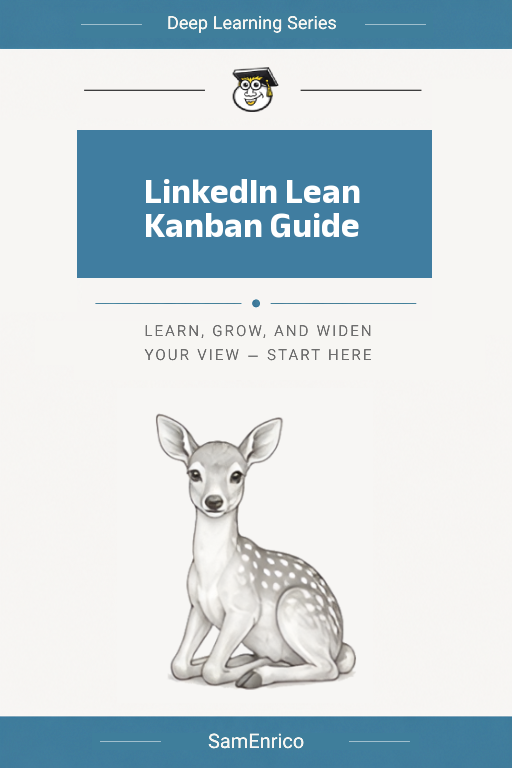
LinkedIn Lean Kanban Guide eBook
Reduce waste using LinkedIn style value stream map
by Bull Vannesa
Reduce waste using LinkedIn style value stream mapping and Kanban for early stage product development.
Formats
Free sample
Chapter 1: The Spam In Mail Economy--–- The first time I watched a founder present a feature they had spent six weeks building, only to hear a beta user say, “That’s nice, but I would never use it,” I realized something fundamental was broken. Not the founder. Not the user. Not even the feature, necessarily. What was broken was the invisible assumption that building things and shipping things and completing tickets was the same as creating value.
That founder had done everything right by conventional startup standards. They had a backlog. They had sprints. They had daily standups. They had a burndown chart that looked beautiful.
And they had just wasted six weeks of engineering time on something nobody wanted.The startup world has a dirty secret that no one talks about in blog posts or conference keynotes. The secret is that most of the work done in early-stage product development is waste. Not the kind of waste you can see, like a server that isn’t being used or a marketing campaign that went to the wrong audience. The kind of waste that hides inside the very processes designed to prevent it. The kind of waste that feels like progress because it produces artifacts—code commits, design files, meeting notes, ticket closures—but produces no actual value for actual customers.I call this the Spam In Mail Economy.Think about what happens when someone sends a spam In Mail on Linked In.
They write a message. They click send. It reaches a thousand inboxes. The sender feels productive. They did a thing.
The platform counts it as an action. But the recipients ignore it, delete it, or report it. No connections are made. No relationships are formed. No value is created.
The sender has engaged in activity that looks like work but produces nothing but waste.Now think about what happens when a startup team builds a feature that no one uses. They write code. They run tests. They deploy to production. The team feels productive.
They did a thing. The project management tool counts it as a completed ticket. But the users ignore it. No retention is improved. No revenue is generated.
No value is created. The team has engaged in activity that looks like work but produces nothing but waste.The Spam In Mail Economy is the default state of most early-stage product development. And the only way out is to see waste clearly, name it honestly, and build a system that makes it impossible to ignore.This chapter is about that system. Or rather, this chapter is about the first part of that system: seeing waste. You cannot fix what you cannot see.
And most startup teams are flying blind, not because they are incompetent, but because they are using the wrong lenses. The traditional lenses of project management—velocity, burndown, story points, hours logged—show you activity. They do not show you waste. To see waste, you need a different set of lenses. You need to understand the eight forms of waste that plague early-stage product development.
You need to recognize the False Positive Trap, where features pass internal reviews but fail in the real world. And you need a simple, brutal tool to audit every feature before it consumes a single hour of engineering time.Let us begin with a story about a dashboard that took three months to build and three days to ignore.The Dashboard That No One Asked For A few years ago, I was advising a B2B Saa S startup that had raised a respectable seed round. They had five engineers, two founders, and a burning desire to build something enterprise-ready. One of their enterprise prospects had mentioned in a sales call that they would love to see “better reporting.” That was it. One sentence in a thirty-minute conversation.
No specifics. No follow-up questions. No validation.The team took that sentence and ran with it. For three months, they built a comprehensive analytics dashboard. It had charts.
It had filters. It had exports to CSV. It had scheduled email reports. It was, by any objective measure, a well-built piece of software.They demoed it to the prospect. The prospect said, “Wow, this is impressive.” The team celebrated.
They shipped it. They wrote a blog post about it. They added it to their pricing page as a feature.And then nothing happened.Existing users did not use it. New users did not ask for it. The prospect who had inspired it never actually logged in to look at a single report.
The dashboard sat there, generating zero value, consuming zero user attention, but occupying a permanent spot in the codebase, the documentation, and the team’s collective sense of what they had “shipped.”This is not a story about a bad team. It is a story about a common waste pattern. And it is the reason this book exists.The Eight Wastes of Early-Stage Product Development Lean manufacturing, originating from the Toyota Production System, famously identifies seven wastes. Later adaptations added an eighth. The acronym TIMWOODS (or TIMWOOD) helps practitioners remember them: Transport, Inventory, Motion, Waiting, Overproduction, Overprocessing, Defects, and Skills.
These wastes were originally described in the context of physical goods moving through a factory. But they translate directly and powerfully to the world of early-stage product development. The key is to translate them into the language of startups, where the “product” is not a car or a widget but a feature, a user story, or a line of code. And the most powerful way to make these wastes tangible is to pair each one with a Linked In analogy. Because every professional understands the visceral feeling of a wasted action on Linked In.Transport Waste: The In Mail That Gets Forwarded Four Times Transport waste is the unnecessary movement of information or materials.
In a factory, this might be parts moving between distant workstations. In product development, transport waste is the friction of moving requirements, designs, or questions between tools and people.Every time a product requirement travels from a customer interview (noted in a notebook) to a Google Doc to a Notion database to a Jira ticket to a Slack channel to a Figma comment to a pull request description, that movement is waste. Each handoff introduces delay, distortion, and the possibility of miscommunication. The worst form of transport waste in early-stage startups is the requirement that lives in five different places, none of which are updated consistently, so no one knows what the current truth actually is.The Linked In parallel is the In Mail that gets forwarded from one person to another to another without anyone replying. You have seen this.
Someone sends a question. The recipient forwards it to a colleague “who handles this.” That colleague forwards it to another. The original sender waits, hears nothing, and eventually gives up. The message traveled. Nothing happened.Inventory Waste: The Backlog of 300 Features Inventory waste is work that has been started but not finished, or work that has been produced but not consumed.
In a factory, inventory is stacks of partially assembled parts. In product development, inventory is the backlog of features that have been…
This is the end of the free sample. Get the eBook to keep going. Buy now
About this book
Details
- Author
- Bull Vannesa
- Publisher
- SamEnrico
- Language
- English
- Genre
- Non-Fiction, Startup Guide
- Released
- 2026-06-01
- Pages (approx.)
- 147
- Available as
- eBook, Audiobook

Read better in the ZLOADR app
Your eBooks on your phone or tablet. Sign in with your SamEnrico account and start reading.
More by Bull Vannesa
 Open Office Noise Survival GuideBull Vannesa$11.99
 IBS CBT Therapy GuideBull Vannesa$11.99
 Discussing Sleep Divorce ArrangementBull Vannesa$11.99
 Scheduling for Job SeekersBull Vannesa$11.99
 Teen Self Esteem and MovingBull Vannesa$11.99
 Persuasion In PoliticsBull Vannesa$11.99
 The Full Time Freelance PipelineBull Vannesa$11.99
 Hydration for Driving CalmBull Vannesa$11.99
 Cervical Dizziness and Neck Pain ExerciseBull Vannesa$11.99
 The Forbidden Code: Love, Espionage, and the Enigma of Alan TuringBull Vannesa$11.99
 The Panama Papers: Ghosts in the MachineBull Vannesa$11.99
 The Last Broadcast of the Titanic: The Forgotten Voice of Jack ThayerBull Vannesa$11.99
You may also like
 Hong Kong Handover 1997Dunn Johnnie$11.99
 Zumba For Postnatal Recovery CourseNeal Christian$11.99
 Zumba for BeginnersLadner Nikia$11.99
 YouTube Comment Mining GuideHumes Pandora$12.99
 Worry Box MeditationCarlin Rudy$11.99
 Workplace Stress MeditationNguyen Lynn$11.99
 Workplace Stress and Sleep RepairHawley Ivory$11.99
 Workplace Perfectionism CureDelaney Jeffry$11.99
 Workplace Injustice Anger GuideWallen Isabelle$11.99
 Work Addiction and Burnout LinkGreenwood Ester$11.99
 Women in Yoga and WellnessBeattie Galina$11.99
 Women in Stand Up ComedyChun Evangeline$11.99