
Non-FictionNon-Obvious CareerLinkedIn
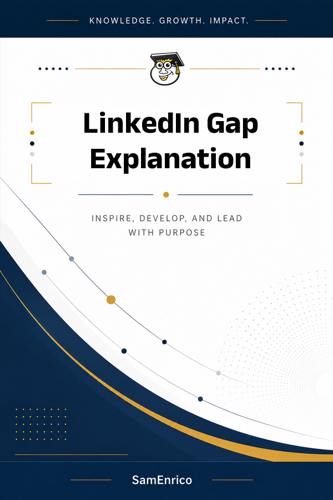
LinkedIn Gap Explanation eBook
Address employment breaks on your professional pro
by Hawley Tory
Address employment breaks on your professional profile.
Formats
Free sample
Chapter 1: The White Space--–- The email arrives at 11:47 AM on a Tuesday. You have been unemployed for four months, or perhaps seven, or perhaps you have stopped counting because the arithmetic has started to feel like a form of self-punishment. A recruiter from a company you actually respect has found your Linked In profile. The message is friendly, professional, and slightly generic: "Your background looks interesting. Would you have fifteen minutes this week for a quick call?"Your heart rate spikes.
Then, almost immediately, it sinks.Because you know what comes next. Before the phone screen. Before the hiring manager. Before anyone asks about your skills, your achievements, or your cultural fit. There is the profile.
And on that profile, lurking in the space between the end of your last position and whatever you have been doing since, is the gap. A stretch of white space on an otherwise tidy timeline. A question mark rendered in pixels. A pause that the human eye is neurologically incapable of ignoring.You have considered lying. You have considered deleting the dates entirely.
You have considered rebranding the entire period as "freelance" and hoping no one asks for client names or tax documents. You have considered leaving the gap completely unaddressed and praying that the recruiter is too busy or too distracted to notice. None of these strategies feel right, and that unease is not merely your anxiety speaking. It is your professional intuition recognizing that almost everything you have been told about employment gaps is dangerously, even catastrophically, wrong.This book exists because the conventional wisdom has failed you. "Just be honest," they say, as if honesty alone has ever protected anyone from algorithmic filtering or unconscious bias.
"Explain it in the interview," they say, as if you will ever reach the interview without first surviving the seven-second visual scan. "Focus on your skills," they say, as if skills alone can compensate for a timeline that appears to have been abandoned.The truth is more complex, but it is also far more liberating. Employment gaps are not the problem. Your inability to control how they are seen is the problem. And that inability is not a character flaw.
It is a skill gap. And like any skill gap, it can be closed with the right knowledge and the right tools.This chapter will show you why recruiters cannot help but notice gaps, why the traditional advice to hide or hope fails every single time, and how to begin shifting your mindset from concealment to what I call strategic timeline management. By the end of these pages, you will understand the neuroscience of the professional scan, the specific visual triggers that transform a neutral pause into a red flag, and the first practical steps toward reclaiming control of your professional narrative.The Neuroscience of Professional Judgment Before we discuss Linked In profiles or recruitment algorithms or any of the tactical strategies that fill the rest of this book, we must first understand the biological reality of how another human being looks at your timeline. The recruiter on the other side of the screen is not your enemy. She is not actively searching for reasons to reject you.
She is, however, a human being with a brain that evolved to detect threats and anomalies in visual patterns long before it evolved to read resumes or evaluate career trajectories.Pattern recognition is one of the oldest and most powerful functions of the human mind. Your distant ancestors survived because they could spot the difference between a harmless rustle in the grass and a predator about to strike. This same neural machinery, refined over millions of years of evolution, is now applied to professional timelines. A tidy sequence of "Job A → Job B → Job C" creates a predictable pattern. Any disruption to that pattern—missing months, inconsistent date formatting, a stretch of unlabeled time—triggers an automatic alert response in the amygdala, the part of the brain responsible for threat detection.This is not conscious bias.
It is not malice. It is neurobiology.Dr. Susan Weinschenk, a behavioral psychologist who has spent decades studying how people interact with digital information, found that the human brain processes visual patterns in as little as fifty milliseconds. That is fifty thousandths of a second. For context, that is roughly ten times faster than the time it takes to blink.
In her research on resume and profile scanning, Weinschenk discovered that recruiters form what she calls a "global impression" of a candidate within the first few seconds of viewing a profile. That impression is based almost entirely on visual structure, not on content. The words come later. The pattern comes first.What does this mean for you? It means that a gap does not need to be fully explained in the first second.
It simply needs to not trigger the alarm. The goal of this book is not to help you write the perfect gap explanation. The goal is to help you format, frame, and position your gap so that the recruiter's ancient, pattern-hungry brain reads it as a neutral pause rather than a suspicious absence.The Seven-Second Window Let us put a specific number on this phenomenon. Multiple peer-reviewed studies of recruiter behavior, including a widely cited 2018 study conducted by The Ladders in collaboration with eye-tracking laboratories, have found that recruiters spend an average of seven to ten seconds scanning a Linked In profile before making an initial decision about whether to read more deeply or move to the next candidate. Seven seconds.
That is less time than it takes to tie a pair of shoelaces, microwave a cup of coffee, or send a single text message.In those seven seconds, the recruiter's eyes follow a remarkably predictable path. They start at your photo and headline, then jump to your current position (if you have one), then scan down the left side of your Experience section looking for the most recent two or three roles. If the timeline is visually continuous and the job titles are relevant to the search, the recruiter clicks "expand" or sends an In Mail. If the timeline shows a gap—especially a gap longer than three months with no explanatory text or a gap that appears as empty white space—the recruiter's brain registers a disruption. The seven-second scan becomes a five-second scan as they move their attention to the next candidate in the search results.Here is the brutal math that most career advice books refuse to acknowledge.
A typical corporate job posting attracts approximately two hundred and fifty resumes. Of those, four to six candidates will receive phone screens. Perhaps two or three will advance to final interviews. One will receive an offer. In a market that competitive, you cannot afford to lose the recruiter's attention during the seven-second window.
The gap does not need to be invisible. It simply cannot be the thing that stops the scan.I have worked with hundreds of professionals across every industry who believed that their gap was simply too large, too recent, or too personally embarrassing to overcome. A software engineer who spent eighteen months caring for a parent with advanced dementia. A marketing director who…
This is the end of the free sample. Get the eBook to keep going. Buy now
About this book
Details
- Author
- Hawley Tory
- Publisher
- SamEnrico
- Language
- English
- Genre
- Non-Fiction, Non-Obvious Career, LinkedIn
- Released
- 2026-06-09
- Pages (approx.)
- 139
- Available as
- eBook, Audiobook

Read better in the ZLOADR app
Your eBooks on your phone or tablet. Sign in with your SamEnrico account and start reading.
More by Hawley Tory
 Stress Vagal Tone ConnectionHawley Tory$11.99
 Pelvic Floor for Men GuideHawley Tory$11.99
 Water As Primary BeverageHawley Tory$11.99
 The Growth Mindset Team GuideHawley Tory$11.99
 The Gladiators of the Games: Ancient Paralympians and the Birth of Adaptive SportHawley Tory$11.99
 Facebook Ad Learning PhaseHawley Tory$12.99
 Nairobi Startup FundingHawley Tory$12.99
 The Breeder's Guide to Buff DucksHawley Tory$11.99
 How to Start a Body for Bus Business (Beginners Guide)Hawley Tory$11.99
 Cloud Network EngineerHawley Tory$11.99
You may also like
 Hong Kong Handover 1997Dunn Johnnie$11.99
 Zumba For Postnatal Recovery CourseNeal Christian$11.99
 Zumba for BeginnersLadner Nikia$11.99
 YouTube Comment Mining GuideHumes Pandora$12.99
 Worry Box MeditationCarlin Rudy$11.99
 Workplace Stress MeditationNguyen Lynn$11.99
 Workplace Stress and Sleep RepairHawley Ivory$11.99
 Workplace Perfectionism CureDelaney Jeffry$11.99
 Workplace Injustice Anger GuideWallen Isabelle$11.99
 Work Addiction and Burnout LinkGreenwood Ester$11.99
 Women in Yoga and WellnessBeattie Galina$11.99
 Women in Stand Up ComedyChun Evangeline$11.99