
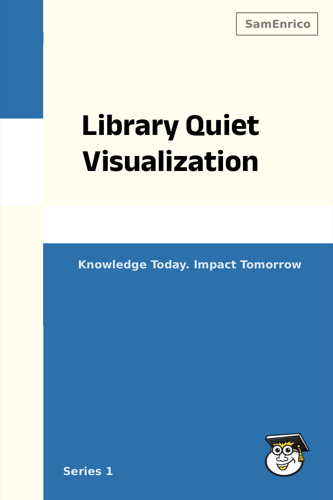
Non-FictionSelf-HelpQuiet Mind
Library Quiet Visualization eBook
Sit in a grand library surrounded by knowledge and
by Ginn Glennie
Sit in a grand library surrounded by knowledge and absolute silence.
Formats
Free sample
Chapter 1: The Architecture of Attention--You have been trying to think your way to calm, and it has not worked. For years, you have told yourself to focus, to relax, to stop worrying, to be present. You have downloaded meditation apps, read books on mindfulness, and maybe even sat on a cushion trying to empty your mind. And yet, here you are, still scattered, still overstimulated, still unable to find the quiet that everyone promised was just three deep breaths away. This is not your fault.
You have been fighting against the very architecture of your own brain, and you cannot win that fight with willpower alone.The truth is simple but rarely stated: your environment dictates your mental state more than any amount of self-discipline ever could. Walk into a hospital emergency room at midnight, and your shoulders will tense before you have even registered the fluorescent lights. Step onto a quiet beach at sunrise, and your breath will slow without any conscious instruction. Your nervous system is not listening to your affirmations. It is listening to the room.
It is feeling the ceiling height, the ambient noise, the temperature, the texture of the air. And until you understand this, you will continue to exhaust yourself trying to shout down your own biology.This book offers a different path. Instead of fighting your environment, you are going to build one. Instead of trying to silence your mind through brute force, you are going to construct a mental space so perfectly designed for quiet that your brain will have no choice but to settle. That space is a library.
Not just any library, but a grand, silent, infinite library of your own making. And by the end of this chapter, you will have walked through its doors for the first time.Why a Library?Most guided visualizations ask you to imagine a beach, a forest, or a meadow. These are pleasant places, but they are not designed for focus. A beach invites you to drift. A forest invites you to explore.
A meadow invites you to lie down and nap. These are not bad things, but they are not what you need when you are trying to concentrate, solve a problem, regulate an emotion, or access deep inner wisdom. What you need is structure.A library is the only common space that explicitly exists for quiet, sustained attention. From the moment you enter a real library, you change. You lower your voice.
You walk more softly. You scan for empty tables. You take off your headphones without being asked. This is not politeness; it is a physiological response to architectural cues. High ceilings create a sense of reverence.
Warm wood and soft lighting signal safety. The sheer volume of books reminds you that you are small, which paradoxically quiets the ego’s constant chatter. And the silence is not an absence; it is a presence. You can feel it pressing gently against your eardrums.Your brain evolved in environments where silence meant safety. A noisy forest meant predators.
A quiet cave meant shelter. That ancient wiring still runs your nervous system today. When you enter a silent, enclosed, warm space filled with the tools of knowledge, your brain receives a single, unambiguous message: You are safe. You can stop scanning for threats. You can focus now.This is the secret that the bestselling books on productivity and mindfulness have missed.
They tell you to meditate anywhere, to find stillness in chaos, to be the calm in the storm. And yes, that is the ultimate goal. But you cannot start there. You cannot run a marathon before you can walk. First, you need a place where stillness is easy.
Then you learn to carry it with you.The Myth of Perfect Visualization Before we go any further, let me address the single biggest reason people give up on visualization practices. You may have already thought it. Here it is: I can’t see pictures in my mind.This is extraordinarily common, and it is not a barrier to this practice. The word "visualization" is misleading. It implies that the primary sense is sight, but for many people, it is not.
Some people feel. Some people hear. Some people simply know where things are in space without seeing them. All of these are valid. All of these work.If you close your eyes and try to picture a red apple, what happens?
Some of you will see a crisp, detailed apple floating against a dark background. Good for you. Some of you will see a vague, transparent outline that disappears when you try to look at it directly. Some of you will not see anything at all, but you will feel the concept of an apple, or you will hear the crunch of a bite, or you will know where the apple is in relation to your body. And some of you will see nothing, feel nothing, hear nothing, and assume you have failed.You have not failed.
You are simply using a different sensory channel.Throughout this book, every practice will include an alternative for non-visualizers. Instead of "seeing" the library, you will be guided to feel the temperature drop, hear the echo of your footsteps, sense the weight of the doors, smell the old paper and beeswax. Your mind knows how to do this. You have been doing it your whole life. When you remember your childhood home, you may not see a photograph in your mind, but you know which way the stairs turned.
That is enough. That is more than enough.So release the pressure. Stop trying to see. Start trying to be there. The library does not care if you see it in high definition.
It only cares if you arrive.The External Reference Desk One of the most useful concepts in this book is something I call the External Reference Desk. In the original outline for this work, it was called an "external hard drive," but that metaphor is flawed. A hard drive is finite. It fills up. It can crash.
Your library is none of those things.The External Reference Desk is the place in your library where you store not memories, but access points to calm. Think of it as a permanent, infinitely expandable workspace that exists outside the chaos of your daily life. When you are anxious, you do not have to solve the anxiety. You simply walk to the Reference Desk, and the calm is already there, waiting for you. When you forget a name or a deadline, you do not have to rummage through the clutter of your working memory.
You walk to the Reference Desk, and the information is filed exactly where you left it.This is not magic. It is the Method of Loci, an ancient mnemonic technique used by Greek and Roman orators to memorize speeches that lasted hours. They discovered that the human brain remembers places far better than it remembers facts. You may forget what you ate for breakfast, but you can walk through your childhood home in your mind, room by room, without effort. The library hijacks this evolutionary quirk.
By attaching calmness and information to specific locations in an imagined space, you make them far easier to retrieve than…
This is the end of the free sample. Get the eBook to keep going. Buy now
About this book
Details
- Author
- Ginn Glennie
- Publisher
- SamEnrico
- Language
- English
- Genre
- Non-Fiction, Self-Help, Quiet Mind
- Released
- 2026-06-06
- Pages (approx.)
- 129
- Available as
- eBook, Audiobook

Read better in the ZLOADR app
Your eBooks on your phone or tablet. Sign in with your SamEnrico account and start reading.
More by Ginn Glennie
 EU Seller Amazon USA GuideGinn Glennie$11.99
 Morning Routine Blue ZoneGinn Glennie$11.99
 Fractionation MethodGinn Glennie$11.99
 The Loving Kindness for ProcrastinationGinn Glennie$11.99
 The Navigators of the Indian Ocean: The Swahili Mariners and the Spice TradeGinn Glennie$11.99
 Industrial / Manufacturing EngineeringGinn Glennie$11.99
 Fast Food GuideGinn Glennie$12.99
 Non Resident LLC for FreelancersGinn Glennie$12.99
 Understanding Reflex Sympathetic Dystrophy SyndromeGinn Glennie$17.99
 How to Start a Napkin Liners Business (Beginners Guide)Ginn Glennie$11.99
You may also like
 Hong Kong Handover 1997Dunn Johnnie$11.99
 Zumba For Postnatal Recovery CourseNeal Christian$11.99
 Zumba for BeginnersLadner Nikia$11.99
 YouTube Comment Mining GuideHumes Pandora$12.99
 Worry Box MeditationCarlin Rudy$11.99
 Workplace Stress MeditationNguyen Lynn$11.99
 Workplace Stress and Sleep RepairHawley Ivory$11.99
 Workplace Perfectionism CureDelaney Jeffry$11.99
 Workplace Injustice Anger GuideWallen Isabelle$11.99
 Work Addiction and Burnout LinkGreenwood Ester$11.99
 Women in Yoga and WellnessBeattie Galina$11.99
 Women in Stand Up ComedyChun Evangeline$11.99