
Non-FictionCapital & Valuation Register
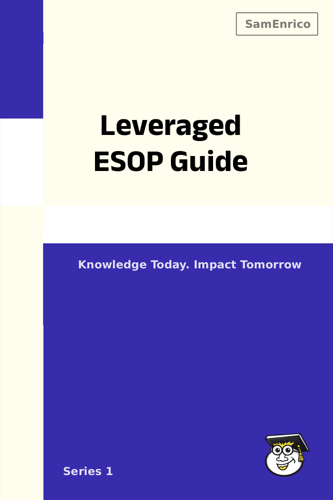
Leveraged ESOP Guide eBook
Documents trust borrowing to acquire sponsor share
Documents trust borrowing to acquire sponsor shares.
Formats
Free sample
Chapter 1: The Silver Tsunami–- On a rainy Tuesday in October, Carol Mitchell, the 63-year-old founder of Mitchell Manufacturing, sat alone in her corner office after everyone else had gone home. The company had been her life for thirty-seven years. She had built it from a single lathe in her garage to a 210-person operation serving the automotive supply chain. Her son, who had run the shipping department for a decade, had just announced he was moving to Arizona with his family. Her daughter, a doctor in Chicago, had never shown any interest in the business.
The private equity firms had been circling like sharks for the past eighteen months, and the most recent offer—a "generous" one, they said—would pay Carol a handsome sum but would almost certainly result in layoffs, a roll-up into a larger portfolio company, and the slow erosion of everything she had built.Carol had a choice. She could sell to the highest bidder, take her money, and walk away, pretending not to notice when the new owners shut down the second shift and outsourced the machining work to a plant in Mexico. Or she could find another way—one that kept the jobs in her community, preserved her legacy, and gave her people something they had never had before: actual ownership in the company they had given their lives to.That other way is what this book is about. It is called a Leveraged ESOP. And it is one of the most powerful, most misunderstood, and most underutilized financial tools available to any business owner in America today.The Crisis No One Is Talking About Every single day for the next decade, roughly ten thousand American workers will reach the age of sixty-five.
That is not a prediction. It is a mathematical certainty. The baby boomer generation—seventy-three million people strong—is retiring in what demographers have called the Silver Tsunami. But here is what most of the news coverage misses: embedded within that wave of retirees are more than 2.5 million business owners who will need to exit their companies in the next ten to fifteen years. These are not giant corporations.
They are the machine shops, the distribution warehouses, the commercial printers, the specialty food producers, the construction firms, the engineering consultancies, and the family-owned manufacturers that form the backbone of the American economy.According to the United States Census Bureau and the Exit Planning Institute, approximately 60 percent of private business owners are between the ages of fifty-five and seventy-five. The average age of a business owner today is 62.4 years. And yet—and this is the number that should keep every economic development official awake at night—only about 30 percent of these owners have a formal written succession plan.What happens to the other 70 percent? Some will close their doors, liquidating assets and sending employees into an uncertain job market. Some will sell to competitors, often at fire-sale prices.
Some will transfer to family members who may or may not be capable of running the business. And some—a significant and growing number—will sell to private equity firms.A sale to private equity is not inherently bad. For certain companies, in certain circumstances, it can be the right answer. But private equity has a structural imperative that is often at odds with the values of a family or founder-owned business. Private equity firms raise money from institutional investors—pension funds, endowments, insurance companies—with a mandate to generate returns within a specific time horizon, typically five to seven years.
They do this by acquiring companies, often using significant leverage, and then implementing operational improvements, cost reductions, and add-on acquisitions to grow the business before selling it to another buyer or taking it public.The employees of a private equity-owned company are not the owners. They are inputs. They are line items on a spreadsheet. And when the spreadsheet says that costs need to be reduced, the line items get eliminated. This is not villainy.
It is arithmetic. But it is arithmetic that Carol Mitchell, sitting alone in her office, found deeply at odds with the relationship she had built with her 209 employees over thirty-seven years.There is a third option. It is not theoretical. It has been used successfully by more than 6,500 companies in the United States, employing more than 14 million workers. It has been endorsed by economists on both sides of the political aisle.
It has been shown in multiple academic studies to increase productivity, reduce turnover, and build long-term wealth for ordinary working people. And yet, most business owners have never heard of it, or if they have, they have dismissed it as too complicated, too expensive, or too risky.That third option is selling your company to your employees through a Leveraged Employee Stock Ownership Plan—a LESOP.What Is a LESOP? (The Thirty-Second Version)Let us start with the simplest possible definition, because the financial and legal details can become overwhelming quickly.A Leveraged ESOP is a retirement plan—like a 401(k)—that is allowed to borrow money to buy the stock of the company that sponsors it. That is it. That is the core idea.Here is how it works in practice: the company creates a trust.
That trust borrows money from a bank. The trust uses that borrowed money to buy shares of the company from the selling owner. The company then makes tax-deductible contributions to the trust each year, and the trust uses those contributions to repay the loan. As the loan gets paid down, the shares held in the trust are released and allocated to individual employee accounts. When an employee retires or leaves the company, they receive their shares—or the cash equivalent—and the company buys them back.Every part of that process has been designed by law to be tax-advantaged.
The selling owner can defer capital gains taxes if structured properly. The company's contributions to the trust are tax-deductible, including the portion that repays the loan principal—something that is not true of ordinary corporate debt. The employees pay no taxes on the shares they receive until they cash out at retirement. And the company gets a powerful motivational tool: workers who own a piece of the business tend to act like owners.The "leveraged" part of Leveraged ESOP is what makes the whole thing work for the selling owner. Without leverage, an ESOP would simply be a retirement plan that receives company stock as an annual contribution.
That would build ownership slowly, over many years, and would not provide the liquidity that a retiring owner needs. With leverage, the trust can buy a controlling or even 100 percent stake in the company all at once, paying for it over time with future profits. The selling owner gets cash today. The employees get ownership over time. And the company gets the benefit of a motivated workforce and a tax-advantaged debt structure.This is not a gimmick.
It is not a loophole. It is a deliberate piece of public policy, enacted by Congress in 1974 as part of the Employee Retirement Income Security Act (ERISA), with bipartisan support that has endured for fifty years. The policy rationale is straightforward: when workers have…
This is the end of the free sample. Get the eBook to keep going. Buy now
About this book
Details
- Author
- Erickson Archie
- Publisher
- SamEnrico
- Language
- English
- Genre
- Non-Fiction, Capital & Valuation Register
- Released
- 2026-06-09
- Pages (approx.)
- 155
- Available as
- eBook, Audiobook

Read better in the ZLOADR app
Your eBooks on your phone or tablet. Sign in with your SamEnrico account and start reading.
More by Erickson Archie
 Travel Burnout ResetErickson Archie$11.99
 Alcoholism and Perfectionism Recovery PlanErickson Archie$11.99
 Compulsive Spending Self AssessmentErickson Archie$11.99
 The Medici Mirage: Florence's Golden Veil of Art and PowerErickson Archie$11.99
 Technical Product ManagerErickson Archie$11.99
 Multi Supplier Order Routing GuideErickson Archie$12.99
 How to Produce an Anderton Shearer LoaderErickson Archie$11.99
 Ultimate Handbook Guide to El-jadida : (Morocco) Travel GuideErickson Archie$11.99
You may also like
 Hong Kong Handover 1997Dunn Johnnie$11.99
 Zumba For Postnatal Recovery CourseNeal Christian$11.99
 Zumba for BeginnersLadner Nikia$11.99
 YouTube Comment Mining GuideHumes Pandora$12.99
 Worry Box MeditationCarlin Rudy$11.99
 Workplace Stress MeditationNguyen Lynn$11.99
 Workplace Stress and Sleep RepairHawley Ivory$11.99
 Workplace Perfectionism CureDelaney Jeffry$11.99
 Workplace Injustice Anger GuideWallen Isabelle$11.99
 Work Addiction and Burnout LinkGreenwood Ester$11.99
 Women in Yoga and WellnessBeattie Galina$11.99
 Women in Stand Up ComedyChun Evangeline$11.99