
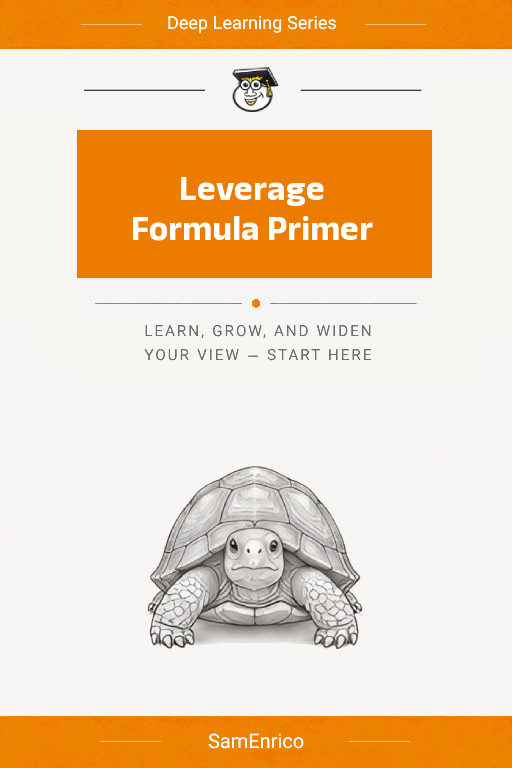
Non-FictionPrimerRisk Tutorial
Leverage Formula Primer
Calculate debt ratio, debt-to-equity, and times in
Calculate debt ratio, debt-to-equity, and times interest earned. Learn how leverage affects risk and return for companies.
Formats
About this book
Free sample
Chapter 1: The Hidden Truth...––Imagine you are standing in a casino. Not the glamorous kind with crystal chandeliers and free drinks, but the kind where the house always wins because it understands something you do not: the mathematics of multiplication. A gambler with a $1,000 bankroll who bets it all on a single hand of blackjack is not gambling—he is committing financial suicide. Yet every day, corporate executives and individual investors do the exact same thing with their companies and portfolios. They borrow money—sometimes modestly, sometimes recklessly—without understanding that debt is not a strategy.
It is a multiplier. And like any multiplier, it amplifies whatever is already there. If your business is profitable, debt makes you more profitable. If your business is struggling, debt makes you bankrupt. There is no third option.This truth is so simple that it feels almost insulting to state it plainly.
And yet, the financial history of the past forty years is littered with the corpses of brilliant people who forgot this one sentence. The collapse of Long-Term Capital Management in 1998—a fund run by Nobel Prize-winning economists and the most sophisticated traders on Wall Street—was not a failure of derivatives pricing or risk modeling. It was a failure to understand that a 5% loss on a portfolio leveraged 20-to-1 is not a 5% loss. It is a 100% loss of your equity. The gambler who bets his entire bankroll on a 51% probability is mathematically guaranteed to go broke eventually, no matter how good his odds.
The same is true for the company that finances its growth with borrowed money without first asking two questions: How much can I afford to lose? And what happens if revenues drop by 20%?This chapter is not about formulas. Those come in Chapter 2. This chapter is about something more fundamental: the psychology, the mathematics, and the hidden traps of using other people’s money. By the time you finish these pages, you will understand why debt is cheaper than equity, why that apparent bargain is the most dangerous seduction in finance, and why the most successful investors in history—from…
This is the end of the free sample. Get the eBook to keep going. Buy now
Contents
- Chapter 1
- Chapter 2
- Chapter 3
- Chapter 4
- Chapter 5
- Chapter 6
- Chapter 7
- Chapter 8
- Chapter 9
- Chapter 10
- Chapter 11
- Chapter 12
Details
- Author
- Muir Everette
- Publisher
- SamEnrico
- Language
- English
- Genre
- Non-Fiction, Primer, Risk Tutorial
- Released
- 2026-06-01
- Pages (approx.)
- 150
- Available as
- eBook, Audiobook

Read better in the ZLOADR app
Your eBooks on your phone or tablet. Sign in with your SamEnrico account and start reading.
More by Muir Everette
 Tax Refund ChristmasMuir Everette$11.99
 The Beginner Meditation Space SetupMuir Everette$11.99
 Senior Humor Esteem GuideMuir Everette$11.99
 Assertiveness in Conflict ResolutionMuir Everette$11.99
 The Joy of GardeningMuir Everette$11.99
 The Last Flight of the Miracle Men: The Impossible Rescue of the Andes SurvivorsMuir Everette$11.99
 How to Become a Dock SupervisorMuir Everette$11.99
 Understanding Myofibroblastic TumorsMuir Everette$17.99
 ServiceNow SWOT GuideMuir Everette$12.99
You may also like
 Hong Kong Handover 1997Dunn Johnnie$11.99
 Zumba For Postnatal Recovery CourseNeal Christian$11.99
 Zumba for BeginnersLadner Nikia$11.99
 YouTube Comment Mining GuideHumes Pandora$12.99
 Worry Box MeditationCarlin Rudy$11.99
 Workplace Stress MeditationNguyen Lynn$11.99
 Workplace Stress and Sleep RepairHawley Ivory$11.99
 Workplace Perfectionism CureDelaney Jeffry$11.99
 Workplace Injustice Anger GuideWallen Isabelle$11.99
 Work Addiction and Burnout LinkGreenwood Ester$11.99
 Women in Yoga and WellnessBeattie Galina$11.99
 Women in Stand Up ComedyChun Evangeline$11.99