
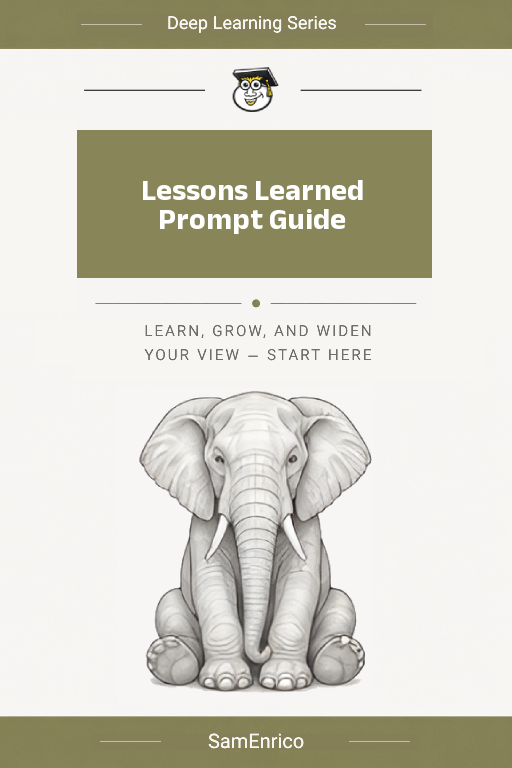
Non-FictionAI OperatorRetrospectives
Lessons Learned Prompt Guide eBook
Generate structured lessons learned documents from
Generate structured lessons learned documents from project retrospectives using prompt templates.
Formats
Free sample
Chapter 1: The Question Trap--“What went well?” the facilitator asked, smiling at the exhausted team. Fourteen people stared at their laptops. Someone said “communication” and everyone nodded. Another person said “teamwork” and someone else wrote it on a sticky note. Forty-five minutes later, the retrospective ended.
The sticky notes were photographed, uploaded to a shared drive, and never seen again. Three months later, the exact same project failure happened again.This scene repeats every day in thousands of companies. Not because teams are lazy or stupid. Because they are asking the wrong questions in the wrong way. The facilitator’s question—“What went well?”—is not harmless.
It is a trap. It invites vague, unactionable, forgettable answers. It trains teams to produce the kind of lessons that sound good in the moment and mean nothing the next morning.This book exists because most lessons learned documents fail before a single word is written. They fail at the moment the question is asked. And the fix is not more effort or better people.
The fix is better questions—questions engineered with a specific structure that forces specificity, neutralizes bias, and produces actions that actually change behavior.This chapter introduces the anatomy of a powerful prompt. It gives you a language for diagnosing why your current retrospective questions are failing and a template for building questions that work. By the end of this chapter, you will never ask “What went well?” again.The Vague Prompt Epidemic Let us examine the most common prompts in project retrospectives. Here is a sample from actual post-mortem documents collected across forty companies:“What did we learn?”“What could we improve?”“What were the key challenges?”“What should we start doing?”“What should we stop doing?”“What should we continue doing?”These questions share a fatal flaw: they contain no constraints whatsoever. They assume the person answering already knows what kind of answer is expected, already remembers the relevant details, and already knows how to format their response.
In practice, these assumptions are almost always false.Consider “What did we learn?” A developer might answer “I learned that our deployment script fails when the database schema changes.” A project manager might answer “We learned to communicate better.” A quality assurance engineer might answer “We learned nothing new.” All three answers are technically correct. Only one is useful. The prompt did nothing to steer the respondent toward the useful answer.This is the vague prompt epidemic. It infects every industry, every team size, every methodology. Agile teams do it in sprint retrospectives.
Waterfall teams do it in phase-gate reviews. Incident response teams do it in post-mortems. The language changes slightly—“what went wrong” becomes “what were our failures”—but the structural problem remains the same.The cost of vague prompts is not just wasted time in the retrospective. The real cost is that vague prompts produce vague lessons, which produce vague actions (“improve communication,” “start earlier”), which produce no actual change, which produces the same failures again, which produces the same vague prompts in the next retrospective. This is the learning loop that never closes.The Five Components of a Powerful Prompt A powerful prompt is not a question.
It is a miniature specification. It tells the respondent exactly what to think about, from whose perspective, what to do with that information, under what constraints, and in what format to deliver the answer.We call these the five components. They are always present in effective prompts, though sometimes implicitly. In weak prompts, most components are missing entirely.Component 1: Context Context anchors the prompt to a specific time, place, phase, or event. Without context, the respondent must guess which part of the project you care about—and they will almost certainly guess wrong.Weak prompt: “What went wrong?”Strong context: “During the integration testing phase between March 1 and March 14…”Context can be temporal (“during the first two weeks of the project”), phase-based (“during the handoff from design to development”), event-based (“during the customer demo on October 5”), or condition-based (“when we were operating at 50 percent staff”).The rule of thumb: if you cannot point to a specific date, phase, or event, your context is not specific enough.Component 2: Role Role specifies whose perspective the respondent should take.
This is critical because the same event looks completely different from different positions in the organization. The project manager sees the timeline. The developer sees the technical constraints. The customer sees the outcomes. All are valid.
All are different.Weak prompt: “What caused the delay?”Strong role specification: “From the perspective of the QA engineer assigned to the payment module…”Role can be functional (“as the product owner”), organizational (“as a member of the vendor team”), or even hypothetical (“as if you were the customer watching our progress”).The most powerful role prompts include a perspective shift: “If you were the project sponsor looking at our timeline, what would concern you?” This forces the respondent to leave their default mental model and see the project through different eyes.Component 3: Task Task specifies the cognitive operation you want the respondent to perform. This is the most frequently missing component. “What happened?” is not a task. It is an invitation to narrate. A task is specific: list, rank, compare, trace, classify, prioritize, quantify, map, or diagnose.Weak prompt: “Tell us about the testing issues.”Strong task specification: “List three assumptions we made about the test environment that turned out to be false…”Each task produces a different kind of insight.
Listing produces enumeration. Ranking produces priorities. Comparing produces differences. Tracing produces causality. Choosing the right task for your goal is essential.
If you want to know the single biggest problem, ask for a ranking, not a list. If you want to understand how a failure unfolded, ask for a trace, not a classification.The chapter appendix includes a complete task taxonomy with examples for each operation.Component 4: Explicit Constraints Constraints are the most powerful and most underused component. Constraints force focus. They prevent the respondent from producing a vague, unbounded answer that covers everything and commits to nothing.Weak prompt: “What could we improve?”Strong constraints: “Identify exactly three improvements. Each improvement must be describable in one sentence.
You have five minutes.”Common constraints include:Number limits (“exactly three reasons,” “no more than five items”)Time limits (“you have four minutes,” “describe events from the first week only”)Length limits (“one sentence per item,” “fifty words maximum”)Format limits (“use bullet points, not paragraphs”)Evidence requirements (“each claim must reference a specific date or metric”)Anonymity rules (“do not name any individual person”)Constraints feel restrictive. That is their purpose. An unbounded prompt produces unbounded answers that are impossible to compare, aggregate, or act upon. A bounded prompt produces answers that fit on a single page and can be turned into actions before the retrospective ends.Component 5: Output Format Output format tells the respondent how to structure their answer. This component is often ignored because facilitators assume “they’ll know how to write an answer.” They do not.
Without a specified format, one person writes a paragraph, another writes bullet points, a third writes a single word. Comparing these answers is impossible.Weak prompt: “What happened…
This is the end of the free sample. Get the eBook to keep going. Buy now
About this book
Details
- Author
- Grogan Zenaida
- Publisher
- SamEnrico
- Language
- English
- Genre
- Non-Fiction, AI Operator, Retrospectives
- Released
- 2026-05-29
- Pages (approx.)
- 125
- Available as
- eBook, Audiobook

Read better in the ZLOADR app
Your eBooks on your phone or tablet. Sign in with your SamEnrico account and start reading.
More by Grogan Zenaida
 Freckle Self Esteem WorkbookGrogan Zenaida$11.99
 De escalating Office ConflictsGrogan Zenaida$11.99
 Fuller Sam TabloidGrogan Zenaida$11.99
 Friend Group Self Esteem GuideGrogan Zenaida$11.99
 The Difficult Conversation with In LawsGrogan Zenaida$11.99
 The Shadow Warriors: The Secret Art of the Iron FistGrogan Zenaida$11.99
 Technical InvestigatorGrogan Zenaida$11.99
 UK Digital Services Tax GuideGrogan Zenaida$12.99
 Understanding Mesomelic Dysplasia Thai TypeGrogan Zenaida$17.99
 How to Start a Sports Recreation Guide Service BusinessGrogan Zenaida$11.99
You may also like
 Hong Kong Handover 1997Dunn Johnnie$11.99
 Zumba For Postnatal Recovery CourseNeal Christian$11.99
 Zumba for BeginnersLadner Nikia$11.99
 YouTube Comment Mining GuideHumes Pandora$12.99
 Worry Box MeditationCarlin Rudy$11.99
 Workplace Stress MeditationNguyen Lynn$11.99
 Workplace Stress and Sleep RepairHawley Ivory$11.99
 Workplace Perfectionism CureDelaney Jeffry$11.99
 Workplace Injustice Anger GuideWallen Isabelle$11.99
 Work Addiction and Burnout LinkGreenwood Ester$11.99
 Women in Yoga and WellnessBeattie Galina$11.99
 Women in Stand Up ComedyChun Evangeline$11.99