
Non-FictionInformativeEducational
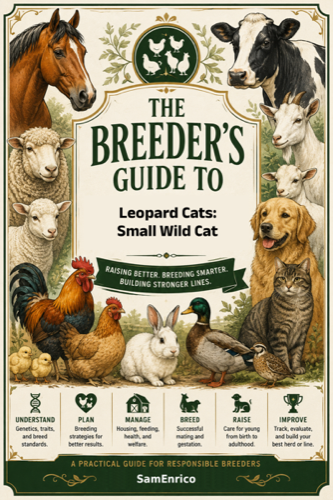
Leopard Cats: Small Wild Cat
This wildlife publication, published by SamEnrico,
This wildlife publication, published by SamEnrico, covers Leopard Cats: Small Wild Cat
Formats
About this book
Free sample
Chapter 1: The Spotted Shadow...--–- It begins, as these things often do, not in a remote jungle or a misty mountain pass, but in the quiet of an ordinary living room. Your cat—the one curled on the sofa, purring in its sleep—shares ninety-six percent of its DNA with a creature you have almost certainly never seen. That creature hunts in the dark, swims across crocodile-infested rivers, and carries in its spotted coat the ghost of an eleven-million-year war for survival. It is called the Leopard Cat, and this book is its untold story.The confusion starts with the name itself. Ask a wildlife biologist what a "Leopard Cat" is, and they will point you to a specific species: Prionailurus bengalensis, a small, spotted felid roughly the size of a large domestic cat, found across Asia from the tropical islands of Indonesia to the temperate forests of Korea.
Ask a conservationist, and they might widen the net to include the Clouded Leopard (Neofelis nebulosa), a more arboreal and enigmatic cat often called a "leopard cat" by locals in Southeast Asia. Ask a pet owner who owns a Bengal, and they will proudly show you a cat whose wild ancestor is Prionailurus bengalensis—but who would never survive a night in the jungle. The term "Leopard Cat" floats between these meanings, a linguistic shadow cast by a creature that prefers shadows.This book embraces that fluidity. We will focus primarily on the Asian Leopard Cat (Prionailurus bengalensis) as our anchor species—the "mainland stalker" whose adaptability has made it the most widespread small wild cat in Asia. But we will also venture into the treetops with the Clouded Leopard, climb the high Andes with the Andean cat, and cross the Atlantic to compare the ocelot and margay of South America.
Why? Because the principles of survival—camouflage, stealth, solitary efficiency—are universal. A spotted cat in Borneo faces the same evolutionary pressures as a spotted cat in Brazil. By looking at all of them, we see the rules of the game.The Small Cat Blind Spot Here is a truth that will…
This is the end of the free sample. Get the eBook to keep going. Buy now
Contents
- Chapter 1
- Chapter 2
- Chapter 3
- Chapter 4
- Chapter 5
- Chapter 6
- Chapter 7
- Chapter 8
- Chapter 9
- Chapter 10
- Chapter 11
- Chapter 12
Details
- Author
- Scott Bethany
- Publisher
- SamEnrico
- Language
- English
- Genre
- Non-Fiction, Informative, Educational
- Released
- 2026-06-02
- Pages (approx.)
- 136
- Available as
- eBook, Audiobook

Read better in the ZLOADR app
Your eBooks on your phone or tablet. Sign in with your SamEnrico account and start reading.
More by Scott Bethany
 Senior Self Esteem After HoardingScott Bethany$11.99
 Qualified Domestic Relations OrderScott Bethany$11.99
 Spending Addiction and ADHDScott Bethany$11.99
 Financial Shame ManagementScott Bethany$11.99
 Self Hypnosis for DrivingScott Bethany$11.99
 Autistic Communication GuideScott Bethany$11.99
 Symptothermal Method GuideScott Bethany$11.99
 Difficult Conversations with ContractorsScott Bethany$11.99
 Mirrored Souls: The Doppelgänger Diaries of the Ancient WorldScott Bethany$11.99
 The Opium Wars: The Warlords of Canton and the Birth of a Crime EmpireScott Bethany$11.99
 How to Produce a PavlokScott Bethany$11.99
 How to Produce CreamScott Bethany$11.99
You may also like
 Hong Kong Handover 1997Dunn Johnnie$11.99
 Zumba For Postnatal Recovery CourseNeal Christian$11.99
 Zumba for BeginnersLadner Nikia$11.99
 YouTube Comment Mining GuideHumes Pandora$12.99
 Worry Box MeditationCarlin Rudy$11.99
 Workplace Stress MeditationNguyen Lynn$11.99
 Workplace Stress and Sleep RepairHawley Ivory$11.99
 Workplace Perfectionism CureDelaney Jeffry$11.99
 Workplace Injustice Anger GuideWallen Isabelle$11.99
 Work Addiction and Burnout LinkGreenwood Ester$11.99
 Women in Yoga and WellnessBeattie Galina$11.99
 Women in Stand Up ComedyChun Evangeline$11.99