
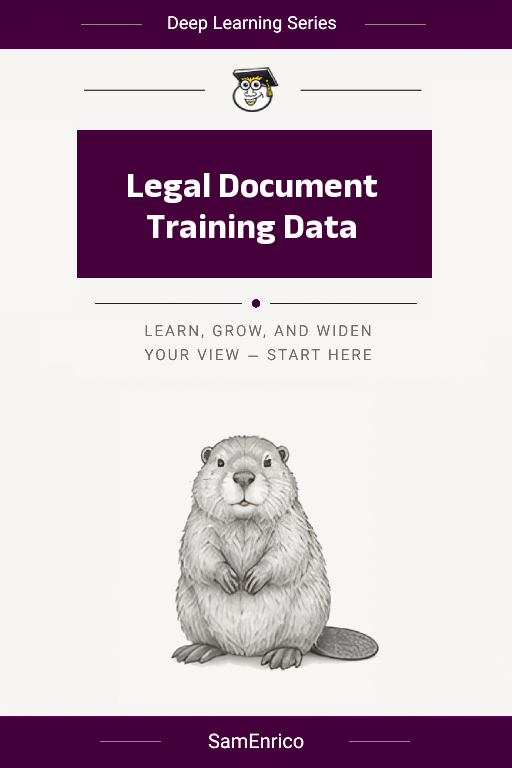
Non-FictionAI OperatorTraining Data
Legal Document Training Data eBook
Prepare training data for custom AI models specifi
by Keane Jaimie
Prepare training data for custom AI models specific to your legal document types.
Formats
Free sample
Chapter 1: The Phantom Precedent--– It was 3:47 on a Tuesday afternoon when Melissa Chen, a seventh-year litigation associate at a prominent Am Law 100 firm, made a discovery that stopped her cold. She had been running a routine quality check on an opposition brief drafted by a newly hired lateral partner when she noticed something peculiar. The brief cited Estate of Crawford v. Cigna Healthcare, 456 F. Supp.
3d 892 (D. Mass. 2022), for the proposition that a claim for bad faith denial of benefits could survive summary judgment even without showing actual financial harm. Melissa had clerked for the District of Massachusetts. She knew that district's recent jurisprudence.
She had never heard of Crawford.She pulled up Westlaw. Nothing. Lexis. Nothing. Google Scholar returned a single, ghostly reference on a sketchy legal blog that scraped content from unknown sources.
She checked the brief's citation again. The pin cite pointed to page 897. The quote attributed to the opinion read: "A plaintiff need not demonstrate out-of-pocket loss where the insurer's conduct evinces a pattern of arbitrary and capricious decision-making."The partner had used the case to defeat a summary judgment motion in a high-stakes class action. The court had relied on it in a tentative ruling. The client had paid $450,000 in legal fees for the motion practice.
And the case did not exist. Not in any reporter. Not in any database. Not in any physical library anywhere in the United States.Melissa printed the brief, walked to the partner's office, and placed it on his desk without a word. "What's this?" he asked, not looking up from his monitor.
She pointed to the citation. He looked at it. Then his face drained of color, the kind of rapid pallor that precedes a medical emergency or a professional one. "I had the AI draft the research section," he said quietly. "I didn't check the cites." Those seven words would cost the firm $187,000 in sanctions, two major clients, and the lateral partner's career.This is not a cautionary tale about lazy lawyers or incompetent professionals.
It is a cautionary tale about the nature of large language models themselves—and the dangerous, widening gap between what these systems appear to know and what they actually understand. The partner in this story was not a technophobe or a shortcut-taker. He was a capable, experienced litigator who had tried twelve cases to verdict. He had asked a general-purpose AI to "find Massachusetts cases supporting bad faith claims without economic loss." The AI, doing exactly what it was trained to do—predicting the most statistically probable next token based on patterns in its training data—generated a citation that looked real, formatted a pin cite that looked precise, and quoted language that sounded exactly like something a federal judge would write. Every word was a hallucination.
And every word was indistinguishable from truth to anyone who did not already know the District of Massachusetts docket by heart.The Confidence Trap This chapter begins with a seemingly simple question: Why would any law firm, in-house legal department, or solo practitioner continue to rely on off-the-shelf AI models for substantive legal work when the consequences of error can include sanctions, malpractice claims, destroyed client trust, and in extreme cases, disciplinary proceedings? The answer is both obvious and insidious: because these models are so often right. And when they are wrong, they are wrong with breathtaking confidence.A general-purpose LLM like GPT-4, Claude, or Gemini answers legal questions with fluid, authoritative prose. It correctly identifies the elements of a negligence claim in under three seconds. It can draft a passable cease-and-desist letter that would fool a non-lawyer.
It summarizes ten-page contracts with reasonable accuracy on first glance. This partial correctness creates a cognitive trap known in safety engineering and aviation psychology as "automation bias"—the documented tendency for humans to overtrust automated systems that perform well most of the time, especially when the cost of manual verification is high and the consequences of error seem remote.The research on automation bias is sobering. In studies of pilots using automated flight systems, participants consistently failed to notice obvious errors when the automation had been reliable for the preceding twenty minutes. In studies of radiologists using AI detection tools, diagnostic accuracy improved when the AI was correct but dropped below baseline when the AI was wrong and the radiologist overruled their own judgment. Legal professionals are not immune.
When a junior associate reads an AI-generated memo, the cognitive load of verifying every proposition is substantially higher than the cognitive load of trusting an AI that has been correct on the last nine questions. The brain takes the path of least resistance. That path leads directly to the phantom precedent.Consider the numbers that legal technology vendors rarely disclose. Internal testing at several Am Law 50 firms, shared under nondisclosure agreements with this author and verified through independent research, suggests that off-the-shelf LLMs hallucinate legal citations at rates between 3 percent and 8 percent per document. That means a thirty-page brief with 150 citations contains, on average, between four and twelve phantom cases.
A due diligence review of a two-hundred-page merger agreement might generate twenty to forty clause summaries that are subtly wrong in ways that change legal outcomes. A regulatory compliance memo might misstate the effective date of a new administrative rule by two months, causing a client to miss a filing deadline and incur six-figure penalties.The firm that decided to "save money" by replacing junior associate review with AI did not save money. It spent $450,000 on the Crawford motion, plus the cost of the sanctions hearing, plus the reputational damage, plus the lost business from two clients who departed within sixty days of learning about the incident, plus the night Melissa Chen spent crying in the firm's wellness room wondering if she should have caught the error earlier and what it meant for her own future at the partnership track. The partner survived the incident but lost his authority within the litigation department. The lateral hire did not survive at all.
His offer was rescinded before his start date.Why Legal Language Breaks General Models To understand why general-purpose AI fails so spectacularly at legal documents, we must first understand how large language models actually work—without the marketing hype, without the vendor promises, and without the breathless trade press coverage that treats every incremental improvement as a revolution. An LLM is, at its most fundamental level, a probability engine. It has been trained on billions of sentences from the public internet, digitized books, academic papers, and crucially for our purposes, some legal databases. When you give it a prompt, it generates a response by predicting the most statistically likely next word, then the next word after that, then the next word after that. It does not "know" anything.
It does not "understand" law. It has no internal model of jurisdiction, precedent, statutory interpretation, or professional responsibility. It is a mirror reflecting the statistical patterns of its training data.The problem is that legal language is fundamentally different from the language on which these models were primarily trained. Linguists call this difference "register"—the set of linguistic features associated with a particular context, profession, or domain. The register of Reddit comments…
This is the end of the free sample. Get the eBook to keep going. Buy now
About this book
Details
- Author
- Keane Jaimie
- Publisher
- SamEnrico
- Language
- English
- Genre
- Non-Fiction, AI Operator, Training Data
- Released
- 2026-05-29
- Pages (approx.)
- 132
- Available as
- eBook, Audiobook

Read better in the ZLOADR app
Your eBooks on your phone or tablet. Sign in with your SamEnrico account and start reading.
More by Keane Jaimie
 Breath Awareness For Insomnia GuideKeane Jaimie$11.99
 Indian American Return To Punjab MemoirKeane Jaimie$11.99
 Baby Sleep Consultant HiringKeane Jaimie$11.99
 The Disaster Recovery Site SelectionKeane Jaimie$11.99
 Grocery Splurging AddictionKeane Jaimie$11.99
 The Wrong Man: The 30-Year Fight for Justice of Randall Dale AdamsKeane Jaimie$11.99
 Understanding Mitral Valve Prolapse, Familial, Autosomal DominantKeane Jaimie$17.99
 How to Start a Hobby in Rock stackingKeane Jaimie$11.99
 Geothermal Energy Capital GuideKeane Jaimie$12.99
 Digital AnalystKeane Jaimie$11.99
You may also like
 Hong Kong Handover 1997Dunn Johnnie$11.99
 Zumba For Postnatal Recovery CourseNeal Christian$11.99
 Zumba for BeginnersLadner Nikia$11.99
 YouTube Comment Mining GuideHumes Pandora$12.99
 Worry Box MeditationCarlin Rudy$11.99
 Workplace Stress MeditationNguyen Lynn$11.99
 Workplace Stress and Sleep RepairHawley Ivory$11.99
 Workplace Perfectionism CureDelaney Jeffry$11.99
 Workplace Injustice Anger GuideWallen Isabelle$11.99
 Work Addiction and Burnout LinkGreenwood Ester$11.99
 Women in Yoga and WellnessBeattie Galina$11.99
 Women in Stand Up ComedyChun Evangeline$11.99