
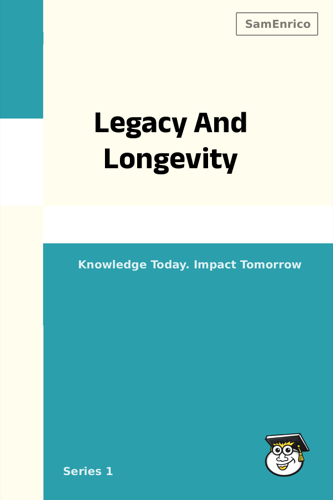
Non-FictionHealth & WellnessLegacy
Legacy And Longevity eBook
Live in a way that serves younger generations as c
Live in a way that serves younger generations as centenarians do.
Formats
Free sample
Chapter 1: The 100-Year Mismatch--We have been preparing for the wrong death.Not the death of the body—that one still comes for everyone. But the death that terrifies us now, in this strange new century, is the death of relevance. The slow, humiliating fade from needed person to tolerated presence to forgotten name. We have built entire industries around extending lifespan, yet we have built almost nothing around extending the period of life in which we are genuinely useful to others. The result is a profound mismatch between how long we live and how long we plan to matter.This chapter opens with a demographic fact so startling that most people refuse to believe it the first time they hear it: a child born today in a developed nation has a better-than-even chance of living to 100.
In Japan, where the oldest old are already the fastest-growing demographic segment, a girl born in 2020 has a 50 percent probability of celebrating her hundredth birthday. In the United States, the number of centenarians has doubled every decade since 1980. By 2050, there will be nearly four million people worldwide over the age of 100.Four million. That is not a statistical anomaly. That is a new human condition.And yet, almost everything about how we organize our lives—our education, our careers, our relationships, our sense of purpose—remains stuck in a template designed for a 70-year lifespan.
The three-box model of life: learn for twenty years, work for forty years, retire for ten years. That model was never scientifically derived. It was an accident of mid-century economics, a temporary equilibrium between rising life expectancy and fixed retirement ages. But it has calcified into something like common sense. We have stopped asking whether it serves us.
We have only asked how to survive it.The problem is not that we will live longer. The problem is that we have not yet learned to live forward into those extra decades. Most people, when they imagine living to 100, imagine the last ten years—the frailty, the nursing homes, the slow diminishment. But that is a failure of imagination. The real revolution of the centenarian era is not that we will die later.
It is that we will be old for longer. Much longer. And being old—truly old, eighty-five or ninety or ninety-five—is not merely a biological state. It is a social role that we have not yet invented.This book is an attempt to invent it.The 70-Year Script That No Longer Fits Let us be precise about the mismatch. In 1935, when the United States established Social Security, the average life expectancy at birth was 61 years.
Retirement at 65 was designed to capture only the final few years of life—a brief rest before death. The system was actuarially sound because most people never lived long enough to claim benefits. Today, a 65-year-old American can expect to live another 20 years. In some wealthy countries, that number is pushing 25. The architects of the modern retirement system did not design it for a world where "retirement" would last as long as childhood.The same mismatch appears in education.
We still educate children as if they will need to know a fixed body of knowledge for a single career that will last forty years. But the average person today will hold twelve different jobs before age 50, and many will change industries entirely. A 20-year-old entering the workforce today will likely work past 75, not because they cannot afford to retire but because they will not want to—if we design work differently. Yet we have almost no educational infrastructure for adults over 50. We spend billions on early childhood education and trillions on end-of-life care.
We spend almost nothing on learning in the "encore" decades.The psychologist Laura Carstensen, who directs the Stanford Center on Longevity, calls this the "longevity paradox." We have added thirty years to human life, but we have not added any vision for what those years should contain. The result is that millions of people drift through their sixties, seventies, and eighties without a clear role, without a sense of purpose, without anyone who genuinely needs them. They are not dead. But they are not fully alive either.This is not inevitable. The centenarians who thrive—the ones who laugh, who teach, who garden, who dance, who remain curious until their final days—do not follow the 70-year script.
They wrote their own. And their scripts share common features that we can learn from. But before we can learn from them, we must first unlearn the story that has been told to us.The Fear of Irrelevance Here is a question that most longevity books never ask: What are you actually afraid of when you think about growing old?If you answer "death," you are probably lying to yourself, or at least answering too quickly. Death is abstract. Death is offstage, around a corner you cannot see.
What keeps people awake at 3 AM is not the fact of their own extinction. It is the fear of becoming irrelevant. It is the terror of being alive yet invisible. Forgotten. Obsolete.
A piece of furniture that everyone has learned to walk around.This fear is not irrational. In a society that worships speed, novelty, and productivity, the old are easily rendered invisible. They do not appear in advertisements unless selling medication. They are not quoted in business magazines unless they founded something. Their wisdom—which is real, and which younger people desperately need—is dismissed as nostalgia, as "the way things used to be," as if the past had nothing to teach the present.But the fear of irrelevance is also a distortion.
It assumes that relevance is something that happens to you, a gift bestowed by a youth-obsessed culture. In fact, relevance is something you build. Every day. With small choices. The centenarians who remain relevant do not wait for someone to notice them.
They insert themselves into the lives of younger people. They ask questions. They offer help without being asked. They learn new things not because they have to but because they want to stay in the conversation.The difference between a forgotten elder and a needed elder is almost never about health or wealth. It is about posture.
One waits to be invited. The other invites themselves into usefulness.This book will teach you how to become the second kind.The Question That Changes Everything Most longevity books begin with the same question: How do I live longer?It is a sensible question. It is also the wrong question.The right question—the one that the healthiest, happiest, most impactful centenarians ask—is this: How do I stay needed?Notice the difference. "How do I live longer?" is a question about the self. It asks how to optimize, how to preserve, how to extend.
It is a question that can be answered with diets, supplements, exercise routines, and genetic testing. And those things are not worthless. But they are insufficient. A perfectly healthy 95-year-old who has no one to talk to, no one to teach, no one who depends on them—that person is not thriving. They are surviving.
And survival without purpose is its own kind of death."How do I stay needed?" is a question about others. It…
This is the end of the free sample. Get the eBook to keep going. Buy now
About this book
Details
- Author
- Burdick Dorathy
- Publisher
- SamEnrico
- Language
- English
- Genre
- Non-Fiction, Health & Wellness, Legacy
- Released
- 2026-06-10
- Pages (approx.)
- 140
- Available as
- eBook, Audiobook

Read better in the ZLOADR app
Your eBooks on your phone or tablet. Sign in with your SamEnrico account and start reading.
More by Burdick Dorathy
 The Roaring Forties AloneBurdick Dorathy$11.99
 The Gut Brain Stress Axis GuideBurdick Dorathy$11.99
 CPR Success StoriesBurdick Dorathy$11.99
 Technical Proposal Clarity GuideBurdick Dorathy$11.99
 Box Breath Square BreathingBurdick Dorathy$11.99
 YouTube Shorts RiseBurdick Dorathy$11.99
 Bipolar In LGBTQ+Burdick Dorathy$11.99
 Kelly Ripa LiveBurdick Dorathy$11.99
 The Vanishing Act: The CIA's Secret War in AfricaBurdick Dorathy$11.99
 The King of the Cage: Bas Rutten's Unstoppable Rise in the UK MMA UndergroundBurdick Dorathy$11.99
 Breaking the Ice: The Race to the Genetic Heart of the PolesBurdick Dorathy$11.99
 The Mineral Guide to MendoziteBurdick Dorathy$11.99
You may also like
 Hong Kong Handover 1997Dunn Johnnie$11.99
 Zumba For Postnatal Recovery CourseNeal Christian$11.99
 Zumba for BeginnersLadner Nikia$11.99
 YouTube Comment Mining GuideHumes Pandora$12.99
 Worry Box MeditationCarlin Rudy$11.99
 Workplace Stress MeditationNguyen Lynn$11.99
 Workplace Stress and Sleep RepairHawley Ivory$11.99
 Workplace Perfectionism CureDelaney Jeffry$11.99
 Workplace Injustice Anger GuideWallen Isabelle$11.99
 Work Addiction and Burnout LinkGreenwood Ester$11.99
 Women in Yoga and WellnessBeattie Galina$11.99
 Women in Stand Up ComedyChun Evangeline$11.99