
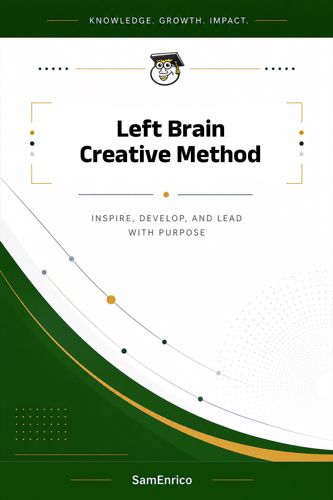
Left Brain Creative Method eBook
Harnesses logical thinking for breakthrough soluti
Harnesses logical thinking for breakthrough solutions without artistry.
Formats
Free sample
Chapter 1: The Inspiration Trap--–- Sarah had done everything right. She had the corner office, the MBA from a top-tier school, and a team of twelve creative professionals who reported directly to her. Her company had given her six weeks and a million-dollar budget to solve a problem that was bleeding forty thousand dollars a week in customer churn. She did what all the creativity books told her to do. She cleared her calendar for a three-day "innovation offsite." She brought in a facilitator who played jazz music during brainstorming sessions.
She covered the walls with sticky notes in every color of the rainbow. She told her team that "no idea was a bad idea" and that they needed to "think outside the box."Three days later, they had produced one hundred and forty-seven ideas.Three of them were illegal. Two were physically impossible. One was a typo. One hundred and thirty-three were variations of things they had already tried and failed.
The remaining eight were so vague that no one could figure out how to execute them. Sarah returned to her office on Monday morning with nothing but a headache and a stack of sticky notes that smelled faintly of the free coffee she had served her team. She had done everything the creativity gurus promised would unlock breakthrough thinking. And she had absolutely nothing to show for it except a smaller budget and a larger sense of failure.Sarah is not real. But I have met hundreds of people exactly like her.
They are engineers, product managers, data analysts, project leads, and operations directors. They are smart, disciplined, and hardworking. They have been told their entire careers that creativity is a mystical gift—something that strikes like lightning, something that requires letting go of logic, something that demands jazz music and purple sticky notes. And they have failed at it, over and over again, not because they lack creativity but because they have been given a fundamentally wrong map of how creativity actually works.This book exists because of one simple, verifiable, and deeply counter-cultural truth: Creativity is not the opposite of logic. Creativity is the predictable output of a well-managed logical system.If that sentence makes you uncomfortable—if you find yourself thinking that creativity requires spontaneity, emotion, chaos, or divine inspiration—then you are exactly the person who needs to read this chapter.
Because the single biggest barrier to creative breakthroughs is not a lack of artistic talent. It is a belief system that treats creativity as magic. And magic, by definition, cannot be reliably produced on demand.The Billion-Dollar Lie Let me name the enemy explicitly. It is not Daniel Pink, whose book A Whole New Mind I will engage with respectfully throughout this chapter. It is not Elizabeth Gilbert, whose TED talk on the elusive muse moved millions.
It is not any single author or speaker. The enemy is a story—a story that has been told so many times, in so many different ways, that it has come to feel like common sense. The story goes like this:Creativity lives in the right hemisphere of the brain. Logic lives in the left. These two hemispheres are in constant competition.
To be creative, you must silence your logical, analytical, critical left brain and let your intuitive, emotional, artistic right brain run free. Inspiration cannot be forced. You must wait for it, cultivate it, and hope it arrives.This story is taught in business schools. It is preached at innovation conferences. It is embedded in the design of thousands of brainstorming workshops, creativity apps, and team offsites.
There is only one problem with this story.It is not true.Not approximately true. Not true for some people. Not true in a metaphorical sense. It is neurologically, empirically, demonstrably false. The left brain is not the enemy of creativity.
The left brain is the engine of creativity. And the belief that you need to silence your logic to unlock your artistry is not a helpful metaphor—it is a trap that has cost Sarah and millions like her billions of dollars in wasted effort.The Science the Gurus Don't Tell You The popular story of left brain versus right brain originated from split-brain research in the 1960s, most famously conducted by neuropsychologist Roger Sperry. Sperry studied patients who had undergone a corpus callosotomy—a surgical procedure that severs the connection between the two hemispheres to treat severe epilepsy. In these patients, the hemispheres could not communicate. Sperry discovered that the left hemisphere was more involved in language and analytical reasoning, while the right hemisphere showed strengths in spatial awareness and facial recognition.This was fascinating science.
It was also massively, catastrophically oversimplified by popular writers.Here is what the oversimplification left out. First, in healthy brains with an intact corpus callosum, the two hemispheres are in constant, rapid, sophisticated communication. They do not compete. They collaborate. Second, the tasks that popular culture assigned exclusively to the right brain—intuition, holistic thinking, even creativity itself—have been shown in hundreds of subsequent studies to recruit both hemispheres extensively.
Third, and most important for our purposes, the kind of pattern recognition that underlies every creative breakthrough is now understood to be a fundamentally left-hemisphere-dominant process.Let me introduce you to the Recursive Mind Hypothesis. This is not a fringe theory. It emerges from decades of research in cognitive neuroscience, including work by Michael Corballis, Elkhonon Goldberg, and Iain Mc Gilchrist. The hypothesis is simple: the left hemisphere's primary evolutionary advantage is its ability to mirror, store, and refine patterns. When you learn a new skill—playing chess, speaking a language, reading a spreadsheet—your left hemisphere encodes the patterns.
With repetition, those patterns become faster and more automatic. Eventually, they become so fast that they feel instantaneous. We call that feeling "intuition." But intuition is not magic. It is accelerated pattern recognition.Here is the key insight for creativity. A novel idea is almost never a completely new pattern.
It is a synergy—a logical combination of two or more existing patterns that have not been combined before. The telephone combined the pattern of voice transmission (telegraphy) with the pattern of real-time conversation. The smartphone combined the pattern of computing with the pattern of telephony with the pattern of touch interfaces. Every patent ever filed is a documented combination of existing patterns. Every invention, every breakthrough, every "creative leap" is pattern synergy.And pattern synergy is a left-brain operation.The Equation That Changes Everything Let me write this in a way that cannot be misunderstood.Creativity = Pattern Synergy = Data Stream A × Data Stream B × Connection Logic This is not a metaphor.
It is a functional equation. If you want a creative breakthrough, you need three things:Sufficient data streams (patterns you have stored in memory)A reason to combine them (a constraint, a problem, a goal)A connection mechanism (the logical operation that links A to B)That is it. There is no fourth variable for "inspiration." There is no fifth variable for "artistic temperament." There is no sixth variable for "waiting for the muse." Creativity is information management. And information management is a logical discipline.Let me prove this to you with…
This is the end of the free sample. Get the eBook to keep going. Buy now
About this book
Details
- Author
- Brannon Kevin
- Publisher
- SamEnrico
- Language
- English
- Genre
- Non-Fiction, Self-Help
- Released
- 2026-06-06
- Pages (approx.)
- 151
- Available as
- eBook, Audiobook

Read better in the ZLOADR app
Your eBooks on your phone or tablet. Sign in with your SamEnrico account and start reading.
More by Brannon Kevin
 Team Idea Bank GuideBrannon Kevin$11.99
 Self Esteem for ManagersBrannon Kevin$11.99
 ADHD Growth Mindset GuideBrannon Kevin$11.99
 The SMART Failure AnalysisBrannon Kevin$11.99
 Outsourcing for Supply ChainBrannon Kevin$11.99
 Mindfulness for Depression BeginnersBrannon Kevin$11.99
 5G Supply Chain RevolutionBrannon Kevin$11.99
 Fantasy Kings: The Rise of Daily Fantasy Sports and the Billion-Dollar Gambling RevolutionBrannon Kevin$11.99
 The Silent Witnesses: How Phone Taps Cracked Australia’s Rum RebellionBrannon Kevin$11.99
 The Essential Guide to Underground RapBrannon Kevin$11.99
 How to Produce PuzzlesBrannon Kevin$11.99
 How to Produce Elliptical Trainer AccessoriesBrannon Kevin$11.99
You may also like
 Workplace Stress MeditationNguyen Lynn$11.99
 Volcano Monitoring ScientistCox Alexis$11.99
 The Tech Professional NetAguiar Nevada$11.99
 The Morning Metta RitualCanales Anya$11.99
 The Chunking Memory TechniqueClanton Hyacinth$11.99
 The Beginner Mistake FixAmmons Cassondra$11.99
 Surrendering to What IsGrimm Reatha$11.99
 Self Hypnosis for Fear of FireBillups Eli$11.99
 Road Rage for Professional DriversBrackett Janise$11.99
 Psychiatric Ward Nurse StressDunning Wyatt$11.99
 Observation vs Evaluation NVCTimmons Alda$11.99
 Networking for Nonprofit ProfessionalsPoole Jesse$11.99