
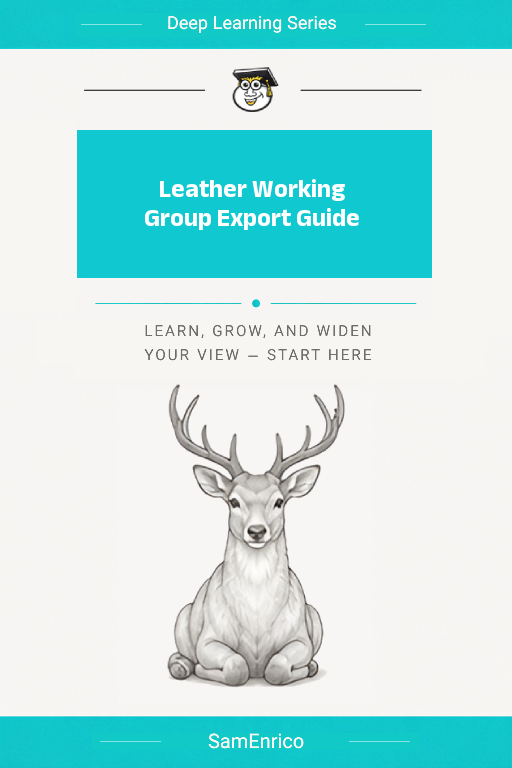
Leather Working Group Export Guide eBook
Certify environmental compliance for tanneries exp
Certify environmental compliance for tanneries exporting leather to European automotive and footwear sectors.
Formats
Free sample
Chapter 1: The 25% Door--–- The first time I saw a tannery lose a €3 million contract because of a missing piece of paper, I was sitting in a leather fair in Milan. The buyer from a German automotive supplier didn't ask about price. Didn't ask about lead times. Didn't even look at the leather samples spread across the table like a rainbow of hides. Instead, she asked one question: "What is your LWG score?" The tannery owner—a third-generation manufacturer who had been supplying leather for twenty years—mumbled something about "working on it." The buyer stood up, walked to the next booth, and placed the order within fifteen minutes.
That tannery never recovered that relationship.This is not an isolated story. Across Europe, from the automotive hubs of Stuttgart and Wolfsburg to the footwear centers of Milan and Porto, a quiet revolution has been underway for the past decade. The Leather Working Group, founded in 2005 as a niche environmental project by a handful of British leather buyers, has become the single most powerful gatekeeper in the global leather trade. Today, LWG certifies roughly 25 percent of the world's leather production. The other 75 percent—thousands of tanneries across Asia, South America, and Eastern Europe—are increasingly locked out of the most lucrative markets on the planet.But here is the truth that most tannery owners discover too late: LWG certification is not about making better leather.
It is about proving that you are not destroying the planet while you make it. And as of March 31, 2027, that proof becomes mandatory for anyone who wants to sell into the European automotive and premium footwear supply chains.The Two Industries That Changed Everything To understand why LWG certification has become non-negotiable, you need to understand the two industries that drive the demand: automotive and premium footwear. These are not casual buyers. They are multi-billion-euro corporations with sustainability targets written into their annual reports, shareholder letters, and—increasingly—their legal obligations.For the automotive industry, leather is not a commodity. It is a statement.
When a customer buys a BMW 5 Series, a Mercedes E-Class, or a Volkswagen Touareg, they are paying for the smell of the leather, the feel of the steering wheel, and the knowledge that their interior will not crack, fade, or fog up the windshield after three years in the sun. Carmakers use LWG certification as a screening tool to guarantee that the leather meets stringent durability, fogging (VOC emission), and abrasion standards. But that is only the beginning.The real driver is carbon accounting. Every major automaker has committed to reducing their Scope 3 emissions—the emissions generated by their supply chains, not their own factories. Leather, which comes from cattle (a notoriously high-emission source), is a major target.
LWG's Life Cycle Assessment data, which covers Global Warming Potential, water use, and eutrophication, feeds directly into automakers' carbon calculations. A tannery without LWG certification cannot provide this data, which means the automaker cannot count that leather in their sustainability reports. And if they cannot count it, they cannot buy it.For the footwear industry, the calculus is different but equally strict. Premium footwear brands—Adidas, Hugo Boss, and the luxury houses of France and Italy—worry less about carbon accounting and more about skin contact. A shoe sits against human skin for hours at a time.
If the leather contains hexavalent chromium, residual solvents, or heavy metals, the brand faces lawsuits, recalls, and reputation damage that can wipe out billions in market value. Footwear brands use LWG certification to manage chemical risk and water pollution from finishing operations. They need to know that the tannery is not only testing its leather but also managing its effluent so that downstream communities are not poisoned. For a detailed breakdown of the chemical differences between these two sectors, see Chapter 6.The 25 Percent Door: Why Being Outside Is Becoming Impossible Here is the uncomfortable math. LWG currently certifies approximately 25 percent of global leather production.
That sounds like a minority. But in the world of B2B supply chains, 25 percent is a choke point.Imagine you are a procurement manager for a European automotive supplier. You need to source 100,000 square meters of finished leather per month. You have two options. Option A: You buy from an LWG-certified tannery.
The certification tells you—at a glance—that the tannery has passed third-party audits for water, energy, chemicals, waste, and traceability. You can forward the LWG report to your sustainability team and move on with your life. Option B: You buy from a non-certified tannery. Now you have to conduct your own environmental audit, hire consultants, verify permits, test effluent, and assume legal liability if something goes wrong. That process costs tens of thousands of euros per supplier and takes months.
You are not going to do that for a commodity material like leather.This is what I call the 25 Percent Door. The certified 25 percent get the meetings, the contracts, and the premium prices. The other 75 percent are invisible—not because they make bad leather, but because they cannot prove they make clean leather.Now, I need to be honest with you about the current reality. Some non-certified tanneries still sell to European buyers today. They do this through intermediaries, by claiming exemptions, or by offering such deep discounts that buyers are willing to take the risk.
This is the gray market, and it is shrinking every year. By March 31, 2027, when the new LWG Sustainability System takes full effect, that loophole will close entirely. After that date, any tannery without LWG certification—and without Chain of Custody traceability (see Chapter 8 for full requirements)—will be automatically excluded from major European supply chains.This book is written for the tannery owner who refuses to be in the desperate 75 percent. You are reading this because you want to be in the winning 25 percent. You want the premium contracts, the long-term relationships, and the ability to charge more because you can prove you are cleaner than your competitors.What BMW, Mercedes, VW, and Adidas Actually Require Let me give you the specific numbers that matter.
These are not theoretical. They are drawn from actual procurement requirements of the brands that drive the market.For automotive Tier 1 suppliers—the companies that make seats, dashboards, and door panels for BMW, Mercedes, and VW—the minimum requirement is LWG Gold certification at 85 percent or higher. Silver is not accepted. Bronze is laughed out of the room. Why?
Because the automakers have done the math. Gold-certified tanneries have, on average, 40 percent lower water consumption, 30 percent lower energy consumption, and significantly better chemical management than Silver tanneries. When you are producing millions of cars per year, those differences add up to measurable carbon reductions.For footwear, the requirements are slightly more flexible but still demanding. Adidas and Nike require Gold for their premium lines (sports performance and luxury collaborations) but accept Silver for their basic lines and for shoes sold outside Europe. Hugo Boss and the luxury houses typically require Gold across all lines because their brand equity depends on sustainability storytelling.Below is a summary of brand-specific requirements as of the publication date.
Always verify directly with your buyer, as requirements change frequently:Brand Minimum LWG Score Notes BMWGold (85%+)No exceptions Mercedes-Benz Gold (85%+)No…
This is the end of the free sample. Get the eBook to keep going. Buy now
About this book
Details
- Author
- Burrell Lucie
- Publisher
- SamEnrico
- Language
- English
- Genre
- Non-Fiction, Business Brief
- Released
- 2026-05-30
- Pages (approx.)
- 144
- Available as
- eBook, Audiobook

Read better in the ZLOADR app
Your eBooks on your phone or tablet. Sign in with your SamEnrico account and start reading.
More by Burrell Lucie
 Eye Fixation Self Hypnosis MethodBurrell Lucie$11.99
 Mindfulness for Beginners Over 50Burrell Lucie$11.99
 Khe Sanh Siege SurvivorBurrell Lucie$11.99
 Dairy Recall ReferenceBurrell Lucie$11.99
 AI Slide QandA GeneratorBurrell Lucie$11.99
 Strength Training For BasketballBurrell Lucie$11.99
 Ilhan Omar RefugeeBurrell Lucie$11.99
 Estonian Unicorn Pipeline AnalysisBurrell Lucie$11.99
 Cellulite Normalization GuideBurrell Lucie$11.99
 The Celestial Heist: Galileo’s Telescope GambitBurrell Lucie$11.99
 The Vanishing Hours: The Mystery of the 1977 Sleep Experiment Gone WrongBurrell Lucie$11.99
 Blood and Silk: The Feud That Shaped the Silk RoadBurrell Lucie$11.99
You may also like
 Hong Kong Handover 1997Dunn Johnnie$11.99
 Zumba For Postnatal Recovery CourseNeal Christian$11.99
 Zumba for BeginnersLadner Nikia$11.99
 YouTube Comment Mining GuideHumes Pandora$12.99
 Worry Box MeditationCarlin Rudy$11.99
 Workplace Stress MeditationNguyen Lynn$11.99
 Workplace Stress and Sleep RepairHawley Ivory$11.99
 Workplace Perfectionism CureDelaney Jeffry$11.99
 Workplace Injustice Anger GuideWallen Isabelle$11.99
 Work Addiction and Burnout LinkGreenwood Ester$11.99
 Women in Yoga and WellnessBeattie Galina$11.99
 Women in Stand Up ComedyChun Evangeline$11.99