
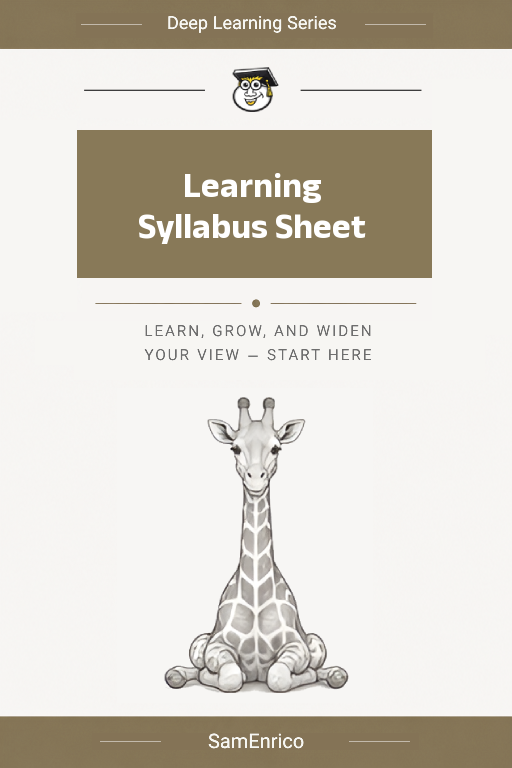
Non-FictionFirst 30 DaysFounder Learning
Learning Syllabus Sheet eBook
Identify skills you need to learn and resources to
Identify skills you need to learn and resources to use on a single personal development page.
Formats
Free sample
Chapter 1: The Learning Trap--You have probably done this exact thing within the last thirty days.You decided to learn something new. Maybe it was data analytics, because everyone said that is where the money is now. Maybe it was Spanish, because you have a trip planned for next year. Maybe it was public speaking, because you froze during a Zoom call last month and you are still replaying the silence in your head.You opened your browser. You typed something like "best way to learn Python" or "how to start a podcast" or "communication skills course."And then the flood began.Twelve blog posts comparing seventeen different courses.
A You Tube video with four million views titled "The ONLY way to learn anything." Three Reddit threads where users argued for two hundred comments about whether Duolingo is better than Babbel. A Linked In influencer who promised that "these 5 habits will change your life." A Udemy sale that expires in four hours. A podcast episode where a guest said the one book you must read. A different podcast where a different guest said that first book is garbage.You spent two hours researching. You bookmarked fifteen tabs.
You added three courses to your cart but did not buy them yet because you wanted to check the reviews one more time. You watched the first eight minutes of a ninety-minute tutorial. You felt productive. You felt like you were learning.You were not learning. You were shopping.And then, because life is demanding and the tabs accumulated and the email reminders went unread, you did nothing.
Or you started something but stopped after the third video. Or you finished the beginner module but never touched the intermediate material. Six months later, you still do not speak Spanish. You still cannot write a SQL query. You still freeze on Zoom calls.You are not alone.
You are not lazy. You are not undisciplined. You are trapped.The Great Paradox of the Learning Age We live in the most information-rich era in human history. The sum total of human knowledge is available from a device in your pocket. You can learn quantum physics from a Nobel laureate for free on You Tube.
You can take a course from a Stanford professor without leaving your couch. You can access the same textbooks used at MIT, Harvard, and Oxford.And yet, study after study shows that the vast majority of people who start a self-directed learning project never finish it. The data is staggering. According to research from MIT and Harvard on their own open online courses, the completion rate for free courses is consistently below ten percent. For paid courses, completion rates rarely exceed fifteen percent.
In one analysis of thousands of online courses across multiple platforms, the median completion rate was just 2.7 percent.Let that number land. 2.7 percent.For every hundred people who decide to learn something new, ninety-seven of them quit before the finish line. They do not quit because they are incapable. They do not quit because the material is too hard. They quit because the system is broken.
They quit because they drown in options before they ever take a single effective action.This is what I call The Learning Trap.The Learning Trap is the gap between the desire to learn and the ability to execute a learning plan. It is the space where good intentions go to die. It is the graveyard of bookmarks, abandoned courses, and "I really should learn that someday."The Learning Trap has three distinct stages, and if you recognize yourself in any of them, you have already been caught.Stage One: Analysis Paralysis Analysis paralysis happens before you ever open a textbook or watch a tutorial. It is the swamp of indecision that surrounds the question: "What should I learn first?"You want to learn digital marketing. But should you start with SEO, or social media, or email marketing, or content writing, or analytics, or paid ads?
Each of those branches splits into sub-branches. SEO alone has on-page, off-page, technical, local, and international. Each sub-branch has dozens of experts, each with their own opinion. You spend three weeks reading "SEO for Beginners" articles. You have not written a single word of website copy.
You are already exhausted.Analysis paralysis feels like preparation, but it is actually procrastination in a fancy disguise. Your brain is wired to avoid uncertainty. Researching feels safer than doing because research has no risk of failure. You cannot fail at watching a You Tube video. You can fail at building a website.
So your brain, helpful creature that it is, keeps you in research mode forever.The dirty secret of the learning industry is that it profits from analysis paralysis. Course creators want you to believe that the perfect resource exists, and that you just have not found it yet. Click this link. Watch this webinar. Buy this comparison guide.
The longer you search, the more ads you see. The more ads you see, the more you search. It is a closed loop that generates revenue but not results.Here is the truth you will not hear from the influencers: the difference between the best resource and the tenth-best resource is negligible compared to the difference between starting and not starting. The person who uses a mediocre resource for one hundred hours will be infinitely more skilled than the person who spent one hundred hours finding the perfect resource and never used it.But knowing this intellectually does not solve the problem. Because even when you escape analysis paralysis, you fall directly into stage two.Stage Two: Tutorial Hell Tutorial hell is the place where active learning goes to die.
You have chosen a resource—congratulations, you have escaped stage one. You have opened the course, started the video, or cracked the book. You are consuming information. You feel smart. You feel like a learner.But you are not learning.
You are watching.Tutorial hell is the state of passive consumption disguised as education. You watch a video about how to build a website. You understand every word. The instructor is clear, the examples are helpful, and you nod along. Then you close the video and realize you cannot build the website.
You can recognize the steps when someone else takes them, but you cannot execute them yourself.This is called the illusion of competence. It is a well-documented cognitive bias where exposure to information creates the feeling of mastery without the reality of it. Your brain confuses recognition with recall. You recognize the term "join statement" when you see it in a tutorial, so your brain tells you that you know what a join statement is. But if someone asked you to write one from scratch, you would stare at a blank screen.Tutorial hell is addictive because it provides the dopamine of progress without the pain of practice.
Every completed video feels like a victory. Every clicked checkbox feels like advancement. But the only thing that correlates with actual skill development is not consumption hours—it is creation hours. The number of times you attempt to produce something, fail, debug, try again, and finally succeed.A person who builds ten…
This is the end of the free sample. Get the eBook to keep going. Buy now
About this book
Details
- Author
- Winfield Aleshia
- Publisher
- SamEnrico
- Language
- English
- Genre
- Non-Fiction, First 30 Days, Founder Learning
- Released
- 2026-06-01
- Pages (approx.)
- 137
- Available as
- eBook, Audiobook

Read better in the ZLOADR app
Your eBooks on your phone or tablet. Sign in with your SamEnrico account and start reading.
More by Winfield Aleshia
 Expense Tracking for StartupsWinfield Aleshia$11.99
 Adidas Originals ComparisonWinfield Aleshia$11.99
 Dave Grohl Foo FighterWinfield Aleshia$11.99
 Breath Awareness for CaregiversWinfield Aleshia$11.99
 Scripting for Financial AbundanceWinfield Aleshia$11.99
 Email Spam Folder DailyWinfield Aleshia$11.99
 ADHD Time Blocking GuideWinfield Aleshia$11.99
 Time Blocking for ArchitectsWinfield Aleshia$11.99
 The Quantum Enlightenment: How Western Minds Unlocked the UniverseWinfield Aleshia$11.99
 The Phantom of La Paz: A 19th-Century Jury's DilemmaWinfield Aleshia$11.99
 How to Produce DonutsWinfield Aleshia$11.99
 Czech Stock Option Tax DeferralWinfield Aleshia$12.99
You may also like
 Hong Kong Handover 1997Dunn Johnnie$11.99
 Zumba For Postnatal Recovery CourseNeal Christian$11.99
 Zumba for BeginnersLadner Nikia$11.99
 YouTube Comment Mining GuideHumes Pandora$12.99
 Worry Box MeditationCarlin Rudy$11.99
 Workplace Stress MeditationNguyen Lynn$11.99
 Workplace Stress and Sleep RepairHawley Ivory$11.99
 Workplace Perfectionism CureDelaney Jeffry$11.99
 Workplace Injustice Anger GuideWallen Isabelle$11.99
 Work Addiction and Burnout LinkGreenwood Ester$11.99
 Women in Yoga and WellnessBeattie Galina$11.99
 Women in Stand Up ComedyChun Evangeline$11.99