
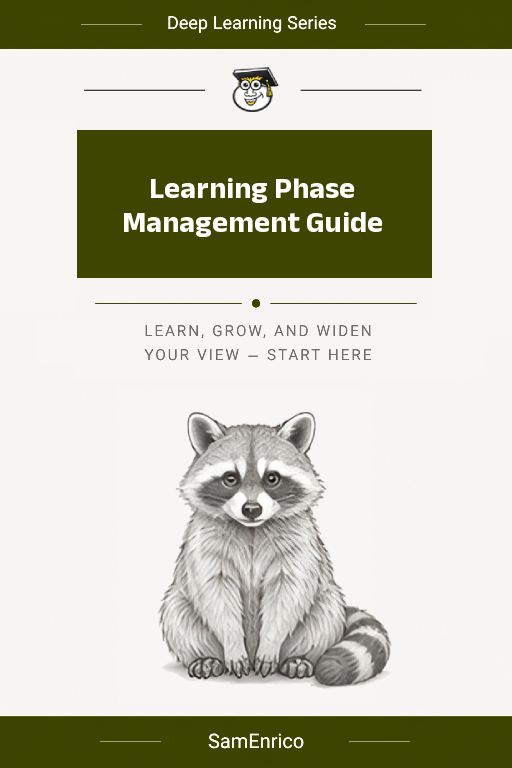
Non-FictionFirst 30 DaysLearning Phase
Learning Phase Management Guide eBook
Navigate Facebook's learning phase for first campa
Navigate Facebook's learning phase for first campaigns. Avoid learning phase limited and exit efficiently.
Formats
Free sample
Chapter 1: The Frozen Pixel--You have probably done it yourself. You log into Facebook Ads Manager on a Monday morning, coffee in hand, ready to launch your first campaign. You have watched the You Tube tutorials. You have read the blog posts about audience targeting. You have created what you believe is a beautiful, compelling ad.
You set your budget, select your interests, and click that big green "Publish" button. Then you wait.An hour passes. Then a day. The numbers start trickling in. A few impressions here, a couple of clicks there.
But the conversions are not coming. Your cost per result is climbing. You start to panic. So you do what almost every advertiser does. You make a small change.
You adjust the audience by adding one more interest. You tweak the headline. You lower the budget slightly because you are nervous about spending too much. And then something strange happens. The campaign gets worse.
The cost per result doubles. You make another change. It gets worse again. Within a week, you have spent $500, generated two sales, and you have absolutely no idea what went wrong.You blame Facebook. You say the algorithm is broken.
You say the platform is rigged against small advertisers. You swear off Facebook ads forever and tell everyone you know that they do not work.But the problem was not Facebook. The problem was you. And the problem was the learning phase.This book exists because the learning phase is the single most misunderstood, mishandled, and underestimated component of Facebook advertising. It is also the single most important concept you will ever learn about this platform.
Master it, and you will consistently scale profitable campaigns. Ignore it, and you will join the thousands of advertisers who burn money every day and blame the algorithm for their own mistakes.Let me tell you about Sarah. Sarah was a real client of mine, though I have changed her name for privacy. She owned an online boutique selling handmade jewelry. Her average order value was 85.Shehadtried Facebookadsthreetimesbeforecomingtome.Eachtime,shehadfollowedthesamepattern.Shewouldlaunchacampaignwitha85.
She had tried Facebook ads three times before coming to me. Each time, she had followed the same pattern. She would launch a campaign with a 85.Shehadtried Facebookadsthreetimesbeforecomingtome.Eachtime,shehadfollowedthesamepattern.Shewouldlaunchacampaignwitha30 daily budget, target five different interests, and then spend the next two weeks "optimizing" based on her gut. She would pause ad sets that did not get sales in the first 24 hours. She would increase budgets on ad sets that got one sale.
She would change creative every three days. Every single campaign died within two weeks, and she had lost over $8,000.When I looked at her account, the problem was immediately obvious. She had never allowed a single ad set to exit the learning phase. Her constant editing had restarted the 50-event clock over and over again. She had created 14 separate ad sets in one campaign, each with a budget so small that none of them could possibly reach 50 conversions.
She was stuck in what I call the "death spiral," which we will explore in detail in Chapter 3. But the root cause was simple. She did not understand the foundational question of this entire book: what is the learning phase, and why does it exist?Here is the truth that Facebook does not shout from the rooftops. The learning phase is not a punishment. It is not a bug.
It is not Facebook's way of extracting more money from you. The learning phase is the price of admission for using one of the most sophisticated machine learning systems ever built. Every time you launch a new campaign, you are asking Facebook's AI to solve a complex problem. You are saying, "Find me people who will take this specific action within this budget." But the AI starts with zero information. It does not know who your customers are.
It does not know what creative resonates. It has to learn. And learning takes time and data.Think of the learning phase like hiring a new salesperson. On day one, that salesperson knows nothing about your product, your customers, or your sales process. You would not expect them to close ten deals in their first week.
You would train them. You would give them feedback. You would let them learn from their mistakes. And after a few weeks, once they have made fifty successful sales, you would trust them to work independently. The Facebook algorithm is exactly the same.
It needs fifty successful conversions to understand what a "good" customer looks like. Until it has those fifty conversions, it is still in training. It is still learning. And any time you make a significant change to the campaign, you are effectively firing that salesperson and hiring a new one who has to start from scratch.This brings us to the three layers of Facebook delivery, which form the foundation of everything else in this book. Understanding these layers will transform how you think about your campaigns.The first layer is the Auction.
Every single time a user opens Facebook or Instagram, the platform runs a real-time auction for every available ad impression. Advertisers do not bid against each other directly. Instead, Facebook calculates a value for each ad using a formula that most advertisers have never seen: Bid times Estimated Action Rate plus Quality. Your bid is how much you are willing to pay. The Estimated Action Rate is Facebook's prediction of whether this specific user will take your desired action.
And Quality is a score based on user feedback, such as hiding the ad or reporting it as irrelevant. The winner of the auction is not necessarily the highest bidder. It is the ad that maximizes the formula. This means you can win auctions with a lower bid if Facebook believes your ad is highly relevant to that user.The second layer is the Prediction Layer. This is where the machine learning magic happens.
Facebook's neural networks analyze trillions of data points about every user. They track what posts users like, what links they click, how long they watch videos, what they buy, and thousands of other signals. The platform then uses this historical behavior to predict future actions. Notice what is missing from that list. Facebook does not care what users say they like.
It cares what they actually do. This is a crucial distinction. In the early days of Facebook advertising, you could target people who said they were "interested in fitness" or "interested in luxury travel." That still works to some degree, but it is far less powerful than it used to be. Today, Facebook's AI predicts behavior based on behavior. If a user consistently buys fitness products, Facebook knows that even if they have never clicked the "fitness" interest.
If a user reads articles about luxury travel, Facebook knows that even if they have never stated an interest. This shift from stated interests to behavioral signals is the single most important change in Facebook advertising over the past five years. It is also why broad targeting often outperforms narrow targeting, a point we will return to in Chapter 5.The third layer is the Exploration Layer. When you launch a new campaign, Facebook faces…
This is the end of the free sample. Get the eBook to keep going. Buy now
About this book
Details
- Author
- Wilkins Melanie
- Publisher
- SamEnrico
- Language
- English
- Genre
- Non-Fiction, First 30 Days, Learning Phase
- Released
- 2026-06-01
- Pages (approx.)
- 137
- Available as
- eBook, Audiobook

Read better in the ZLOADR app
Your eBooks on your phone or tablet. Sign in with your SamEnrico account and start reading.
More by Wilkins Melanie
 Teen Phobia HelpWilkins Melanie$11.99
 Affirmations For Social Anxiety GuideWilkins Melanie$11.99
 Estate Planning for FarmersWilkins Melanie$11.99
 Belgium Consumer GuideWilkins Melanie$11.99
 Mindfulness of Current Emotion DBTWilkins Melanie$11.99
 The Silk Roads of the Sahel: The Entrepreneurial Empire of WangaraWilkins Melanie$11.99
 Max Levchin GuideWilkins Melanie$12.99
 Understanding Palmoplantar KeratodermaWilkins Melanie$17.99
 How to Start a Vending Machine Operator BusinessWilkins Melanie$11.99
 ConfectionerWilkins Melanie$11.99
You may also like
 Hong Kong Handover 1997Dunn Johnnie$11.99
 Zumba For Postnatal Recovery CourseNeal Christian$11.99
 Zumba for BeginnersLadner Nikia$11.99
 YouTube Comment Mining GuideHumes Pandora$12.99
 Worry Box MeditationCarlin Rudy$11.99
 Workplace Stress MeditationNguyen Lynn$11.99
 Workplace Stress and Sleep RepairHawley Ivory$11.99
 Workplace Perfectionism CureDelaney Jeffry$11.99
 Workplace Injustice Anger GuideWallen Isabelle$11.99
 Work Addiction and Burnout LinkGreenwood Ester$11.99
 Women in Yoga and WellnessBeattie Galina$11.99
 Women in Stand Up ComedyChun Evangeline$11.99